A contract arrives as a 90-page PDF, an operations manager needs renewal terms by Friday, and the source data is scattered across shared drives, email, and a CRM. The practical question is not simply, “can AI process contracts?” It is whether AI can produce reliable, traceable outputs that move work forward without creating legal, financial, or compliance exposure.
The answer is yes, within defined boundaries. AI can read, classify, extract, compare, summarize, and route contract data at a speed no manual team can match. It can also identify missing clauses, flag deviations from approved language, and trigger downstream workflows. But AI is not a substitute for legal authority or accountable business judgment. Production-grade contract automation depends on the workflow around the model: document quality, system integration, validation rules, auditability, permissions, and human review at the right points.
Can AI Process Contracts Reliably?
AI can process contracts reliably when the task has a clear output, the underlying documents are accessible, and the system has controls appropriate to the risk. Extracting a termination date from a signed agreement is a different problem from deciding whether an indemnification clause creates unacceptable exposure. The first can often be automated to a high degree. The second should be escalated to legal or a designated approver.
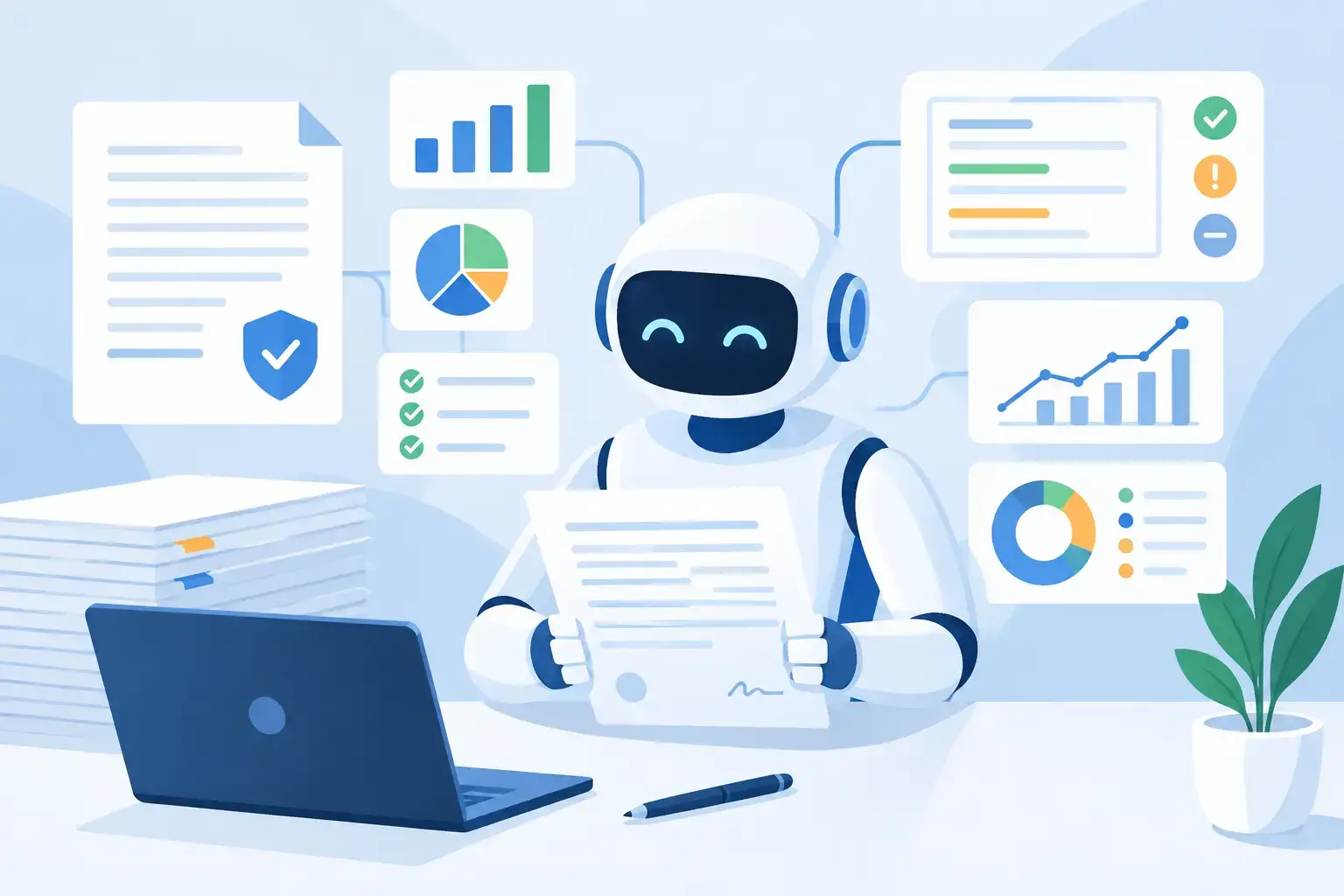
Modern document AI combines optical character recognition, language models, structured extraction, and business rules. It can work with native PDFs, scans, Word files, and sometimes email attachments. The system converts the agreement into searchable content, recognizes the document type, identifies relevant clauses and fields, then writes approved data to the systems where teams already work.
For a mid-market company, the value is usually operational. Procurement gains a reliable view of supplier commitments. Finance can identify payment terms and renewal obligations. Sales operations can surface nonstandard customer terms before they affect forecasts. Legal teams spend less time locating routine information and more time reviewing the exceptions that need expertise.
Reliability is not a property of the model alone. It is an outcome of good architecture.
Where AI Delivers Immediate Contract Value
The strongest use cases are repetitive, high-volume, and connected to a defined business action. Contract intake is one example. AI can classify incoming files as NDAs, master service agreements, statements of work, order forms, leases, or vendor agreements, then route each document to the appropriate workflow.
Field extraction is another high-value application. Depending on the agreement type, a system can capture parties, effective dates, expiration dates, notice periods, governing law, payment terms, auto-renewal language, liability caps, service levels, and data-processing obligations. These fields can be normalized into a contract repository, CRM, ERP, procurement platform, or internal dashboard.
Clause comparison is especially useful where a business maintains approved templates or playbooks. AI can compare submitted language against standard provisions, highlight changed wording, and explain the difference in plain business language. This does not mean the system should approve a deviation on its own. It means the reviewer starts with a focused exception report rather than a blank page and a redline-heavy document.
AI also improves obligation management after signature. Many businesses have contracts but lack a dependable process for acting on them. A workflow can create renewal alerts, send a task to the contract owner before a notice deadline, open a finance review when pricing changes, or create a customer-success action when a service commitment is due. This is concrete automation, not generic AI hype.
The Limits: AI Should Not Make Legal Decisions
A contract model can produce an answer that sounds confident and is still wrong, incomplete, or based on an ambiguous clause. Scanned documents may have OCR errors. A provision may be qualified elsewhere in the agreement. Different agreements can use the same term for different commercial purposes. These are not edge cases in contract work. They are normal conditions.
AI should therefore support legal and business decision-making, not impersonate it. It should not independently accept contractual risk, determine legal enforceability, or provide legal advice. For high-stakes agreements, regulated industries, unusual deal structures, or clauses involving liability, privacy, intellectual property, or exclusivity, the workflow needs defined human approval.
The appropriate level of automation depends on materiality. A company may automatically extract dates and route standard NDAs while requiring counsel review for deviations in a strategic enterprise agreement. That is not a limitation of the program. It is responsible process design.
What a Production Contract AI Workflow Requires
A useful contract AI solution starts with the business process, not a chatbot interface. Before selecting a model, define which contract types matter, which fields and clauses must be captured, what confidence level is acceptable, and what action follows each result.
The implementation should account for five operational requirements:
- Document ingestion and normalization: Agreements need to be collected from approved sources, deduplicated, converted into usable text, and associated with the correct account, vendor, opportunity, or project.
- Extraction schema and validation: Each contract type needs a defined data model. Rules should validate dates, currency, legal entities, required fields, and logical relationships such as whether a renewal notice date occurs before expiration.
- Source-grounded outputs: Users should be able to see the relevant contract text and page reference behind an extracted answer. A result without evidence is difficult to review and risky to operationalize.
- Workflow integration: Findings need to trigger work in systems such as CRMs, ERPs, procurement tools, ticketing platforms, and internal approval systems. A spreadsheet of extracted clauses is rarely the endpoint.
- Security and governance: Role-based access, encryption, retention policies, audit logs, vendor controls, and environment separation are necessary when agreements contain customer, employee, pricing, or confidential business data.
Confidence thresholds are also essential. A mature workflow does not treat every extraction equally. High-confidence, low-risk fields can flow into downstream systems automatically. Low-confidence or high-impact findings should create a review task with the extracted value, source citation, and clear owner.
Build for Exceptions, Not Just Happy Paths
The most common implementation mistake is demonstrating AI on a clean sample set and assuming the same results will hold across a live contract archive. Production documents include missing pages, handwritten edits, old templates, embedded tables, poor scans, conflicting amendments, and agreements that reference other documents.
A better approach begins with a representative sample of real contracts. Test the system against the document types, layouts, jurisdictions, and exceptions the business actually handles. Measure field-level accuracy, reviewer correction rates, processing time, and the percentage of documents that can move through without manual intervention.
Then design an exception queue. When the system cannot identify a party, finds conflicting dates, detects an amendment, or falls below the confidence threshold, it should not quietly guess. It should route the document to the right reviewer and preserve the context needed to resolve it quickly.
This is where custom engineering often matters more than the choice between two similarly capable AI models. Secure connectors, schema design, approval logic, observability, and QA determine whether contract AI becomes a dependable operating capability or another disconnected pilot.
A Practical Path to Contract Automation
Start with one contract category and one measurable problem. For example, a company with hundreds of vendor agreements may focus first on extracting renewal dates, notice windows, and annual spend commitments. A SaaS business may prioritize finding nonstandard liability and data-security terms during sales review.
Define the baseline before deployment. How long does review take now? How often are notice dates missed? How many people touch each agreement? What is the cost of a missed obligation or delayed approval? These measures make it possible to evaluate the automation on business value rather than model demos.
Next, build a controlled pilot that uses real documents and connects to the target workflow. Review its outputs with subject-matter experts, refine the extraction and escalation rules, and test permissions and audit logs. Once the results meet the agreed standard, expand to adjacent contract types or additional downstream actions.
Invatechs approaches this work as an integration and delivery problem: AI must fit the systems, controls, and decisions that already run the business. The goal is not to make every contract autonomous. It is to remove manual searching, repetitive data entry, and preventable deadline risk while keeping accountable people in control of material decisions.
The right next step is to identify the contract process where delays or missed obligations have a measurable cost, then automate that narrow workflow well enough that teams trust it enough to use it every day.