A claims team receives 8,000 documents a week. Some are clean PDFs generated by a portal. Others are photographed forms, multi-page invoices, handwritten notes, and email attachments with inconsistent naming. The real decision in AI OCR vs manual processing is not whether software can read text. It is whether your operation can turn incoming documents into trusted, usable data without creating a larger exception queue or compliance problem.
Manual processing can look reliable because people recognize context, resolve ambiguity, and apply judgment. But it becomes expensive and difficult to control as volume grows. AI OCR can reduce repetitive effort dramatically, but only when it is designed as part of a workflow with validation, routing, system integration, and human review where needed.
For most operationally complex businesses, the right answer is not a simplistic replacement decision. It is a production workflow that assigns routine extraction to AI and directs uncertain or high-risk cases to qualified employees.
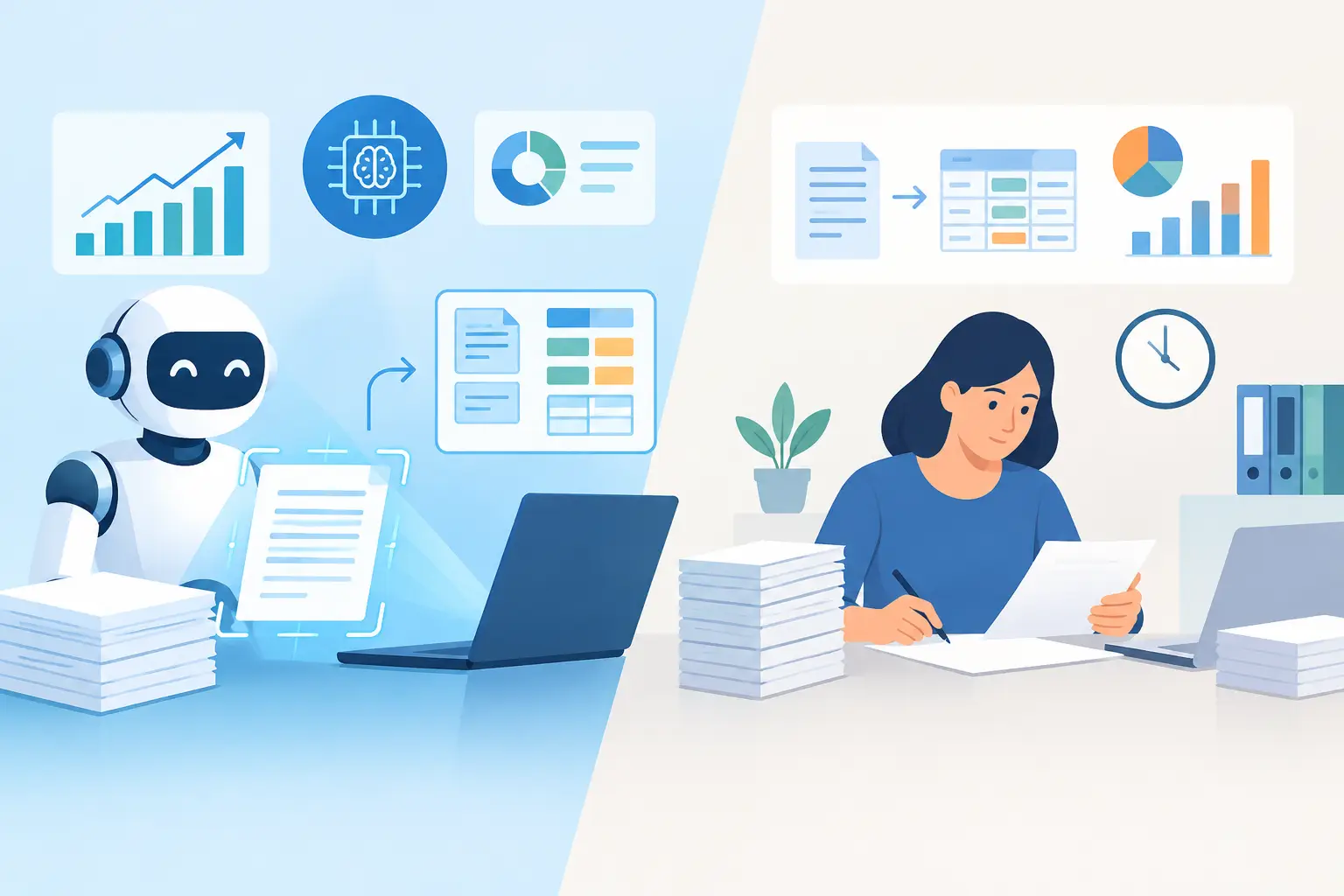
AI OCR vs manual processing: the operational difference
Manual processing usually follows a familiar sequence: an employee opens a file, identifies the document type, reads relevant fields, enters data into a CRM, ERP, claims platform, or spreadsheet, and checks the result against policy or business rules. The process is flexible, but it depends on staff availability, training quality, and consistent execution.
AI OCR changes the sequence. A document enters through email, a customer portal, file storage, or an API. The system classifies it, extracts relevant text and fields, validates values, and sends structured data to downstream systems. Records that meet confidence and business-rule thresholds can proceed automatically. Records that fail are routed to a review queue with the source document and flagged fields visible to the reviewer.
That distinction matters. OCR alone is not an operations solution. Reading "Invoice Total" from a PDF does not confirm that the amount matches a purchase order, belongs to an approved vendor, uses the correct currency, or should be posted to a particular cost center. A workable implementation combines document intelligence with workflow logic.
Where manual processing still has an advantage
Human review remains the better option for low-volume work, highly variable documents, and decisions requiring interpretation rather than extraction. A legal agreement with unusual clauses, a medical narrative, or an underwriting submission with incomplete evidence may need experienced judgment that should not be automated away.
Manual processing also makes sense when the process itself is changing weekly. Automating an unstable workflow too early can encode confusion into software. In that case, mapping the current process, defining required data, and standardizing document intake may produce more value before an AI build begins.
The trade-off is that manual work carries hidden operational cost. Leaders often measure labor hours but miss rework, delayed approvals, quality sampling, turnover, training, backlog management, and the cost of records entered inconsistently across systems. A process that works at 200 documents per month may break down quickly at 20,000.
What AI OCR does well - and where it fails
Modern AI OCR is effective at extracting data from semi-structured and unstructured documents, including invoices, applications, bills of lading, tax forms, IDs, and correspondence. It can classify documents, capture key-value pairs, identify tables, and use surrounding context to distinguish a billing address from a shipping address.
This is especially valuable when teams repeatedly handle the same document categories but receive them from many sources and layouts. Instead of building a rigid template for every supplier invoice, an AI-based extraction layer can generalize across common variations. That reduces setup effort and improves coverage as new formats arrive.
However, AI OCR does not remove the need for controls. Low-quality scans, handwriting, unusual layouts, missing pages, conflicting values, and unfamiliar document types can reduce accuracy. So can labels that appear in multiple places, such as several dates or totals on one document.
A production-grade system treats uncertainty as a workflow event, not an embarrassment. It records extraction confidence, applies deterministic validation rules, and preserves an audit trail from the structured field back to the source page. A reviewer should be able to see why an item was flagged and correct it without rekeying the entire document.
Compare cost by throughput, exceptions, and risk
The cost comparison is rarely just "software subscription versus employee salary." Manual processing has a largely variable cost: more documents generally require more hours. AI OCR has implementation, integration, monitoring, and usage costs, but can process routine volume at much lower marginal cost once it is operating reliably.
The business case improves when a team spends significant time on repetitive extraction, document volumes are predictable or growing, and the data must be entered into more than one system. It also improves when slow handling creates downstream costs, such as delayed onboarding, missed payment terms, slower claims resolution, or poor customer response times.
Exception rates are the key metric. If 90% of routine documents can be extracted, validated, and posted automatically, the remaining 10% can receive focused human attention. If half of all documents need extensive review, the problem may be poor input quality, unclear data requirements, insufficient validation logic, or a document category that is not yet suitable for automation.
Risk changes the calculation as well. In finance, insurance, healthcare, and regulated operations, a wrong field may be more costly than a delayed one. That does not automatically favor manual work. Manual entry can also produce errors. It means the automation must use the right approval thresholds, segregation of duties, logging, retention policies, and exception handling for the process.
The architecture behind reliable document automation
The strongest AI OCR programs begin with a narrow, measurable workflow rather than a broad promise to automate all documents. A company might start with vendor invoices for a defined business unit, loan application intake, or extraction of service requests from emailed PDFs.
First, define the documents, target fields, acceptable error rates, turnaround expectations, and exception owners. Then identify the systems of record. If extracted data lands in a spreadsheet before someone re-enters it into the ERP, the workflow has not solved the core problem.
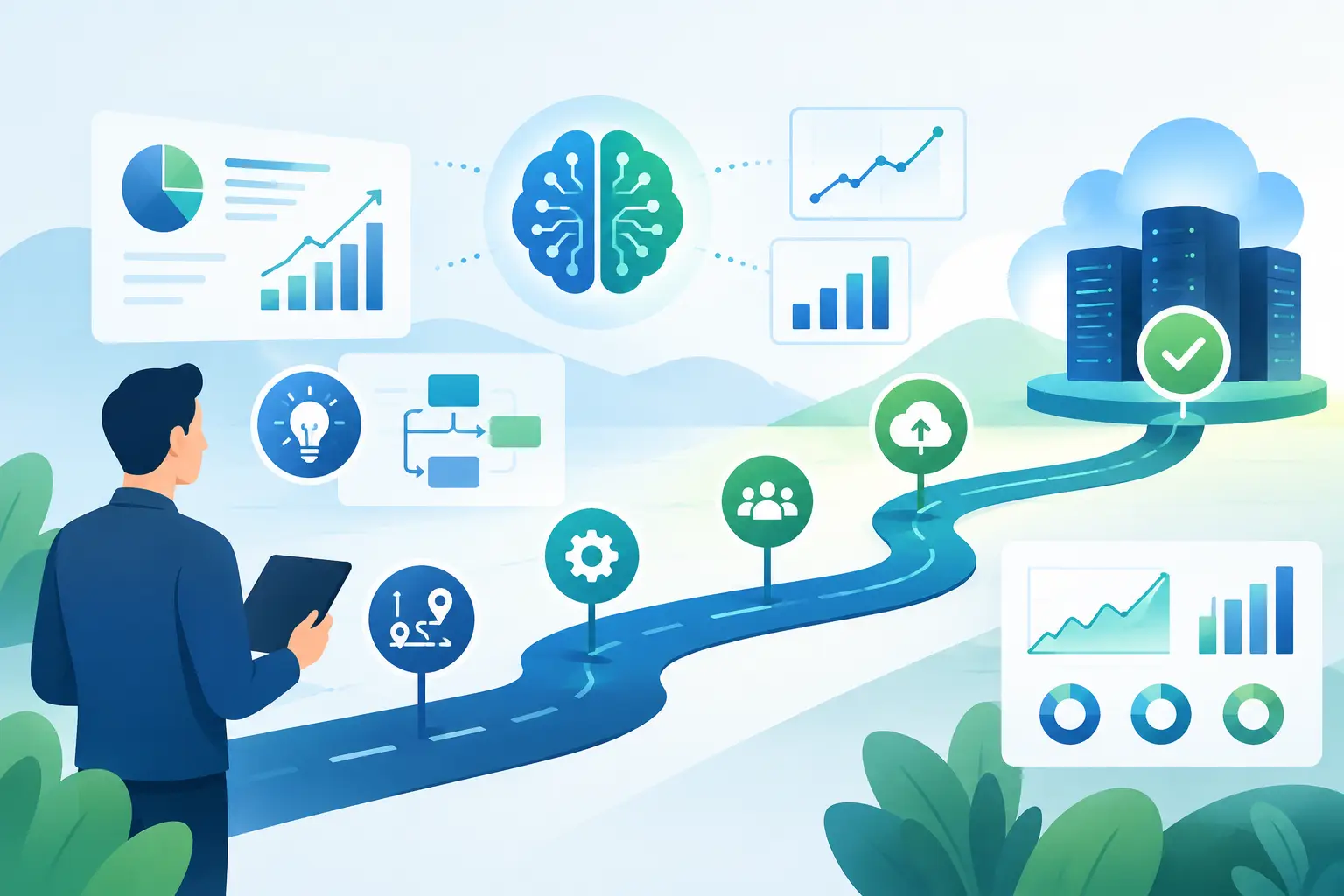
A typical architecture includes an intake layer, document storage, classification and extraction services, business-rule validation, a human review interface, and connectors to operational systems. The exact stack depends on security requirements and existing platforms, but each component has a clear job.
Validation deserves particular attention. It should include checks such as required fields, date formats, duplicate invoice detection, tax calculations, vendor matching, policy limits, and cross-reference checks against master data. AI can interpret the document; rules and connected systems determine whether the extracted result is acceptable for the next step.
Human-in-the-loop review should be designed for speed. Reviewers need side-by-side access to the original file, extracted values, confidence signals, and the relevant account or case context. Their corrections should feed monitoring and improvement work, not disappear into an unmeasured queue.
Security and compliance are implementation requirements
Document workflows often contain personal information, financial details, health data, contracts, and internal operating records. Sending files to an OCR service without confirming data handling, access controls, retention practices, and contractual requirements creates unnecessary exposure.
The implementation should define who can submit documents, who can view source files, who can approve corrections, and which systems receive the resulting data. Encryption, role-based access, audit logging, environment separation, and retention controls should be planned before deployment, not added after a pilot reaches production.
For compliance-sensitive processes, organizations also need a defensible record of what was extracted, what validation occurred, whether a person intervened, and which version of the workflow made the decision. This is where generic AI demos often stop short. The operational requirement is traceability.
How to decide where to start
Choose a process with enough volume to matter, clear inputs and outputs, and a visible operational pain point. The best first use cases are usually repetitive but not trivial: they have measurable handling time, common data fields, and a defined downstream action.
Establish a baseline before building. Measure current document volume, average handling time, error and rework rates, turnaround time, backlog age, and the number of employees involved. Then define success in business terms, such as reducing manual touches by 60%, cutting intake time from two days to two hours, or improving data completeness before records reach an operations team.
A pilot should test representative documents, including poor scans and edge cases, rather than only the cleanest examples. It should also prove the integration path, review experience, and monitoring process. Invatechs approaches this work as a connected software delivery problem: extraction quality matters, but so do the APIs, QA, controls, and workflow outcomes around it.
The practical next step is to take one document-heavy process and map its exceptions. Those exceptions reveal what should stay with people, what can be validated by rules, and where AI OCR can remove the repetitive work that keeps skilled teams from moving the business forward.