A model that works in testing can still fail in operations
An AI workflow can produce strong results during a pilot and become unreliable weeks later. A document classifier encounters a new form version. A support agent receives a policy update that never reached its knowledge base. An underwriting model sees an applicant mix that differs from its training data. The system still returns an answer, which makes the failure harder to spot.
That is the operational case for model monitoring. It is the discipline of measuring how an AI system behaves after deployment, detecting changes that affect performance, and giving teams a clear path to investigate and correct issues. For companies using AI inside customer, finance, operations, or compliance workflows, monitoring is not a dashboard add-on. It is part of production architecture.
The goal is not to watch every technical metric available. The goal is to know whether the system is still making useful, safe, and cost-effective contributions to the business process it supports.
What model monitoring should cover
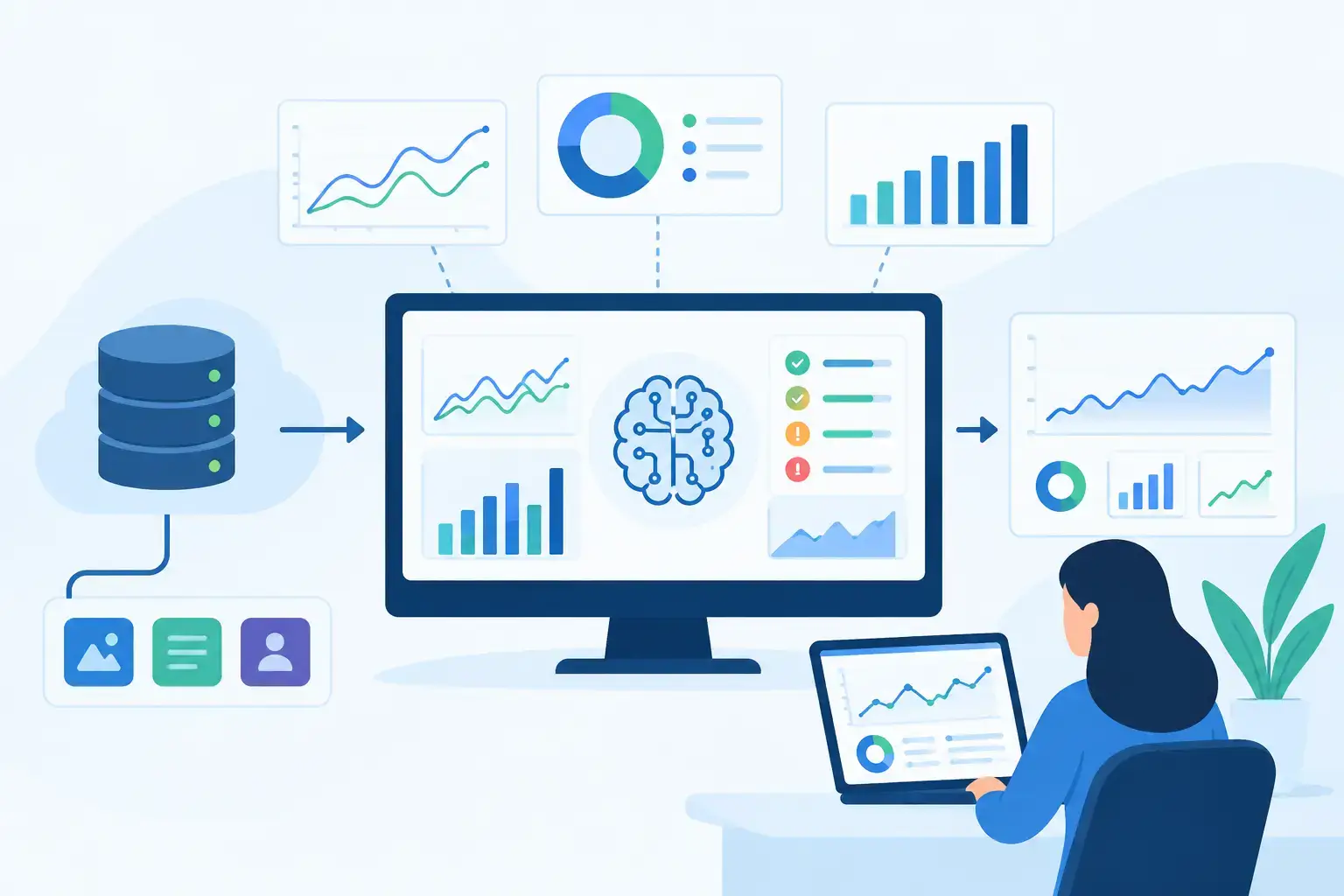
A production AI system is more than a model endpoint. It includes source data, retrieval systems, prompts, business rules, APIs, user interfaces, human approvals, and downstream actions. Monitoring needs to reflect that reality.
For a traditional predictive model, teams usually monitor input distributions, prediction distributions, accuracy, and calibration. If a fraud-risk model begins scoring far more transactions as high risk, that could indicate a change in customer behavior, a data pipeline problem, or genuine threat activity. The alert is the starting point, not the diagnosis.
For LLM applications, the measurement surface is wider. Teams need visibility into prompt and response patterns, retrieval quality, tool-call success, latency, token usage, refusal behavior, hallucination rates, and user escalation. An agent that gives fluent but unsupported answers is not performing well simply because users receive a response quickly.
Business metrics matter just as much. A claims intake assistant may be technically accurate but create extra review work if it extracts fields in a format the claims platform cannot accept. A support agent may resolve more conversations automatically but damage customer satisfaction if it overconfidently closes complex cases. Monitoring should connect system behavior to completion rates, handling time, rework, exception volume, revenue impact, and other workflow outcomes.
The failure patterns that matter most
Data drift changes the inputs
Data drift occurs when live inputs no longer resemble the data used to train or validate a model. In operations, this can happen for ordinary reasons: a new product line, a revised intake form, seasonality, a vendor migration, or changes in how staff enter records.
Drift does not always mean the model is wrong. It means prior assumptions may no longer hold. A useful monitoring setup compares key live-data characteristics against a baseline and highlights meaningful movement. For a document-processing workflow, that might include document type, page count, OCR confidence, language, template version, and the percentage of missing fields.
The right thresholds depend on risk. A small shift in marketing lead scores may warrant observation. A small shift in a compliance decision workflow may require immediate review.
Concept drift changes what the data means
Concept drift is more subtle. Inputs may look familiar, but the relationship between the inputs and the correct outcome has changed. A customer behavior model trained before a pricing change, for example, may no longer predict churn accurately even if its input fields appear stable.
Concept drift is difficult to detect without reliable feedback. Teams need labeled outcomes from downstream systems, sampled expert reviews, or both. If final outcomes arrive weeks after a model decision, monitoring should account for that delay rather than treating short-term proxy metrics as proof of quality.
Integration failures create quiet errors
Many production AI issues begin outside the model. An API field changes. A CRM connector loses access. A retrieval index stops refreshing. A tool returns an incomplete response, but the agent continues as if it received valid data.
These failures require system-level observability. Track connector health, authentication failures, schema changes, data freshness, queue depth, retry rates, and tool-call error patterns. In high-impact workflows, the AI should fail safely: route the case to a person, pause an automated action, or use a defined fallback process.
Quality decays before users complain
Users often adapt to a weak system before leadership sees the problem. They rewrite prompts, check every output, or avoid the tool for certain cases. Usage may remain stable while trust declines.
That is why quality monitoring should combine automated checks with structured human review. Automated evaluators can test groundedness, format compliance, policy adherence, and task completion at scale. Human reviewers should inspect a representative sample, with extra attention to high-value, high-risk, or low-confidence cases. The review process must use clear rubrics. Vague feedback such as “not useful” rarely produces an actionable engineering fix.
Build monitoring around decisions, not just metrics
A dashboard that nobody owns is not monitoring. Before implementation, define the decisions each signal will support.
If retrieval relevance drops below an agreed threshold, who investigates the knowledge base and how quickly? If an agent starts exceeding its cost budget, is the fix prompt compression, model routing, tool-call reduction, or a change in the workflow? If a model’s confidence distribution shifts, does the system increase human review until validation is complete?
This operating model should identify an accountable owner for each class of issue. Product teams may own user experience and acceptance criteria. Data or AI engineers may own model and evaluation changes. Platform teams may own observability and integration reliability. Operations leaders should own the business rules for escalation and exception handling.
Alerting needs restraint. Alerts should be tied to severity and action. A notification that fires for routine variation will be ignored. A better design uses tiers: informational trends for review, warnings that trigger investigation, and critical alerts that pause or restrict automation when material risk is present.
Establish a baseline before scaling automation
The first production release creates the reference point for future monitoring. Record the model version, prompt version, source-data definitions, retrieval configuration, tool schemas, evaluation set, expected costs, and workflow KPIs. Without this baseline, teams cannot distinguish a real regression from normal variation.
A practical baseline includes both technical and operational expectations. For example, an invoice-processing system may target a specified field-extraction accuracy on approved document types, a defined percentage of straight-through processing, a maximum review queue size, and a cost per processed invoice. Those targets should be segmented by document type and customer group where differences are material.
Segmentation is critical because averages hide failures. An agent may perform well overall while consistently failing for a specific region, product category, language, or document template. Monitoring slices should reflect the company’s actual operating complexity, not only the fields that are convenient to chart.
Evaluate changes before and after release
Every material change needs a controlled evaluation path. That includes a new foundation model, prompt revision, retrieval strategy, policy rule, tool integration, or source-data transformation. Small changes can produce large behavior differences when AI systems interact with business logic.
Use a versioned evaluation set that represents routine cases, difficult edge cases, policy-sensitive requests, and known failure modes. Compare the proposed release against the current production version on task quality, safety, latency, and cost. For workflows with measurable outcomes, use a limited rollout or parallel run before broad deployment.
There is a trade-off here. Extensive evaluation adds time and effort, while weak evaluation creates expensive production rework. The appropriate level of rigor depends on the consequence of a bad answer. An internal content helper can tolerate more experimentation than an AI process that triggers payment actions or informs regulated decisions.
Treat privacy and auditability as monitoring requirements
Monitoring data can itself become a security and compliance problem. Logs may contain personal information, financial records, proprietary documents, or customer conversations. Capture enough detail to diagnose failures, but minimize sensitive content, apply role-based access, define retention periods, and redact or tokenize data where appropriate.
For compliance-sensitive workflows, maintain an auditable record of what happened: the model and prompt version used, the inputs or input references, retrieved source material, tool calls, final output, human overrides, and subsequent actions. This supports incident analysis and makes it possible to explain why an automated process behaved as it did.
Turn signals into continuous improvement
The strongest monitoring programs create a feedback loop between operations and engineering. Repeated exceptions reveal where source data is weak, where a workflow needs a human checkpoint, where business rules are ambiguous, or where automation should not be used at all.
Invatechs approaches this as production engineering: connect AI systems to the right operational data, instrument the full workflow, and improve the process against measurable outcomes. A model can be sophisticated and still fail to create value if it is disconnected from the systems and controls that make work move.
Start with one business-critical workflow, define the failure modes that matter, and establish ownership before rollout. When monitoring is designed as part of delivery rather than added after an incident, teams can expand automation with evidence instead of assumptions.