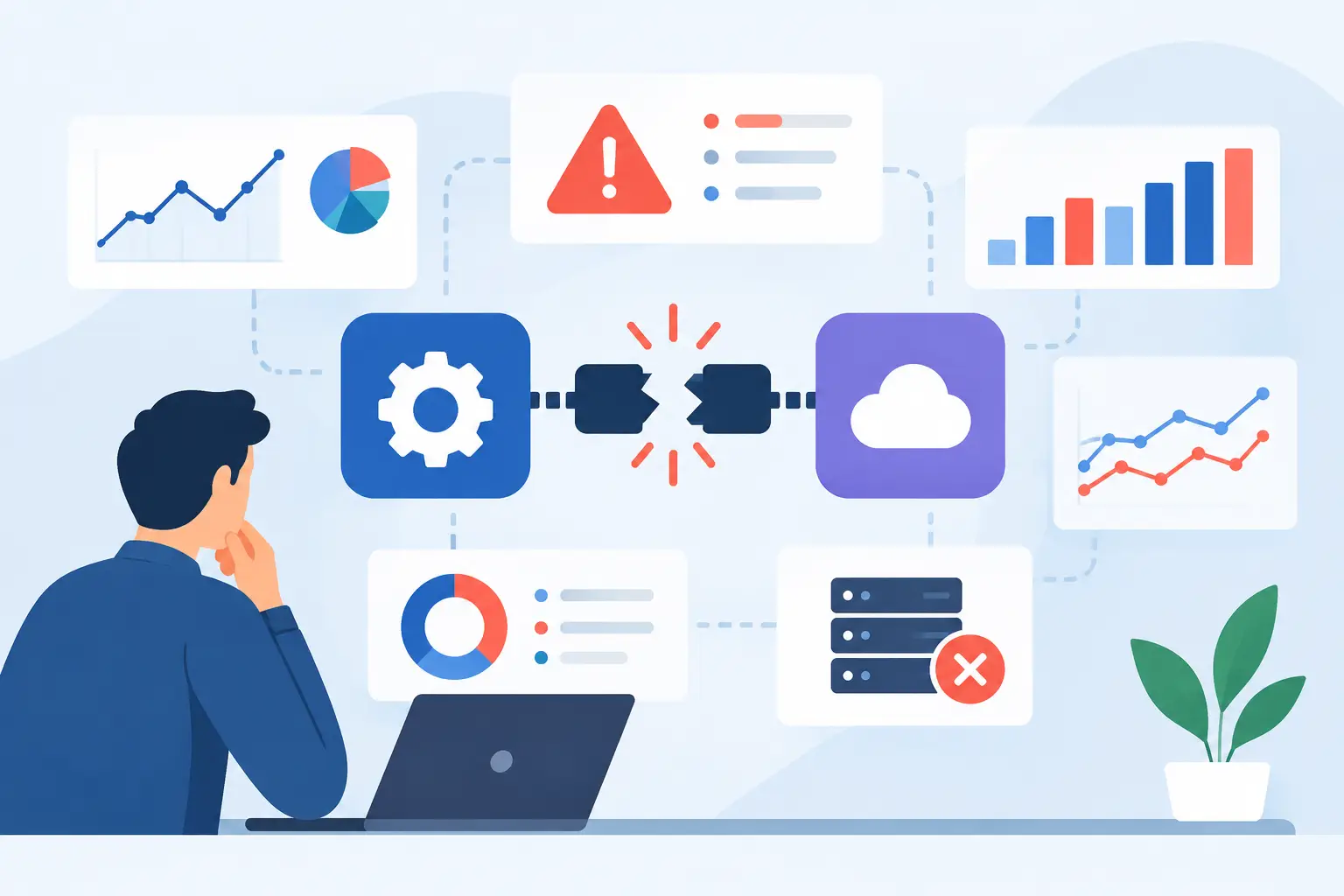
A customer record changes in the CRM, but the billing platform still shows the old account owner. An order is marked fulfilled in one system and remains open in another. A support agent sees incomplete data, makes the wrong decision, and creates more cleanup work. This is why do API integrations fail in the way that matters most: not always through a dramatic outage, but through quiet operational errors that spread across connected systems.
For mid-market businesses, integrations are no longer a technical convenience. They carry revenue data, customer status, inventory, approvals, financial records, and increasingly, AI-driven decisions. When an integration is unreliable, the business reverts to manual checks, spreadsheets, exception queues, and workarounds. The promised efficiency disappears.
The root cause is rarely that an API simply "does not work." Most failures come from weak assumptions about data, workflows, ownership, and production conditions. Building a connector is one task. Operating a dependable business process across multiple systems is another.
Why Do API Integrations Fail After Launch?
An integration can pass a demo, complete a pilot, and still fail under normal business use. Test environments rarely reflect production volume, real user behavior, incomplete records, permission variations, or third-party platform changes. A successful API call proves connectivity. It does not prove that the workflow is correct, recoverable, secure, or maintainable.
The most common failure pattern is a gap between technical implementation and operational reality. A team may map fields correctly but overlook what should happen when a record is edited twice, a downstream system is unavailable, or an employee changes a status outside the intended workflow. Those edge cases are not rare at scale. They are standard operating conditions.
The data model does not match the business model
Two systems can use the same label for different concepts. A "customer" in a CRM may represent a prospect, an active account, or a parent organization. In an ERP, that customer may need a legal entity, billing address, tax status, credit terms, and account code before it can be created.
Field mapping alone cannot resolve that mismatch. The integration needs explicit business rules: which system is authoritative, when a record should be created, which changes can flow in each direction, and what happens when data is incomplete. Without those decisions, teams create duplicate records, overwrite valid information, or push data before it is ready for the receiving system.
This becomes more difficult when AI is involved. An AI agent may classify a support request, extract data from a document, or recommend an action. Before that output reaches a CRM, claims platform, or finance system, it needs validation rules, confidence thresholds, approval paths, and a clear audit trail. Automation should reduce operational risk, not transfer it downstream at machine speed.
Ownership is unclear across systems and teams
Every integration needs a source of truth for each critical data element. If sales operations can update account information in the CRM while finance can update the same fields in an accounting system, conflict is inevitable unless the rules are defined.
Bidirectional synchronization is especially prone to failure. It sounds complete, but it adds complexity quickly: update loops, timestamp conflicts, competing values, and ambiguous deletion behavior. In many cases, a controlled one-way flow with targeted write-backs is safer and easier to support.
Ownership must also exist at the organizational level. Engineering may build the integration, but operations often owns the process it supports. Security may control credentials. A vendor may control the API itself. When no one owns the end-to-end outcome, incidents remain unresolved because each team can say its individual component is functioning.
Error handling was treated as an afterthought
APIs fail for normal reasons: rate limits, expired tokens, temporary service outages, malformed payloads, network interruptions, and maintenance windows. A production integration should expect these events rather than treating them as exceptional.
A weak implementation catches an error, logs it, and moves on. A production-grade implementation classifies the error and responds appropriately. Some requests should retry with backoff. Some should enter a queue for review. Some must stop immediately because retrying could create duplicate invoices, duplicate shipments, or repeated customer notifications.
Idempotency is central here. If a workflow retries after a timeout, the receiving system must not process the same business action twice. This requires stable identifiers, request tracking, and deliberate design. It is less visible than a user interface, but it prevents some of the most expensive integration defects.
The Architecture Problems Behind Failed Integrations
Many integrations fail because they are built as direct, point-to-point connections with too much hidden logic. A CRM calls an ERP, the ERP triggers an email platform, and a separate automation tool writes back to the CRM. It may work initially. Over time, the business cannot easily see where a record changed, why a process stopped, or which connection should be modified when requirements change.
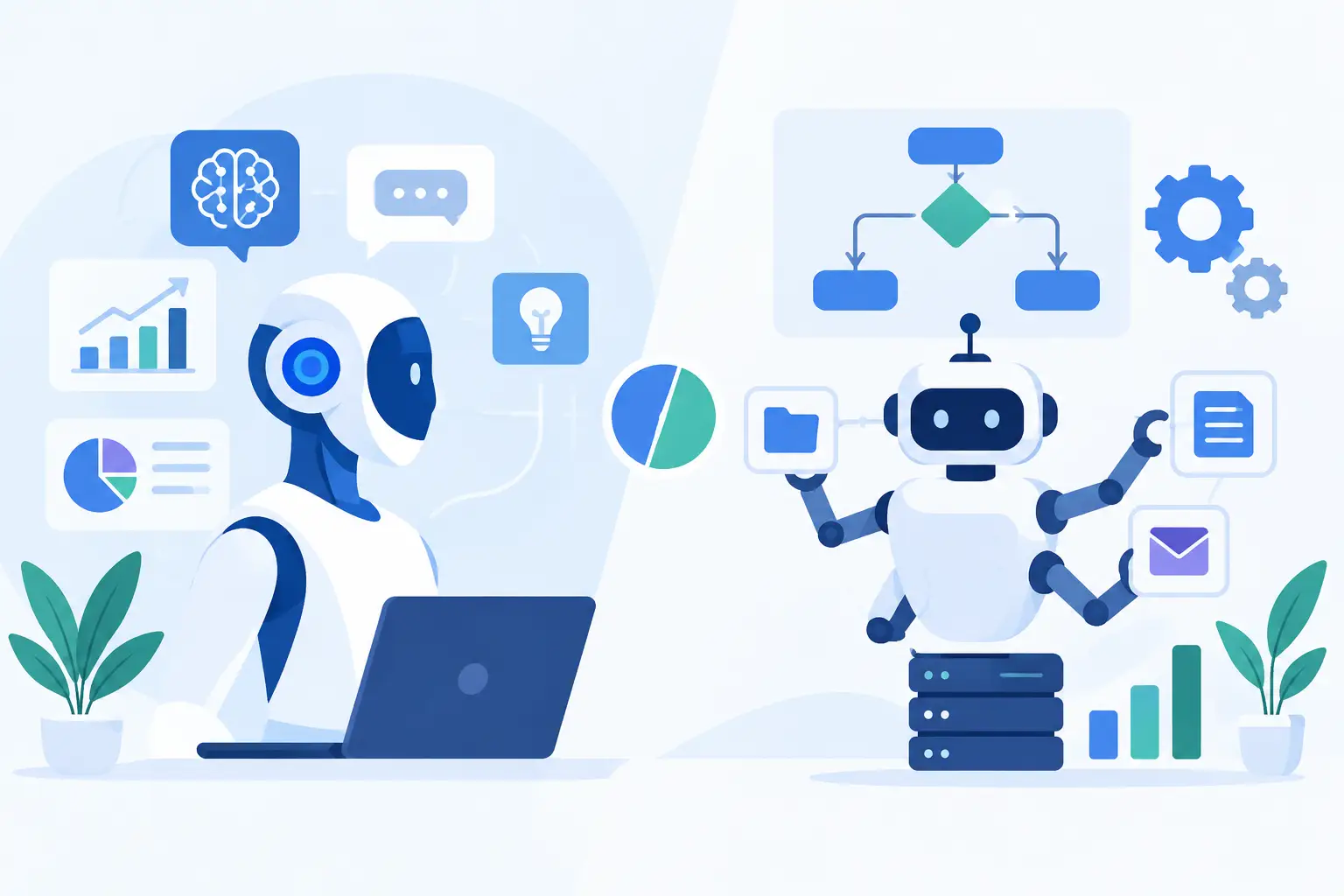
A better architecture separates workflow orchestration from system-specific connectors. The connector handles authentication, API formats, pagination, rate limits, and vendor-specific behavior. The orchestration layer applies business rules, coordinates steps, tracks outcomes, and routes exceptions. This separation makes it easier to replace a vendor, add an approval step, or reuse the same data across multiple workflows.
That does not mean every company needs a large integration platform. The right approach depends on transaction volume, process criticality, data sensitivity, and the expected pace of change. A lightweight scheduled integration may be sufficient for a nightly reporting task. Real-time order, payment, or compliance workflows require stronger controls.
Security and compliance arrive too late
Credentials are often the fastest way to turn a proof of concept into a production risk. Hard-coded API keys, shared service accounts, overly broad permissions, and unmonitored tokens create unnecessary exposure. If an integration can read or write sensitive customer, financial, or health-related information, access controls must be designed from the beginning.
The same applies to auditability. Regulated or compliance-sensitive processes need to show what data moved, who or what initiated the action, what rules were applied, and whether a human approved an exception. Logs should be useful for investigation without exposing confidential data unnecessarily.
Security can add delivery effort, especially when multiple vendors, identity providers, and data classifications are involved. But retrofitting it after deployment is usually slower, more disruptive, and more expensive than designing for least-privilege access and traceability upfront.
Monitoring measures infrastructure, not business outcomes
A dashboard showing that an API endpoint returned a 200 status code is not enough. The integration may be technically available while failing to produce the intended business result. For example, records may be delivered but rejected by validation rules, or orders may sync without their required line items.
Effective monitoring includes technical and operational signals. Teams should know whether requests are failing, slowing down, or approaching rate limits. They should also know whether records are stuck, exception volumes are rising, sync lag is increasing, or expected business events have stopped arriving.
Alerts need ownership and practical runbooks. If a critical workflow fails at 2:00 a.m., the responsible team should be able to identify the affected records, determine whether retries are safe, and restore processing without manually reconstructing every transaction.
How to Build Integrations That Keep Working
Reliable integrations begin with discovery, not endpoints. Before development, define the workflow in operational terms: the triggering event, source-of-truth systems, required data, transformations, approvals, failure paths, and measurable outcome. This exposes gaps early, when they are still inexpensive to resolve.
Then build for controlled change. APIs evolve, business rules change, and systems are replaced. Version interfaces where possible, isolate vendor-specific logic, document data contracts, and test against realistic scenarios. Include duplicate events, out-of-order updates, missing fields, permission failures, partial completion, and recovery after downtime.
A staged production rollout is usually the right trade-off. Start with a limited workflow, a defined user group, or a subset of records. Monitor results, inspect exceptions, and confirm that business teams can operate the process before expanding volume. This is not hesitation. It is how teams protect critical operations while moving quickly.
At Invatechs, integration work is approached as production software delivery, not as a one-time connector project. The objective is concrete automation that survives real data, real users, vendor changes, and the accountability requirements of the business.
The useful question is not whether two systems can exchange data. Most can. Ask whether the process will still be correct when the data is messy, the API is unavailable, a rule changes, and a customer needs an answer now. Design for that moment, and the integration becomes an operational asset rather than another source of manual work.