A claims analyst opens a submission, extracts details from a PDF, checks policy data in the core system, flags missing information, and routes the case for review. That single workflow illustrates the real question behind AI agents vs RPA platforms: does the process require a system to follow fixed instructions, interpret variable information, or do both under controlled conditions?
For operationally complex businesses, the answer is rarely a blanket choice. RPA remains effective for stable, rules-based work across existing applications. AI agents are better suited to tasks involving language, documents, judgment, and changing context. The strongest automation programs use each where it performs reliably, with clear controls around exceptions and business decisions.
What RPA platforms are designed to do
Robotic process automation platforms execute predefined actions. A bot may log into a legacy application, copy values from one screen to another, generate a report, update a CRM record, or reconcile files according to established rules. The logic is explicit: if this condition occurs, complete that action.
This approach works well when the workflow is structured, repetitive, and unlikely to change often. Consider a finance team that downloads a daily bank file, validates a set of fields, posts transactions to an ERP, and sends an exception report. The inputs follow a known format, and the validation rules are deterministic. RPA can reduce manual effort without asking a model to reason about the process.
RPA is particularly useful when a business must automate around systems that lack modern APIs. Screen-based automation can provide a practical bridge while a larger modernization effort is underway. But it also introduces a dependency: if a user interface changes, a bot may fail. Automation that relies on clicking buttons and locating screen elements needs monitoring, testing, and maintenance.
Where AI agents change the equation
AI agents use language models and connected tools to handle work that cannot be fully described through fixed rules. They can interpret unstructured documents, retrieve relevant information from internal knowledge bases, decide which system action is appropriate, and generate a response or next step based on the available context.
An agent can review an inbound vendor email, classify the request, extract invoice data, compare it against purchase order information, ask for missing documentation, and prepare a case for approval. The workflow is still governed by business logic, but the agent handles the ambiguity that makes traditional automation difficult.
That capability does not mean an agent should operate without boundaries. Language models can misinterpret context, produce unsupported answers, or take an incorrect action if the tool permissions and instructions are poorly designed. Production AI requires a defined scope, trusted data sources, structured outputs, approval thresholds, audit logs, and fallback paths when confidence is low.
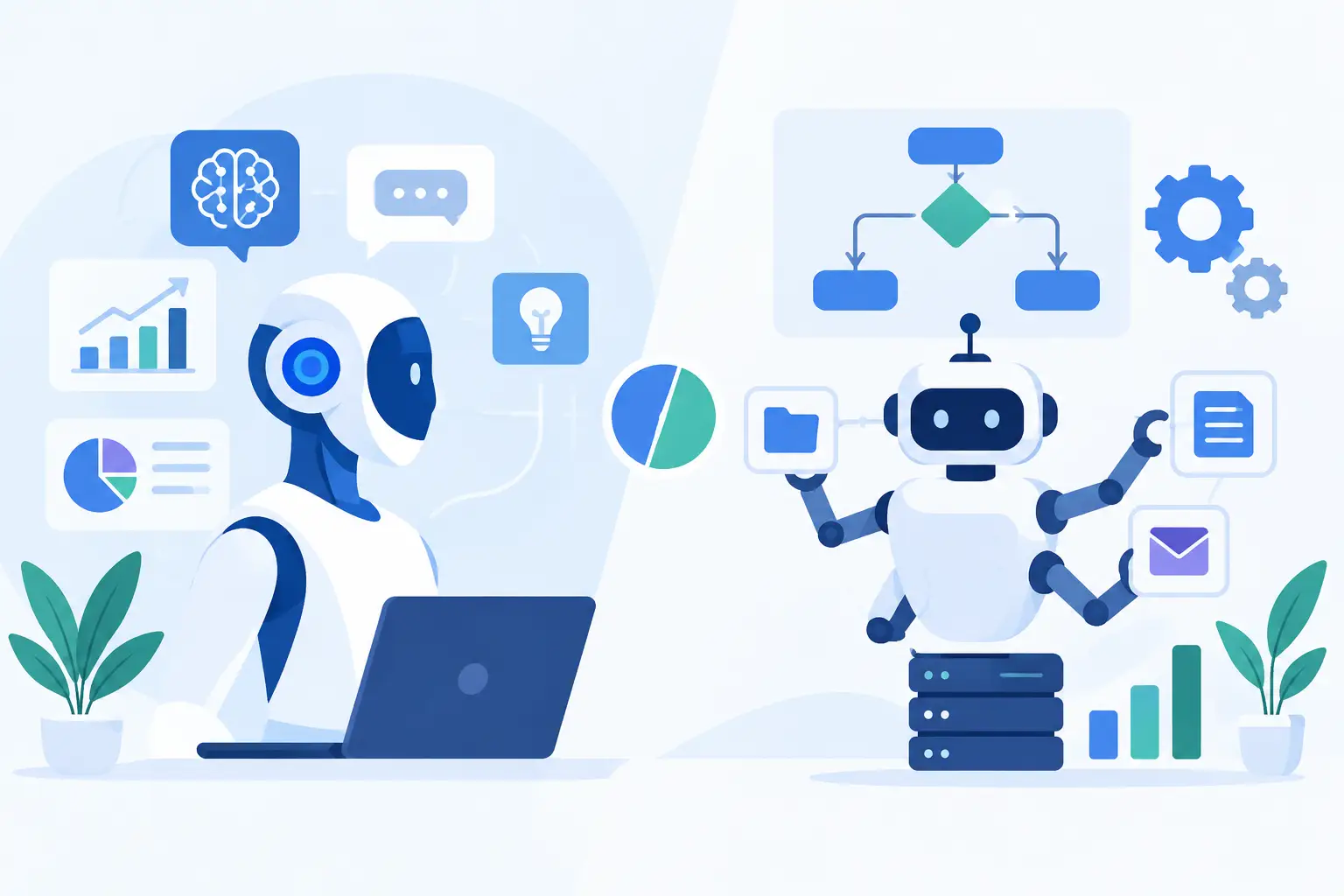
The distinction matters. An RPA bot generally follows a process exactly as configured. An AI agent can select among actions based on context. That flexibility creates value in document-heavy, customer-facing, and knowledge-intensive operations, but it also raises the bar for architecture and governance.
AI agents vs RPA platforms: the operational differences
The simplest way to compare the two is by looking at the nature of the work, not the popularity of the technology.
RPA platforms are strongest when inputs are predictable and success can be defined by exact execution. They are well suited to moving data between systems, applying fixed validation rules, scheduling routine tasks, and completing high-volume transactions. Their behavior is easier to test because the same inputs should produce the same outputs.
AI agents perform better when inputs vary in format or meaning. They can process contracts, support requests, emails, call summaries, claims narratives, and internal documentation. They can also coordinate multi-step workflows across APIs when the next action depends on what they find. For example, an agent supporting customer operations may identify intent, retrieve account context, draft a compliant response, create a ticket, and escalate only the cases that require human intervention.
The trade-off is predictability. An agent needs stronger evaluation than a basic workflow bot. Teams should test it against representative edge cases, define acceptable error rates, restrict access to sensitive systems, and measure outcomes after launch. For compliance-sensitive workflows, a human approval step may remain necessary for decisions involving payments, eligibility, legal interpretation, or customer commitments.
The most effective model is often a combined architecture
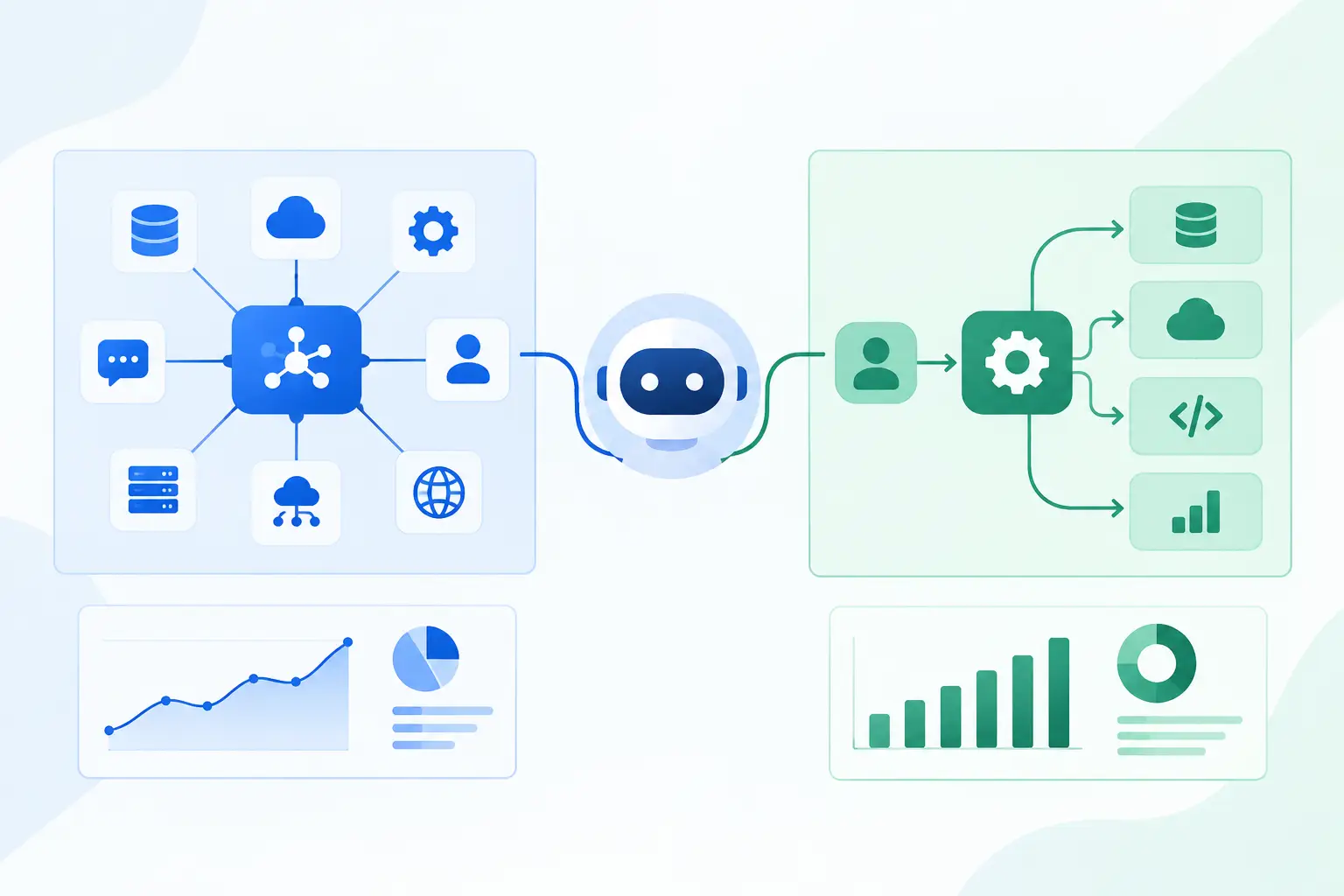
Treating AI and RPA as mutually exclusive can create unnecessary constraints. In many production environments, an AI agent provides interpretation and orchestration while RPA or API-based services execute controlled actions.
For example, an agent can read a new client onboarding package, identify the document type, extract required fields, detect missing information, and assign a risk category. It can then call an API to create records in the CRM or ERP. If the downstream system has no API, an RPA bot can perform the final data entry. The agent handles the messy front end of the workflow; the bot handles the repeatable transaction.
This design also makes responsibility clearer. The AI layer should not be given unrestricted access simply because it can reason across a task. Instead, it can submit a structured action request to a controlled workflow service. That service validates required fields, enforces permissions, records the action, and sends it to the appropriate system.
API integration should be the preferred path where available. APIs are generally more reliable, observable, and maintainable than screen automation. RPA remains valuable where API access is unavailable or too costly to build in the near term, but it should not become an excuse to leave brittle processes unexamined.
How to choose the right starting point
Start with a process inventory, then identify where time is being lost. The highest-value candidates usually combine meaningful volume with expensive manual review, slow turnaround, or recurring errors. A workflow that is merely annoying may not justify the engineering and change-management effort.
Choose RPA first when the process has stable screens or files, clear business rules, limited exceptions, and an immediate need to reduce manual clicks. Choose an AI agent when employees spend significant time reading, interpreting, summarizing, searching, classifying, or drafting across inconsistent inputs.
If the process includes both, separate the work into components. Ask which steps require interpretation and which require deterministic execution. This prevents a common mistake: using a language model to perform simple, high-volume rules that standard automation can handle more cheaply and consistently.
A practical discovery effort should also surface the constraints that shape the implementation. These include data sensitivity, identity and access controls, source-system quality, audit obligations, exception rates, and ownership after deployment. An impressive prototype that cannot access approved data, fit into existing workflows, or pass security review is not an operational solution.
Measure automation by business outcomes
The right metric is not the number of bots or agents deployed. It is the measurable effect on operations. Depending on the workflow, that may include cycle time, cost per transaction, first-response time, document-processing accuracy, backlog reduction, error rates, revenue leakage, or the percentage of cases resolved without escalation.
Baseline those measures before implementation. Then run a focused pilot with representative data and users. A pilot should prove more than model quality. It should validate integration behavior, approval flows, reliability under load, and the real effort required to handle exceptions.
This is where experienced implementation matters. AI agents are not standalone chat interfaces, and RPA bots are not maintenance-free scripts. Both need architecture, QA, observability, and ongoing optimization. Invatechs approaches automation as working software connected to the systems that run the business, with controls designed for production rather than demonstrations.
The best first project is usually not the most ambitious one. It is the workflow where better interpretation, faster execution, and clear governance can produce a result the business can measure - then build from there.