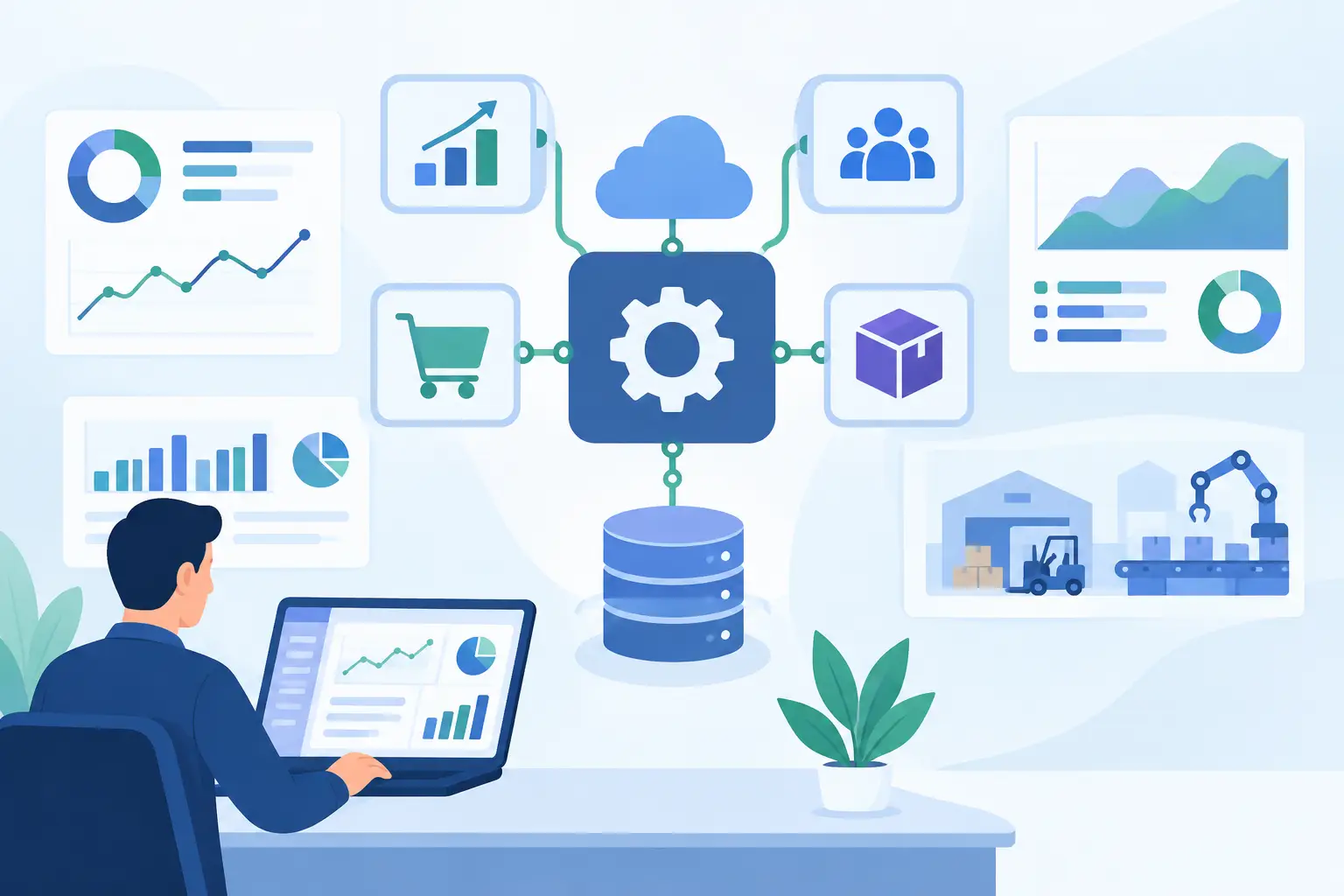

A claims operations team receives 3,000 submissions each week. Some arrive as standardized forms, others as scanned PDFs, and many include emails, policy documents, and notes that require judgment before work can proceed. Traditional automation can move the clean, predictable cases quickly. An AI system can interpret the exceptions. The real decision in LLM agents vs RPA is not which technology is more advanced. It is which parts of a business process are deterministic, which require interpretation, and where human control must remain.
For operationally complex companies, treating this as a technology contest leads to poor architecture. RPA and LLM agents solve different problems. Used with clear boundaries, they can form a reliable automation layer across CRM, ERP, finance, support, and internal knowledge systems.
LLM Agents vs RPA: The Core Difference
Robotic process automation, or RPA, is designed to execute defined tasks through rules and repeatable actions. It can log into an application, copy data from one field to another, generate a report, update a record, or trigger a workflow. It performs well when the inputs, process steps, and expected outcomes are known in advance.
An LLM agent uses a large language model to understand unstructured information, reason through a defined objective, select from approved tools, and take actions in connected systems. It can read a customer email, compare its contents with policy documentation, retrieve account history, draft a response, and route the case based on confidence and business rules.
The distinction matters because RPA follows instructions exactly. An LLM agent can handle ambiguity, but its output must be constrained, validated, and monitored. RPA is strongest when consistency is the priority. Agents are strongest when the work begins with language, documents, context, or changing requests.
Neither approach removes the need for process design. Both require clear ownership, reliable system access, exception handling, logging, and testing before production deployment.
Where RPA Still Delivers the Best Result
RPA remains a practical choice for high-volume, rules-based work, particularly when APIs are unavailable or older systems still rely on user interfaces. If a process is stable and the same steps happen thousands of times, an RPA bot can reduce manual effort with predictable behavior.
Common examples include transferring approved invoice data into an accounting platform, downloading scheduled reports, reconciling fields between systems, creating standard user accounts, and processing fixed-format files. In these cases, adding an LLM can introduce unnecessary cost and uncertainty.
The limitation is brittleness. RPA bots often depend on screen layouts, field names, and fixed paths. A changed button label, revised document template, or unexpected pop-up can stop the process. The answer is not to abandon RPA. It is to build it with operational safeguards: error queues, retry logic, monitoring, and a maintenance plan for upstream changes.
RPA also struggles when the process requires interpretation. A bot can extract a value from a known location in a standard invoice. It cannot reliably decide whether an email is requesting a contract amendment, reporting a service issue, or asking for a billing exception unless every variation has already been modeled as a rule.
Where LLM Agents Create More Value
LLM agents are suited to workflows where employees spend time reading, searching, categorizing, summarizing, and deciding what should happen next. These are often the hidden bottlenecks in customer operations, underwriting, procurement, compliance review, and internal support.
Consider an onboarding workflow. An agent can review submitted documents, identify missing information, compare details against onboarding requirements, create a structured case summary, and prepare a follow-up request. It can then call approved tools to update the CRM, create a task for an operations specialist, or route a high-risk case to compliance.
That does not mean the agent should make every final decision. In regulated or financially material processes, the right model is often assisted decision-making. The agent prepares evidence, applies policy-aware checks, and recommends the next action. A qualified employee approves exceptions, edge cases, and high-impact outcomes.
The value comes from reducing the time between intake and action. Instead of asking staff to search across disconnected knowledge bases and systems, an agent can retrieve relevant context and work within a controlled set of tools. This is concrete automation, not generic AI hype.
An agent is not just a chatbot
A chat interface can answer questions. A production agent needs more: authenticated access to business systems, defined tool permissions, knowledge retrieval, workflow state, audit logs, validation rules, and escalation paths. Without those components, a promising demo remains a disconnected assistant.
For example, a support agent should not be free to issue refunds, modify subscriptions, or expose account information based solely on a text prompt. It should verify identity, retrieve the right record, follow policy thresholds, record its actions, and hand off cases that exceed its authority.
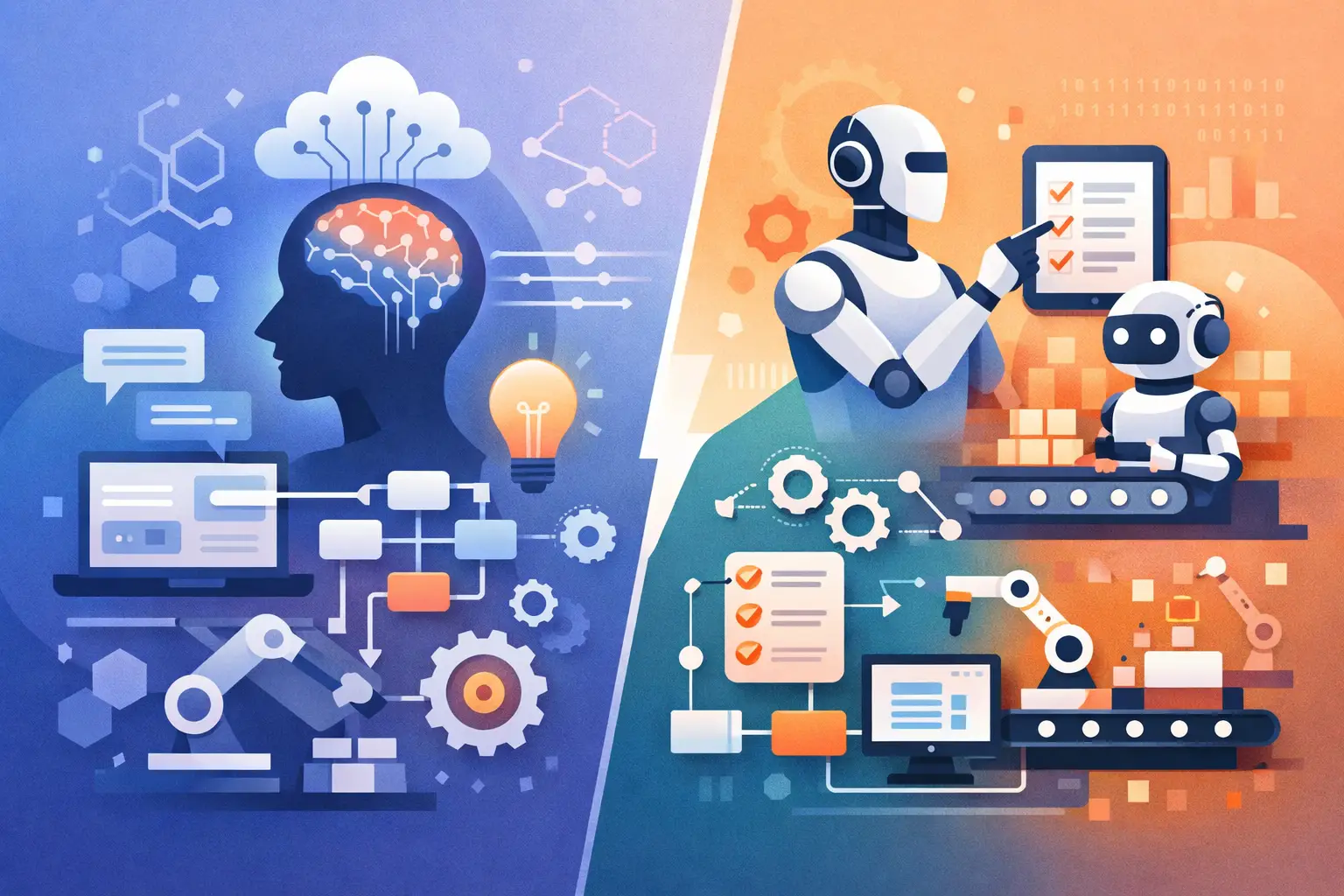
The Most Effective Pattern: Agents for Judgment, RPA for Execution
Many organizations do not need to choose one platform. The better architecture often uses an LLM agent at the front of the workflow and deterministic automation behind it.
An agent can classify inbound requests, extract details from mixed document formats, detect missing information, and decide which workflow applies. RPA or API-based automation can then execute the fixed actions: update the ERP, create the service ticket, notify the account owner, or generate the standard document.
This division of labor improves reliability. The agent handles the variable inputs that make manual work slow. The deterministic layer performs known actions in a controlled way. Each component has a narrower job, which makes testing and troubleshooting more manageable.
API integrations are usually preferable to UI automation when they are available. APIs are less vulnerable to interface changes, support stronger authentication and validation, and produce cleaner system-to-system behavior. RPA still has a role when a critical legacy application has no usable API, but it should not become the default integration strategy simply because it is familiar.
How to Choose the Right Automation Approach
Start with the process, not the tool. Map the workflow from intake to completion and identify where people spend time. Separate repetitive system actions from interpretation, decision points, and exceptions. This quickly reveals whether the process needs RPA, an LLM agent, conventional software integration, or a combination.
Ask four practical questions:
- Are the inputs structured and consistent, or do they arrive as emails, documents, images, and free-form requests?
- Can the decisions be expressed as stable rules, or do employees need to interpret context and policy?
- Does the process require access to multiple systems and internal knowledge sources?
- What happens when the automation is wrong, incomplete, or uncertain?
If the cost of a wrong action is low and steps are fixed, RPA may be enough. If work is dominated by document review, communication, and retrieval of dispersed information, an agent may deliver more value. If both conditions exist, combine them.
Process volume matters, but it is not the only factor. A lower-volume workflow with expensive specialist review can be a stronger AI candidate than a high-volume workflow with simple, easily scripted steps. The business case should account for cycle time, rework, error rates, customer response time, and the capacity released for higher-value work.
Production Requirements for Both Technologies
Automation that touches customer, financial, or operational data needs production discipline. A pilot that works on a sample dataset is not proof that it can operate safely at scale.
For RPA, production readiness includes credential management, bot monitoring, error handling, version control, test environments, and defined support ownership. For LLM agents, the requirements expand to include prompt and workflow versioning, retrieval quality, tool authorization, output validation, evaluation datasets, observability, and guardrails against unauthorized actions or data exposure.
Human review should be designed intentionally rather than added after errors occur. Define confidence thresholds, escalation conditions, approval points, and the information reviewers need to make fast decisions. A reviewer who receives only an AI-generated recommendation without source context cannot provide meaningful oversight.
Security also depends on least-privilege access. An agent should receive only the tools and permissions required for its assigned workflow. Separate read access from write access where possible, retain audit logs, and test failure scenarios before deployment. This is especially important when workflows involve personal data, contracts, payments, healthcare information, or regulated decisions.
Build Around Measurable Outcomes
The strongest automation programs begin with a narrow, valuable workflow and a measurable target. Reduce document handling time by 40 percent. Cut support triage from hours to minutes. Increase the percentage of complete onboarding submissions before a human reviewer opens the case. These targets give the implementation team a way to assess whether the architecture is working.
At Invatechs, this typically means moving from discovery and workflow design to a focused pilot, then hardening the solution for integration, QA, monitoring, and ongoing optimization. The goal is not to introduce AI into a process for its own sake. The goal is to turn AI into working software that improves an operating metric.
The useful question is not whether LLM agents will replace RPA. It is where each can remove friction without creating new operational risk. Start with one process where work is slow, repetitive, and measurable. Design the controls before the automation, then expand only after the results hold up in production.