

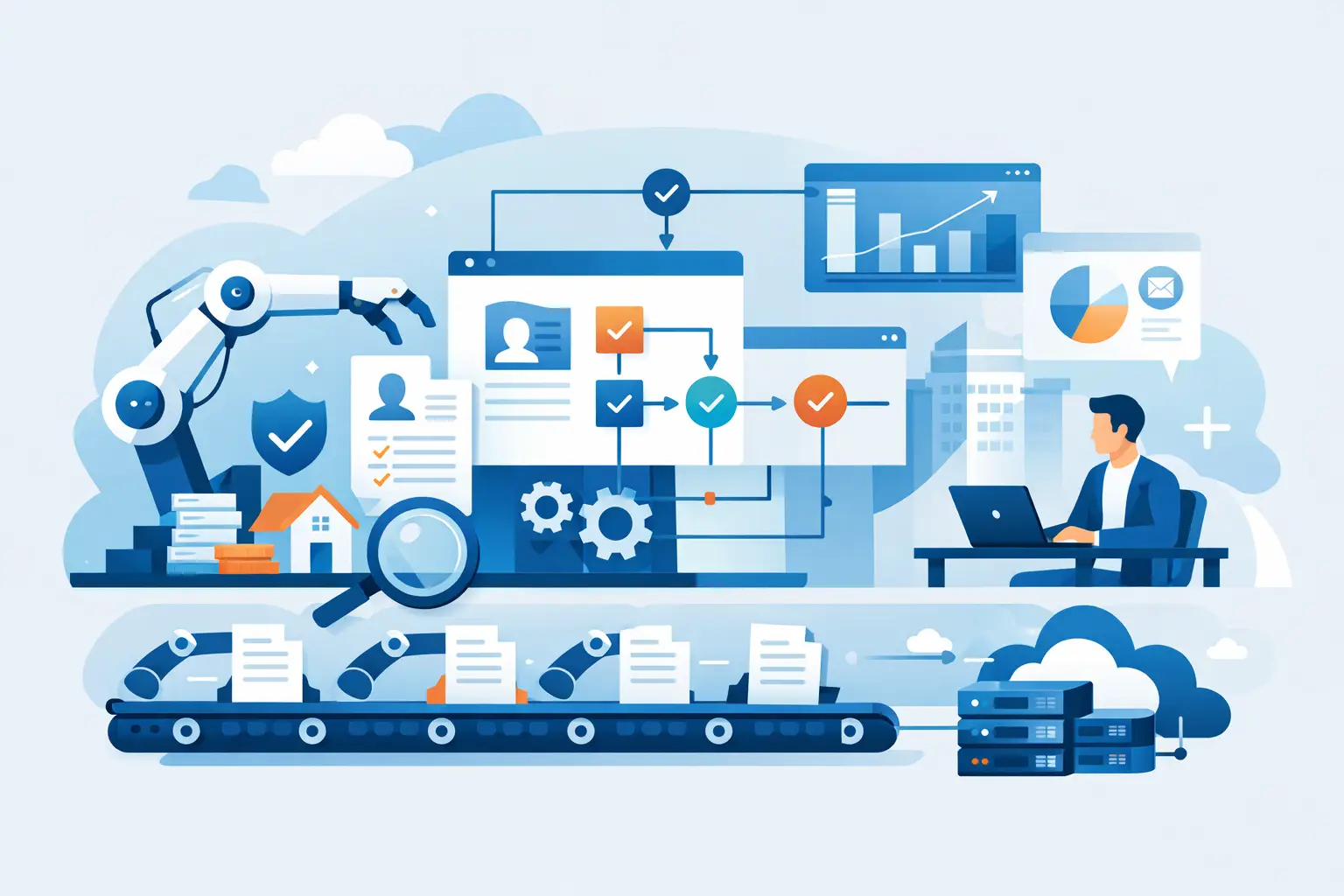
Underwriting teams rarely have a capacity problem alone. They have a workflow problem: information arrives in different formats, analysts rekey data across systems, exceptions get buried in inboxes, and decisions wait on documents that were available hours ago. Learning how to automate underwriting workflows means redesigning that operating model without weakening credit, risk, or compliance controls.
The goal is not to remove human judgment from every decision. It is to make routine work faster, make exceptions visible earlier, and give underwriters a complete, traceable case file when judgment is required. For lenders, insurers, and other risk-led businesses, that is where automation produces measurable value.
Start with the underwriting decision, not the AI tool
Automation projects stall when teams begin by selecting a document AI platform or a workflow product before defining the decision path. Underwriting is not one task. It is a chain of intake, verification, data gathering, analysis, rules evaluation, escalation, decisioning, communication, and recordkeeping.
Map the current workflow from application receipt to final disposition. Document each handoff, system, data source, manual entry point, approval threshold, and exception type. Measure how long each stage takes, how often a case is touched, and where rework occurs. This exposes the highest-value targets for automation.
A practical first scope is usually a narrow, high-volume workflow with stable rules. For example, an insurer may automate extraction and validation of loss-run data before an underwriter reviews risk. A commercial lender may automate financial statement intake, borrower identity checks, and policy-based routing for low-risk applications. These use cases reduce manual effort while keeping final authority where the business needs it.
Build a reliable data and integration layer
Underwriting automation fails when it becomes another disconnected interface. Production workflows need data to move between the systems teams already use: CRM, loan origination or policy administration platforms, document repositories, core banking systems, payment tools, third-party data providers, and internal reporting environments.
Start by defining a canonical case record. This is the structured representation of an application that includes applicant details, source documents, extracted fields, verification results, calculated ratios, risk indicators, decision status, and an event history. Each system can retain its role, but the workflow needs a consistent record to coordinate activity.
API integrations should handle real operational conditions, not only happy-path demos. That includes duplicate submissions, missing fields, provider timeouts, changes to source data, partial extraction failures, and retries that do not create duplicate records. Role-based access controls, encryption, retention rules, and detailed logs should be designed into the architecture from the start.
For organizations with legacy systems, direct replacement is rarely the best first move. A middleware layer or custom integration service can orchestrate existing applications while new capabilities are introduced in stages. This approach lowers implementation risk and prevents a workflow improvement project from becoming a multi-year core-system migration.
Apply AI where unstructured work slows the process
AI is most useful in underwriting when information is trapped in documents, emails, call notes, and inconsistent narratives. It can classify submissions, extract fields from statements and applications, identify missing evidence, summarize relevant history, and prepare a structured underwriting brief.
That does not mean an AI model should make every approval or decline decision. For compliance-sensitive decisions, AI outputs need confidence scoring, source references, validation rules, and a clear review path. If the system extracts annual revenue from a financial statement, the underwriter should be able to see the source document, page, field label, and extraction confidence.
A controlled design separates deterministic logic from probabilistic AI. Business rules should handle clear policy requirements such as minimum coverage limits, debt-to-income thresholds, required documents, authority limits, and prohibited risk categories. AI can handle interpretation and extraction, then route uncertain findings to a person.
This distinction matters. A language model may summarize a complex document effectively, but it should not silently override underwriting policy. Reliable automation uses AI to accelerate analysis and improve case preparation, while rules engines and human approvals govern the decision boundary.
Design exception management before straight-through processing
Straight-through processing is valuable, but it is not the only measure of success. In many underwriting operations, the larger opportunity is faster exception handling. A well-designed system identifies why a case cannot proceed and routes it to the right person with the information needed to resolve it.
Common exception paths include conflicting applicant information, expired documentation, low-confidence extraction, adverse third-party data, policy conflicts, fraud indicators, and cases that exceed delegated authority. Each exception should have an owner, service-level target, escalation rule, and resolution code.
A production workflow should make these states visible through operational dashboards. Leaders need to see the volume entering each queue, aging by stage, exception rates by source, decision turnaround time, and the reasons cases leave automated processing. Without that visibility, teams can automate intake while simply moving bottlenecks downstream.
How to automate underwriting workflows in phases
A phased rollout protects operations while proving value early. It also allows policy, model, and integration issues to surface before they affect every application. A practical implementation sequence includes these five stages:
- Discovery and workflow design: Define the target process, decision authorities, data requirements, exception categories, compliance controls, and success metrics.
- Pilot one use case: Automate a contained workflow, such as document classification and extraction for a single product line or risk tier.
- Validate against real cases: Compare automated outputs with experienced underwriter decisions, measure accuracy and cycle time, and tune rules and prompts.
- Deploy with human oversight: Route automation results into existing review queues, require approvals where appropriate, and monitor failures closely.
- Expand based on evidence: Add new document types, products, data sources, and straight-through decision paths only after performance is stable.
The right pilot is not necessarily the simplest process. It should be frequent enough to generate useful data, bounded enough to manage risk, and meaningful enough to demonstrate business impact. A workflow that saves five minutes on ten cases a month will not justify the same engineering effort as one that removes repetitive work from thousands of submissions.
Set controls that stand up to audit and change
Underwriting criteria change. Regulations change. Third-party data providers change their formats. Automation must be built for ongoing control rather than treated as a one-time implementation.
Maintain versioned decision rules, approval workflows for rule changes, test cases for common and edge scenarios, and audit logs that record what data was used, which rule set applied, who approved the outcome, and when the decision occurred. For AI-assisted steps, retain the input source, output, confidence level, and reviewer action where required by policy.
Quality assurance should test more than functional behavior. Teams need to test permission boundaries, integration failures, document variants, data drift, model performance, and peak-volume conditions. A workflow that works on clean sample files but fails on scanned documents, incomplete statements, or unusual applicant structures is not ready for production.
Fairness and explainability also require deliberate attention. If automated recommendations influence pricing, eligibility, or risk classification, legal, compliance, and risk teams should help define permitted inputs, review thresholds, adverse-action requirements, and monitoring criteria. The correct controls depend on the product, jurisdiction, and decision type, but the architectural need is consistent: every material outcome must be traceable.
Measure operational outcomes, not just automation rates
A high automation rate can hide poor outcomes if exceptions rise, decisions require more rework, or underwriters no longer trust the system. Track cycle time from submission to decision, manual touches per case, extraction accuracy, exception resolution time, rework rate, service-level attainment, and decision quality indicators relevant to your portfolio.
Also measure adoption. If experienced underwriters routinely work outside the automated workflow, that behavior is feedback about the process design. It may indicate missing data, weak case summaries, impractical rules, or an exception queue that does not match real work. The response should be to improve the workflow, not force use of an unreliable system.
The strongest underwriting automation programs treat technology as an operating capability. They combine custom workflow design, secure integrations, tested decision logic, and AI that is constrained by real business controls. Start with one decision path your team can measure, build it to production standards, and let the evidence determine where automation should go next.