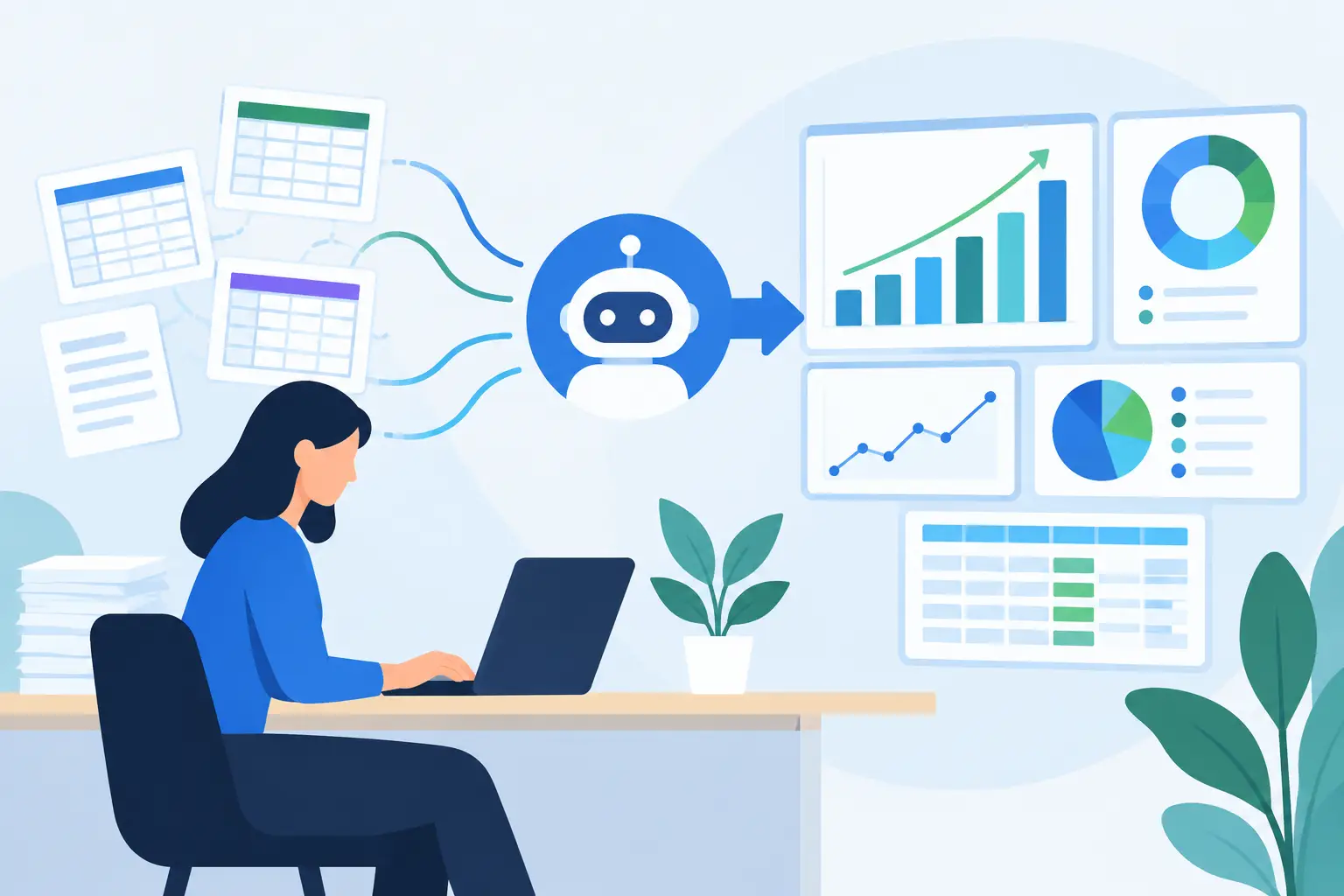

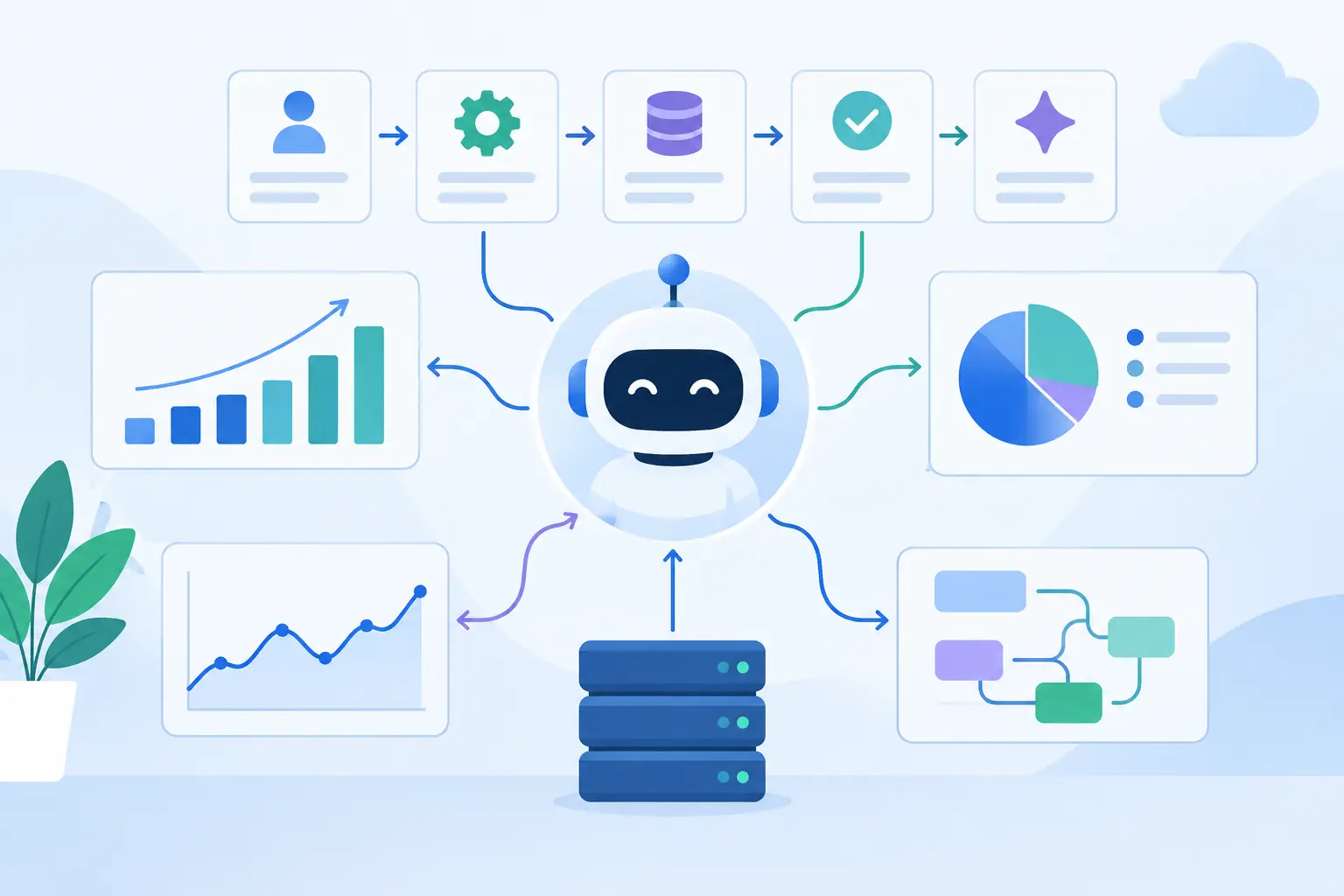
A support team receives a renewal request with a contract attachment, an account history spread across systems, and a billing exception that needs review. A standard chatbot can summarize the request. Agentic workflows can classify it, retrieve the relevant account data, check policy rules, prepare the right actions in connected systems, and route only the uncertain cases to a person.
That distinction matters. Agentic workflows are not a chat interface placed on top of a business process. They are controlled systems that combine AI reasoning, business rules, integrations, and human oversight to complete multi-step work. For operationally complex companies, that is where AI begins to create measurable value.
What agentic workflows actually do
An agentic workflow gives an AI agent a defined objective, access to approved tools, and clear boundaries for acting. The agent can assess context, select the next step, call systems through APIs, validate results, and continue until it reaches a completion condition or requires human input.
For example, an insurance operations workflow may receive a submission package, extract key fields from documents, identify missing information, compare the submission against underwriting guidelines, update the CRM, and draft a follow-up request. The workflow does not need to treat every case the same way. It can adapt its sequence based on the data it finds.
This is different from simple automation. Traditional workflow automation follows fixed logic: if a form field equals X, send an email or create a record. That approach remains valuable for stable, predictable tasks. An agent is useful when the work involves unstructured inputs, incomplete information, changing context, or decisions that require interpretation.
It is also different from deploying a general-purpose AI assistant. A helpful assistant can answer questions, but it does not automatically have the permissions, system context, error handling, and audit trail needed to perform business-critical work. Production value comes from the workflow around the model, not the model alone.
Where agentic workflows deliver practical value
The best candidates are repetitive processes that consume skilled employee time because the inputs are messy or the work crosses multiple systems. Document-heavy operations are a common starting point. An agent can read incoming files, extract data, compare it against internal records, flag exceptions, and create a structured work item for review.
Customer operations offer another strong use case. An agent can triage requests across email, chat, and support tickets; pull order, account, or product information; resolve routine issues within approved policies; and escalate cases with a concise evidence package. The goal is not to remove people from sensitive interactions. It is to reduce queue volume and give staff the complete context needed to make better decisions.
Finance teams can use agentic workflows to reconcile transaction data, investigate invoice discrepancies, collect supporting documents, and prepare approval packets. Sales and account management teams can use them to update CRM records, identify renewal risks, generate follow-up tasks, and assemble account briefs from scattered data sources.
The return depends on the process. High-volume work with clear outcomes often produces faster savings. Lower-volume processes may still justify investment when errors are costly, response time affects revenue, or compliance demands consistent handling.
Production architecture matters more than the demo
A convincing demonstration can be built in days. A dependable operational system requires more discipline. The AI model is only one component in the architecture.
The first requirement is trustworthy access to business systems. Agents need secure, scoped connectors to tools such as CRMs, ERPs, help desks, finance platforms, document repositories, and internal databases. Permissions should follow least-privilege principles. An agent that can read a customer record does not automatically need the ability to issue a refund, change payment details, or delete data.
The second requirement is process control. Each workflow needs explicit triggers, tool definitions, validation steps, completion criteria, retry behavior, and escalation paths. The agent should know which actions it may take independently, which require approval, and when it must stop. This prevents a reasonable-sounding model response from becoming an uncontrolled operational action.
The third requirement is observability. Teams need logs that show what the agent received, which tools it called, what information influenced its decision, and what action was taken. For regulated or compliance-sensitive processes, this is essential. It supports incident investigation, quality assurance, policy reviews, and continuous improvement.
Finally, workflows require fallback paths. APIs fail. Source data is incomplete. Documents are unreadable. A mature design anticipates those conditions and routes work to the right person rather than forcing the system to guess.
The right role for human approval
Human-in-the-loop design is not a sign that automation has failed. It is often the correct control model. The right approval point depends on risk, confidence, and reversibility.
Low-risk actions, such as categorizing an inbound request or creating a draft task, can often run automatically. Moderate-risk actions may proceed when the workflow meets defined confidence and policy thresholds. High-impact actions, including credit decisions, pricing exceptions, contract changes, financial transfers, or regulated communications, usually require approval before execution.
This layered approach avoids two common mistakes: requiring staff to review every trivial action, which destroys the efficiency gain, or allowing the agent to take actions that carry more risk than the organization can accept.
How to choose the first workflow
Do not begin with the broadest possible ambition, such as automating an entire department. Start with a process that has a clear business owner, meaningful volume, accessible source data, and a measurable outcome.
A practical discovery process examines the current workflow step by step. What triggers the work? Which systems are involved? Where do employees spend time interpreting documents, searching for information, rekeying data, or making routine decisions? What exceptions occur, and what rules govern them? The answers define whether the process needs deterministic automation, an AI agent, or both.
The strongest initial projects typically have a constrained scope. A pilot might handle one document type, one request category, or one approval stage. That scope makes it possible to measure accuracy, cycle time, escalation rate, and cost per case before expanding the system.
Success criteria should be operational, not vague. Useful measures include reduced handling time, fewer manual touches, faster first response, higher data completeness, lower exception rates, and improved adherence to internal policies. If the organization cannot describe what better looks like, it is too early to automate the process.
Common failure modes to avoid
The most common failure is treating an agent as an isolated tool rather than part of an end-to-end workflow. Without integration, the agent may produce useful text while employees still copy information between systems and manually complete the real work.
Another failure is relying on the model to enforce business policy. Models can interpret policies, but critical rules should also be represented in deterministic checks, approved knowledge sources, and validation logic. Policy changes must be traceable and testable.
Poor data quality can also limit results. If customer records are duplicated, document naming is inconsistent, or key fields are missing, the workflow needs a strategy for resolving ambiguity. AI can help identify and organize those issues, but it cannot make unreliable source systems reliable by itself.
Finally, teams often underinvest in testing. Agentic workflows should be tested against normal cases, edge cases, incomplete records, conflicting instructions, tool failures, and adversarial inputs. QA is not a final phase. It is an ongoing operating requirement as models, policies, and connected systems change.
Moving from pilot to operating capability
A successful pilot creates evidence, not just enthusiasm. Once a workflow demonstrates measurable results, the next step is to harden it for broader use: strengthen security controls, expand test coverage, define monitoring thresholds, document ownership, and establish a change-management process.
At Invatechs, the work starts with the operational process and the systems it touches. The objective is concrete automation, not generic AI hype: agents that can access the right context, take approved actions, and produce records that teams can trust.
The most effective agentic workflows are rarely the most theatrical. They are the ones employees stop noticing because the backlog moves faster, the records are cleaner, and the right exceptions arrive with the evidence needed to resolve them.