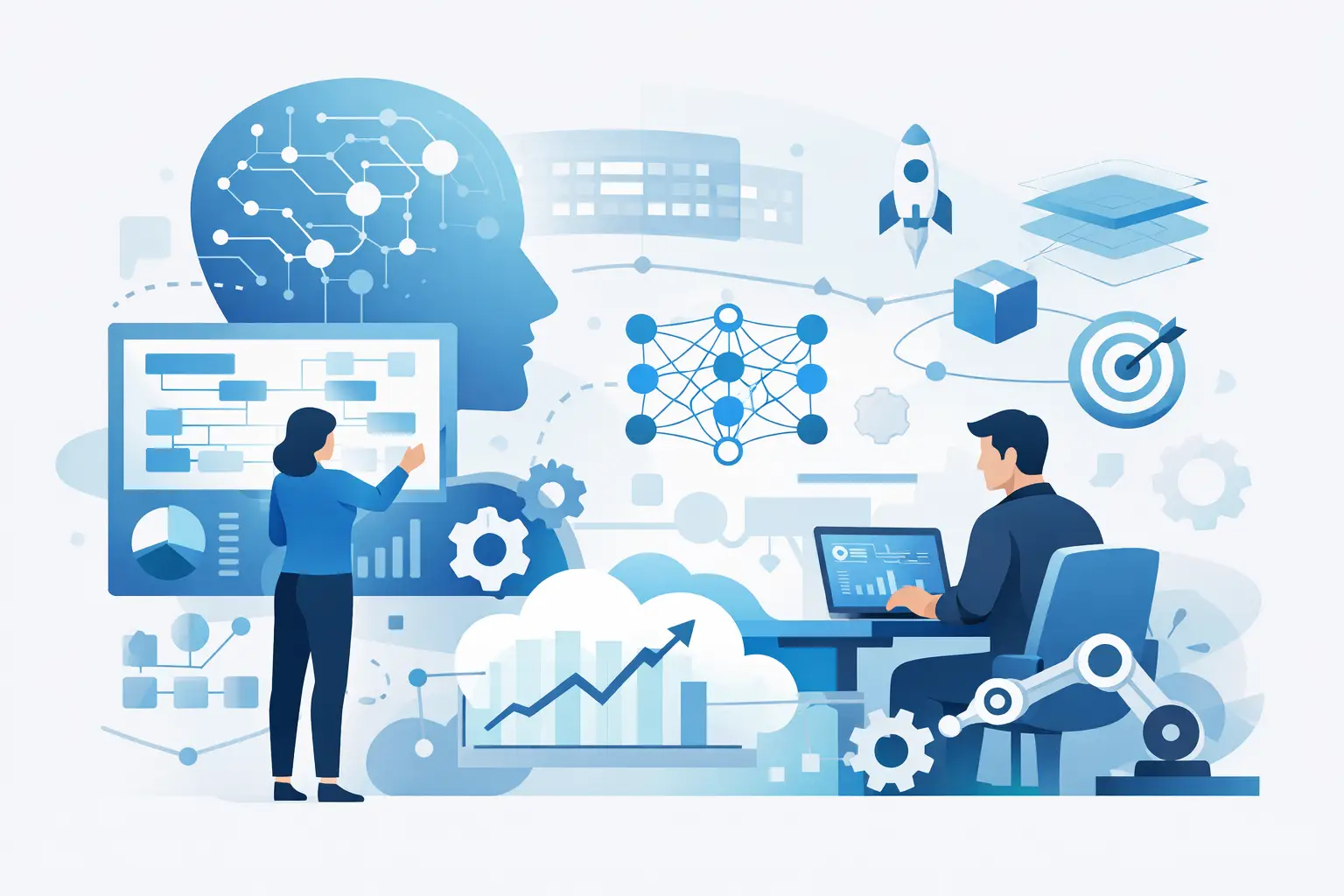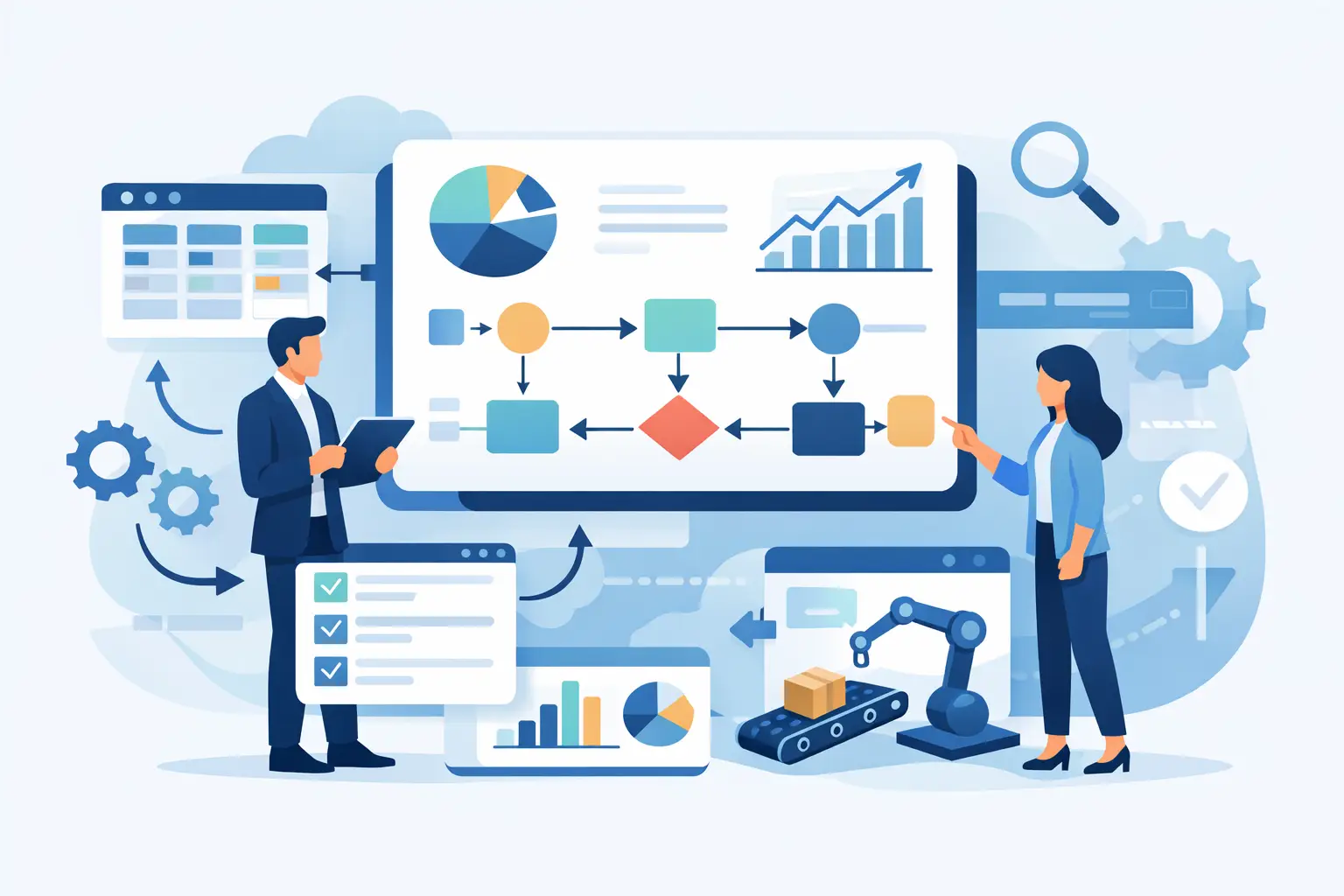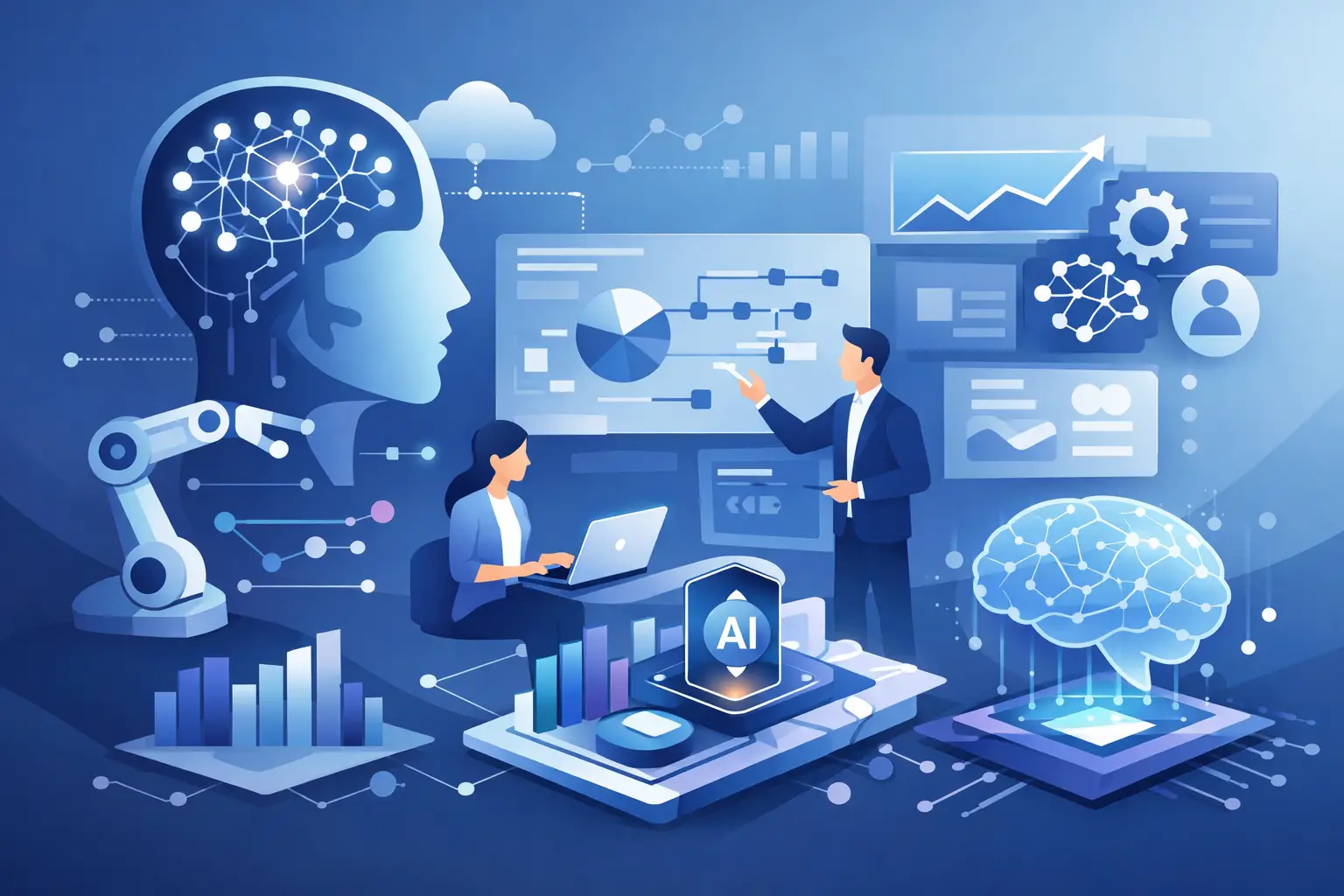
A support team spending hours each day locating contract clauses, checking account history, and drafting replies does not need a chatbot bolted onto its help desk. It needs a system that can retrieve approved information, apply business rules, create the right ticket updates, and route exceptions to a person. That is the practical standard for ai first application development: AI is designed into the operating workflow from the start, not added as a novelty after the core product is already built.
For operations leaders and product teams, the distinction matters. A generic AI feature can produce an impressive demo. An AI-first application can reduce handoffs, shorten cycle times, improve decision consistency, and give teams capacity to handle growth without adding the same level of overhead. Getting there requires more than a model API. It requires product architecture, reliable integrations, security controls, evaluation, and a clear definition of what the system is allowed to do.
What AI-First Application Development Actually Means
AI-first application development starts by identifying where judgment, language, documents, or unstructured data slow down a process. The application is then designed around an AI capability that supports a concrete job: classify an intake request, extract fields from a document, recommend the next action, generate a compliant draft, or execute an approved update in a connected system.
This is different from simply placing a chat interface inside an existing app. A chat interface may be useful, but it is only one interaction pattern. The value comes from the workflow behind it: which data the model can access, how it finds trustworthy context, which systems receive the output, who approves sensitive actions, and how the organization measures performance.
A claims platform, for example, might use AI to read submitted documents and prepare a structured case file. But a production-grade workflow must also validate extracted values, show source evidence, flag confidence issues, apply routing rules, and write approved records into the system of record. The application is not just generating text. It is moving work forward safely.
The Architecture Behind Production-Ready AI
An AI-first product needs a conventional software foundation as much as it needs model intelligence. That foundation is what turns a useful response into a dependable business outcome.
At a high level, the architecture usually includes four connected layers:
- Experience and workflow layer: The web or mobile interface where users review results, provide input, approve actions, and manage exceptions.
- AI orchestration layer: Prompts, model selection, retrieval logic, tool calling, agent workflows, and guardrails that determine how AI completes a task.
- Business systems layer: Secure connections to CRMs, ERPs, support platforms, finance systems, document stores, and internal APIs.
- Control and observability layer: Identity management, permissions, audit logs, evaluations, monitoring, error handling, and cost controls.
The AI orchestration layer deserves particular attention. A model should not receive unrestricted access to every company record or execute arbitrary actions because a user wrote a convincing request. Production systems use scoped permissions, validated tool inputs, data filters, approval gates, and clear fallback paths. In compliance-sensitive workflows, the application should retain the inputs, source references, actions taken, and reviewer decisions needed for auditability.
Model choice is also an engineering decision, not a branding decision. A larger model may deliver stronger reasoning on ambiguous tasks but add latency and cost. A smaller model can be a better fit for high-volume classification or extraction. Some use cases require private deployment options or stricter data handling. The correct answer depends on task complexity, accuracy thresholds, throughput, regulatory requirements, and the cost of a wrong result.
Start With a Workflow, Not a Model
The fastest path to wasted AI spend is beginning with the question, “Where can we use a large language model?” A stronger starting point is, “Which recurring workflow has enough volume, friction, and measurable business impact to justify automation?”
Good candidates typically have repeatable inputs, clear outcomes, and an existing process that can be observed. Consider document-heavy onboarding, sales operations, customer support triage, underwriting preparation, invoice processing, internal knowledge requests, or compliance reviews. These workflows often combine structured records with emails, PDFs, notes, and policy documents - the kind of fragmented information that conventional rules engines handle poorly on their own.
Discovery should map the current process in detail. What triggers the work? Which systems hold the relevant data? Where do people rekey information or search for answers? What decisions require policy interpretation? Which actions can be automated, and which must remain human-approved? A useful design also identifies exceptions early. Edge cases are not an afterthought; they are where business risk usually appears.
From there, define success in operational terms. That might mean reducing average handling time by 30%, increasing first-response accuracy, cutting document review backlog, improving data completeness, or decreasing the number of manual touches per case. “Better AI” is not a business metric. A measurable change in throughput, cost, quality, or customer experience is.
Build the Smallest Useful Production Pilot
A pilot should test more than whether a model can generate a plausible answer. It should validate the end-to-end path: real inputs, controlled access to real business data, integration behavior, user review, and outcome measurement.
The smallest useful pilot focuses on one high-value workflow segment. For instance, an operations team may start with extracting required fields from a defined set of documents and creating a review queue. The first release does not need to automate every document type or make final decisions. It needs to prove that the system can achieve an acceptable accuracy level, reduce manual effort, and handle failures predictably.
This approach creates evidence before a broad rollout. It also prevents teams from hard-coding assumptions that fail when they encounter real data variation. Once the pilot demonstrates value, the application can expand into adjacent tasks, such as data validation, follow-up generation, case routing, or approved updates to downstream systems.
Human Review Is a Design Choice, Not a Failure
Leaders sometimes assume that human review means the automation is incomplete. In many business processes, it is the correct control. The question is not whether people should remain involved. The question is where their attention has the highest value.
AI can prepare a recommendation, summarize supporting evidence, and handle routine cases. A qualified employee can review low-confidence results, approve high-impact actions, and resolve exceptions. This human-in-the-loop design protects quality while still removing repetitive work from the queue.
The approval experience matters. Reviewers need to see why the system reached a result, what sources informed it, and what action will occur next. Asking employees to trust an unexplained output creates friction and encourages workarounds. Showing evidence, confidence signals, and editable fields makes the system usable in real operations.
Evaluate AI Like a Business System
Traditional QA remains essential in AI-first products, but it must be extended. Standard testing verifies authentication, APIs, interfaces, integrations, and expected workflows. AI evaluation verifies whether outputs meet the business standard across representative inputs.
A practical evaluation set should include routine cases, ambiguous cases, malformed documents, outdated information, conflicting records, and cases that should be rejected or escalated. Teams should assess accuracy, groundedness in approved sources, policy adherence, response time, and the rate of successful downstream actions. For workflows with material risk, define hard failure conditions before launch.
Monitoring continues after release because model behavior, source content, user behavior, and connected systems all change. Track task completion, override rates, exception volume, latency, cost per completed workflow, and user feedback. A rising override rate can reveal a retrieval issue, a changed policy, or a workflow assumption that no longer holds.
Where AI-First Development Creates the Most Value
The strongest opportunities sit between systems that already contain valuable information but do not work together effectively. An AI-enabled application can interpret incoming requests, gather relevant context across those systems, and coordinate the next action under defined controls.
For a growth-stage company, that may mean a sales operations assistant that qualifies inbound requests, enriches account records, and prepares follow-up drafts for review. For a service organization, it may mean support automation that finds approved answers across product documentation and customer history, then escalates exceptions with a complete summary. For a finance or insurance operation, it may mean document intake that extracts data, checks completeness, and builds an auditable review package.
These use cases create value because they combine intelligence with execution. The model does not sit beside the process. It participates in it through secure connectors, business logic, and accountable handoffs.
Choose Delivery Discipline Over AI Theater
An AI-first initiative should be judged by the same standards as any critical business system: does it integrate with the tools people actually use, protect sensitive data, perform under normal demand, handle exceptions, and produce a measurable result? If the answer is no, the project is still an experiment.
Effective delivery pairs AI engineering with full-cycle application development. Product discovery clarifies the workflow and ROI case. Architecture defines data boundaries and integration patterns. Engineering builds the interfaces, APIs, automation logic, and controls. QA tests both application behavior and model outputs. Ongoing support improves evaluation sets, workflows, and performance as the business changes.
Invatechs approaches AI this way: as working software connected to the operations that determine cost, speed, and customer experience. The goal is concrete automation, not generic AI hype.
The best first move is rarely a company-wide AI program. Choose one workflow where delay, rework, or fragmented information is already visible. Build the controls into the design, measure the result in production, and let proven operational value determine what comes next.