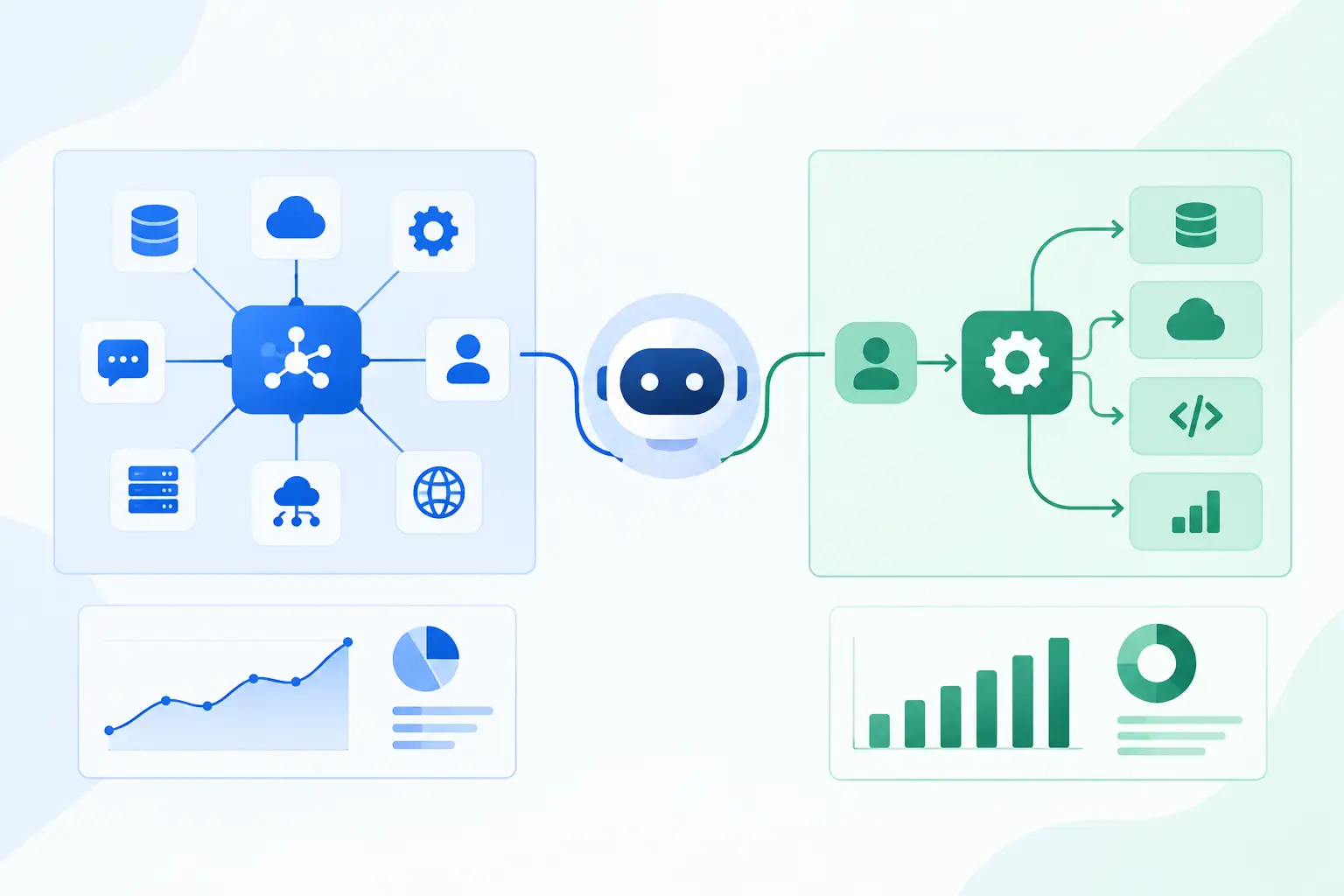
A CRM that does not update the ERP creates rework. A support platform disconnected from order data forces agents to search across tabs. An AI assistant without controlled access to business systems becomes a demo rather than an operational tool. API integration cost is the price of solving those gaps reliably, not simply writing code that sends data from one endpoint to another.
For mid-market companies, the real question is not, "What does an integration cost?" It is, "What level of reliability, security, and operational ownership does this workflow require?" A simple connection can be inexpensive. A production integration that moves financial, customer, or regulated data through critical processes needs more design, testing, and long-term care.
What determines API integration cost?
The biggest cost driver is the difference between a connection and an integration. A connection proves that two systems can exchange data. An integration defines what happens when records are incomplete, APIs are unavailable, user permissions change, a payment fails, or the same event arrives twice.
A basic integration may read data from one well-documented SaaS platform and create a record in another. A more complex implementation may synchronize customers, orders, inventory, invoices, and service cases across several systems while preserving field mappings, validation rules, audit history, and permission boundaries. These are not comparable scopes, even if both are described as "API work."
System complexity and API maturity
Modern platforms with stable REST or GraphQL APIs, clear documentation, sandbox environments, and webhooks are usually faster to integrate. Older ERPs, custom databases, legacy SOAP services, and systems with incomplete documentation require more discovery and defensive engineering.
Rate limits, pagination rules, inconsistent identifiers, and weak error responses also affect effort. If a system cannot notify another application when data changes, the team may need scheduled polling. That increases infrastructure use, creates timing trade-offs, and requires careful handling to prevent missed or duplicate updates.
Data quality and business rules
Integration projects often expose data issues that have existed for years. A customer may have different IDs in the CRM and accounting system. Product names may be free-form in one platform but controlled by a catalog in another. Required fields may be missing, or historical data may not follow current rules.
The engineering work is only part of the cost. Teams must also define the source of truth, ownership of each field, conflict-resolution rules, and exceptions that need human review. Skipping these decisions can lower the initial quote, but it typically shifts the cost into operational failures after launch.
Security, compliance, and access control
An integration that handles public product data has a different risk profile than one that accesses health information, financial records, customer conversations, or internal knowledge bases. Secure credential management, encryption, least-privilege access, audit logging, and environment separation take time because they reduce real business risk.
For compliance-sensitive workflows, the integration may need approval paths, retention controls, traceability, and role-based restrictions. AI-enabled workflows add another layer: the system must control what information an agent can retrieve, what actions it can take, and when a human must approve an outcome.
Typical API integration cost ranges
Pricing varies by delivery model, technical environment, and the level of production readiness required. Still, practical budget ranges help teams scope a conversation.
A straightforward one-way integration between two cloud tools, with limited field mapping and basic monitoring, often falls in the $5,000 to $15,000 range. Examples include sending qualified CRM leads to a marketing platform or creating a project record after a contract is signed.
A two-way integration with data normalization, business rules, retries, error handling, and quality assurance commonly ranges from $15,000 to $50,000. This is where many customer, order, finance, and operations workflows sit.
Complex, multi-system programs can range from $50,000 to $150,000 or more. These projects may involve ERP integrations, custom applications, data migration, event-driven architecture, user-facing exception management, compliance controls, and ongoing support. AI agents connected to internal systems can also fit this category when they need secure retrieval, action permissions, evaluation, and human escalation paths.
These figures are planning ranges, not fixed prices. A $10,000 integration may be the right answer for a contained workflow. It becomes the wrong answer when the process supports revenue recognition, underwriting, fulfillment, or customer commitments and requires production-grade controls.
Where integration budgets are often underestimated
The visible API call is usually the smallest part of the effort. The underestimated work is what makes the workflow dependable under normal and abnormal conditions.
Error handling is a common example. APIs time out. Tokens expire. A downstream system rejects a record because a required field changed. A reliable integration must capture the failure, retain enough context to investigate it, retry safely when appropriate, and alert the right owner. Without this design, operations teams discover problems only after customers or finance teams report them.
Testing is another area where shortcuts create expensive outcomes. A production integration should be tested against valid records, invalid records, duplicate events, partial updates, high-volume conditions, and system outages. If the workflow creates financial transactions or changes customer-facing information, business users need acceptance testing as well.
Finally, integrations require operational ownership. APIs evolve, vendors retire versions, internal processes change, and new fields get added. A project budget should account for monitoring, documentation, incident response, and planned maintenance rather than treating deployment as the finish line.
A better way to scope an API integration project
A reliable estimate starts with discovery, not a guess based on the number of applications involved. Two systems can be easy to connect and difficult to operationalize. Conversely, five systems can be manageable when the workflow is standardized and the data model is clean.
Start by defining the business event. For example: when a customer signs a proposal, create the account, provision the service, notify finance, and open the onboarding workflow. Then define the expected outcome, systems of record, data required at each step, failure scenarios, and the team responsible for exceptions.
Next, separate the first release from the full vision. A pilot can validate the highest-value path with a limited set of fields, users, or transaction types. The production plan can then add edge cases, reporting, historical synchronization, and broader automation based on evidence from the pilot. This approach controls spend without pretending that operational complexity does not exist.
Architecture choices also matter. Direct point-to-point integrations can be efficient for a small number of stable workflows. As the environment grows, an integration layer, event-driven design, or shared data services may reduce duplication and make future changes less costly. There is no universal answer. The right choice depends on how quickly systems and processes are expected to change.
How to evaluate an integration proposal
A useful proposal explains more than endpoints and hours. It should state what is included in discovery, mapping, authentication, development, testing, deployment, monitoring, documentation, and post-launch support. It should also identify assumptions, dependencies on internal stakeholders, and items that could change the estimate.
Ask how the team will handle failed transactions, duplicate records, API outages, credential rotation, and schema changes. Ask who can access data and how actions are logged. If AI is part of the workflow, ask how the system restricts tool use, evaluates output quality, and routes uncertain cases to people.
The lowest bid can be appropriate for a low-risk experiment. For a core workflow, a low estimate may indicate that security, QA, observability, or maintenance has been excluded rather than eliminated. That distinction becomes clear only when the proposal describes the operating model after launch.
Budget for the workflow, not the API call
API integration cost should be evaluated against the manual work, delays, errors, and missed visibility it removes. If an integration saves several operations employees from rekeying data, shortens fulfillment time, or prevents billing mistakes, the return can justify a more disciplined implementation.
Invatechs approaches integration as working software inside a real business process: defined data ownership, secure system access, tested failure paths, and measurable operational outcomes. That is the standard worth budgeting for when the workflow matters.
The most productive next step is to map one high-friction process from trigger to exception. Once the business rules and risks are visible, the right integration scope and investment become much easier to define.