
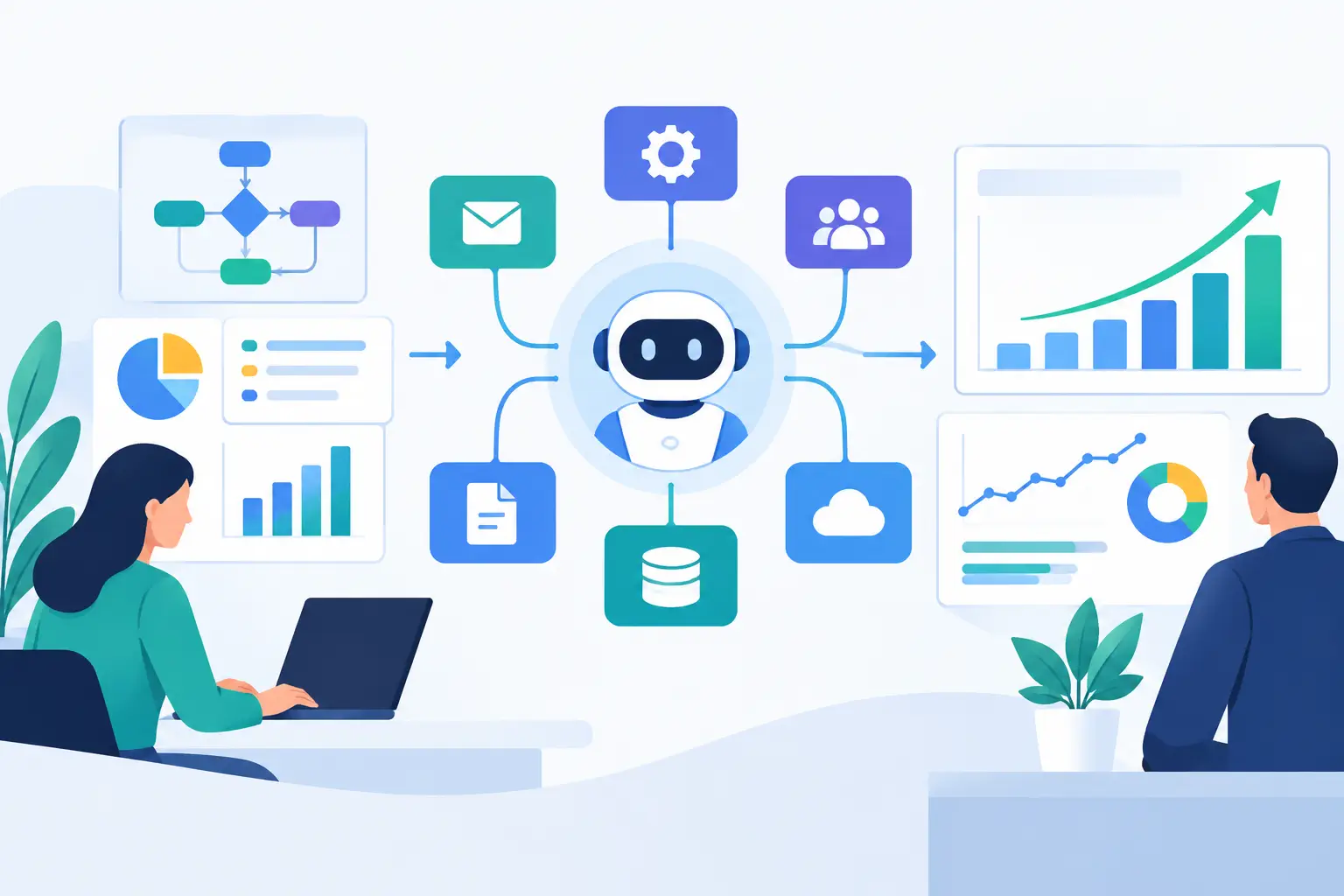
A support team that copies information across a CRM, inbox, billing platform, and internal knowledge base does not need another chatbot. It needs a controlled workflow that can read the request, gather the right context, recommend or take the next action, record what happened, and escalate exceptions. That is where agentic workflow adoption becomes commercially relevant.
The distinction matters. A conversational AI demo can produce an impressive answer from a prompt. An agentic workflow operates inside a real business process, using approved tools and data to complete bounded work. It must handle identity, permissions, system failures, uncertain inputs, audit trails, and human review. The business value comes from reducing cycle time, rework, and operational bottlenecks without creating a new layer of risk.
For mid-market companies, the goal is not to deploy an agent everywhere. It is to place reliable AI-driven execution where the process is repetitive, data is available, decisions follow recognizable patterns, and results can be measured.
What agentic workflow adoption actually changes
Traditional automation follows a fixed path: if a form is submitted, create a ticket; if an invoice reaches approval, notify finance. This remains useful and, in many processes, it is the right answer. Agentic systems add reasoning to steps that are too variable for simple rules. They can classify unstructured documents, retrieve policy guidance, determine which systems to query, draft a response, and choose among approved next actions.
That capability should not be confused with unlimited autonomy. In production, effective agents work within a defined operating boundary. They have a specific role, a limited set of tools, rules for when to stop, and a clear escalation path. For example, an underwriting assistant may collect documents, validate completeness, extract relevant facts, and prepare a recommendation. A qualified underwriter retains the authority to approve or decline a high-impact case.
This is why adoption is an operating-model decision as much as a technology decision. Teams need to determine which work can be automated, which work should be augmented, and where a human must remain accountable. The answers vary by process, risk profile, and data quality.
Start with a process, not an AI capability
Companies often begin with broad requests such as “build an AI agent for operations.” That framing is too vague to produce a dependable solution. A stronger starting point is a process with a clear cost, delay, or quality problem.
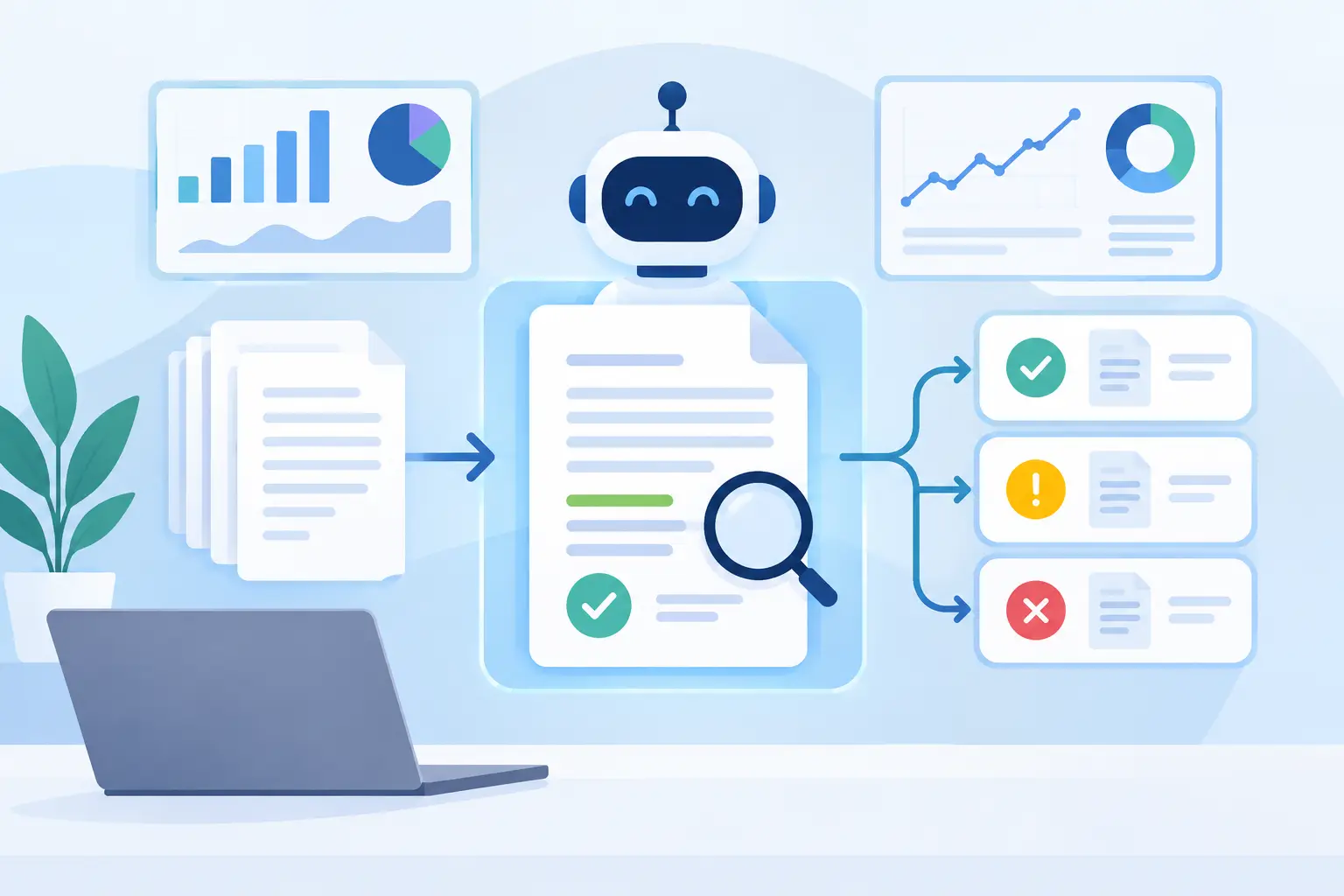
Consider a claims intake workflow. Staff may spend hours reading emails and attachments, identifying missing documents, updating a case-management system, and routing the file to the right specialist. An agentic workflow can triage the submission, extract fields, compare the file against a checklist, create system records, and request missing information using approved language. The process owner can then measure the reduction in handling time, incomplete submissions, and manual touches.
Good first candidates typically have several characteristics: meaningful volume, repeatable decisions, accessible source data, existing system interfaces, and a measurable baseline. The best process is not always the most visible one. A back-office workflow that saves 10 minutes across thousands of monthly transactions can create more value than a customer-facing experiment with unclear ownership.
Before development, document the current process in enough detail to expose friction. Identify inputs, systems of record, business rules, exception types, approval thresholds, and the people responsible for each handoff. If the existing workflow cannot be explained, an agent will not make it reliable. It may simply automate confusion faster.
Build the architecture around control
Production agents need more than a language model and a prompt. They need an integration architecture that reflects how work is actually performed.
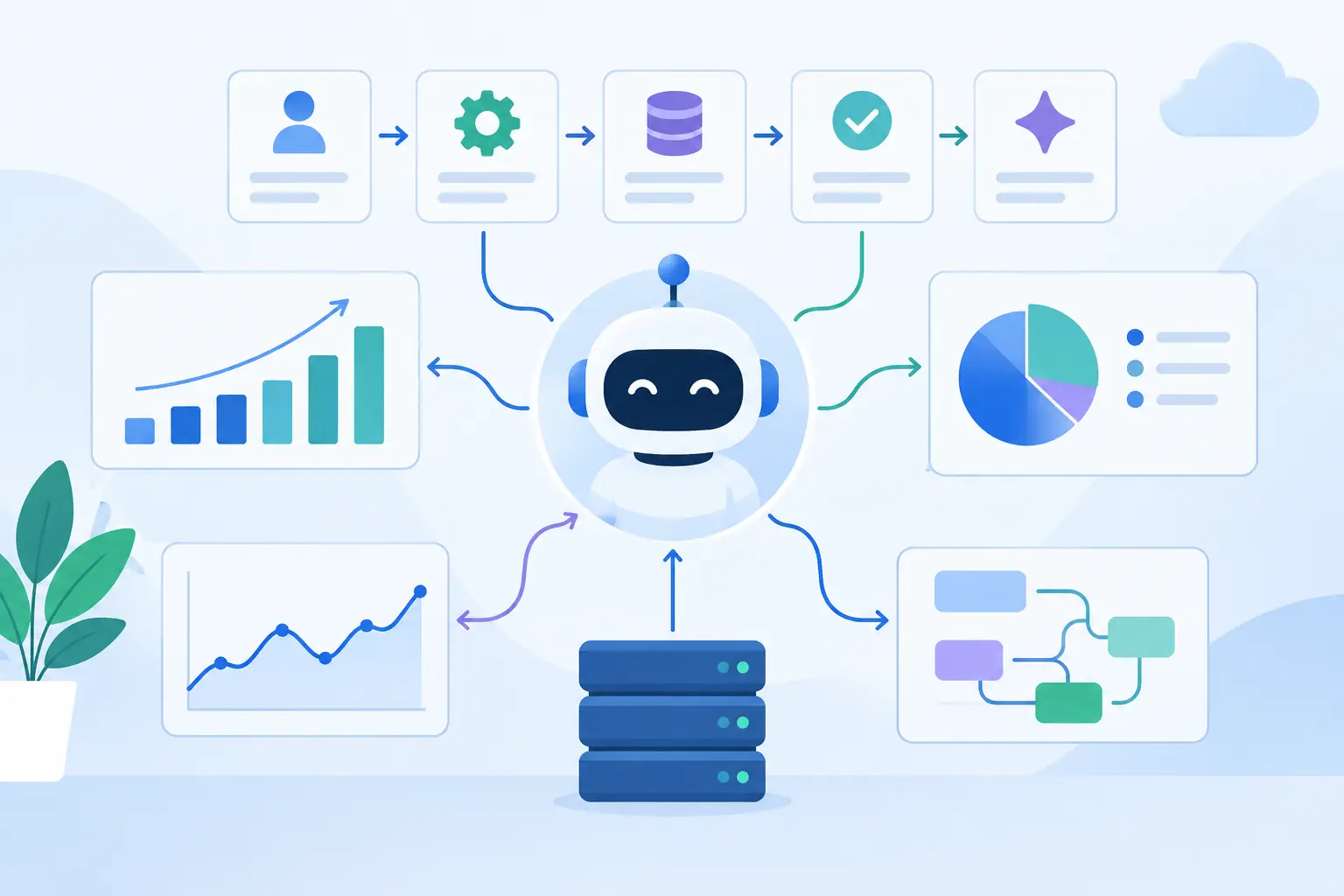
The agent should access business systems through secure, scoped connectors and APIs. It should retrieve only the data needed for the task and act only through approved functions, such as creating a ticket, updating a status, generating a draft, or submitting a request for approval. Direct database access and broad administrative permissions may accelerate a prototype, but they create avoidable security and governance exposure in production.
A practical architecture also separates deterministic work from judgment-based work. Use conventional software, workflow engines, and rules for known steps: validation, calculations, routing, deadlines, and transaction updates. Use an AI agent where the workflow requires interpretation of text, document understanding, context retrieval, or selection among permitted actions. This hybrid design is usually more accurate, less expensive, and easier to test than asking a model to manage every step.
Define action boundaries before model behavior
Every agent should have an explicit action policy. What information can it read? Which tools can it call? What dollar amount, customer impact, or compliance category requires human approval? What should happen when a source system is unavailable or confidence is low?
These decisions should be implemented in software controls, not stated only in a prompt. A prompt can guide behavior, but it is not a security boundary. Authorization, validation, rate limits, approval gates, and immutable logs belong in the surrounding application layer.
Treat observability as a core feature
When an agent takes action across systems, teams need to reconstruct what occurred. Logging should capture the request, data sources consulted, tools called, outcome, exceptions, and the identity of the approving user where applicable. Sensitive content must be handled according to retention and privacy requirements, but an absence of observability is not an acceptable trade-off.
This record supports troubleshooting, QA, compliance reviews, and continuous improvement. It also gives operations leaders the evidence needed to decide whether the workflow should gain more autonomy or remain human-supervised.
Pilot for proof, then industrialize
A narrowly designed pilot is the fastest way to validate business value. It should use representative data, connect to the systems that matter, and run against real workflow conditions. A prototype that works only with manually prepared test data rarely answers the questions that determine adoption.
Set success criteria before the pilot starts. Depending on the use case, that may include document extraction accuracy, percentage of cases completed without intervention, time to resolution, reduction in manual review, error rate, or customer response time. Also define failure criteria. If the agent cannot verify a key fact, does it route the case correctly? If it encounters conflicting policy documents, does it stop and request review?
Human-in-the-loop design is especially useful early on. Reviewers can approve proposed actions, correct outputs, and categorize failures. Their feedback should improve prompts, retrieval design, rules, interfaces, and source-data quality. The objective is not merely to increase model accuracy. It is to make the full workflow dependable.
After the pilot, production hardening begins. This includes authentication, role-based access, monitoring, load testing, retry logic, version control, evaluation suites, incident response, and maintenance plans. Organizations that skip this phase often discover that a promising agent becomes unreliable when volumes increase, systems change, or edge cases accumulate.
Common adoption failures and how to avoid them
The most common failure is automating a broken process. If ownership is unclear, knowledge is outdated, or exceptions are handled through informal workarounds, AI will expose the problem. Process redesign and data cleanup may be required before an agent can deliver consistent results.
Another failure is measuring activity instead of outcomes. Counting conversations, generated drafts, or agent calls does not show whether operations improved. Tie the program to a metric that the business already cares about: cost per case, turnaround time, conversion, first-contact resolution, error rates, or cash collection speed.
Over-autonomy is equally costly. An agent that can make unrestricted external commitments, payments, customer changes, or compliance decisions creates risk disproportionate to its value. Begin with recommendations or low-risk actions, then expand authority when logs, evaluations, and operating controls demonstrate consistent performance.
Finally, avoid treating implementation as a one-time software release. Models change, business policies change, source systems change, and users find new edge cases. Agentic workflows require monitoring and ongoing optimization just as any business-critical application does.
Make adoption a measurable capability
Agentic workflow adoption works when it is owned by both operations and technology. Operations leaders define the business outcome, process rules, and exception handling. Technical teams build secure integrations, enforce controls, test behavior, and operate the solution over time. Neither group can deliver a production-grade result alone.
A capable implementation partner can accelerate that work by combining workflow design, custom software engineering, LLM agent development, API integration, QA, and support. Invatechs approaches this as concrete automation, not generic AI hype: connect the agent to the systems where work happens, constrain its authority, and prove improvement through operational metrics.
The strongest next step is often modest: select one process where delays and manual effort are visible, define a meaningful success metric, and design the smallest controlled workflow that can move it. A reliable result in that setting gives the organization a foundation for broader adoption - and a standard every future AI initiative should meet.