
A useful AI agent is rarely limited by its ability to generate text. It is limited by what it can safely access, what actions it can take, and whether the business can trust its output. Secure AI system connectors solve that operational problem by giving AI controlled access to the systems where work actually happens - without turning sensitive data, permissions, or business logic into an unmanaged risk.
For companies operating across a CRM, ERP, support platform, document repository, finance tool, and internal database, this is the difference between a promising demo and working software. An assistant that can summarize a policy is helpful. An assistant that can retrieve the right customer record, verify authorization, create a compliant case, and log every action can change an entire workflow.
Why AI integrations fail after the prototype
Most early AI prototypes are designed around a narrow question: can the model understand a document, classify a ticket, or draft a response? That question matters, but it leaves out the harder production requirements.
A production system must determine which identity is making a request, which data that identity may access, which actions the AI is permitted to perform, and how every decision can be reviewed later. It also needs to handle source-system changes, incomplete records, API failures, rate limits, and conflicting business rules. Those are engineering problems, not prompt-writing problems.
The common failure mode is a connector built for speed rather than control. A broad service account is granted access to an entire platform. Data is pulled into an AI workflow with weak filtering. The model receives more context than it needs, and its actions are not constrained by a clear approval path. The workflow may work in a controlled test, but security, compliance, and operations teams have valid reasons to stop it before deployment.
The right approach is not to avoid AI access to business systems. It is to design the access layer as a first-class part of the architecture.
What secure AI system connectors actually do
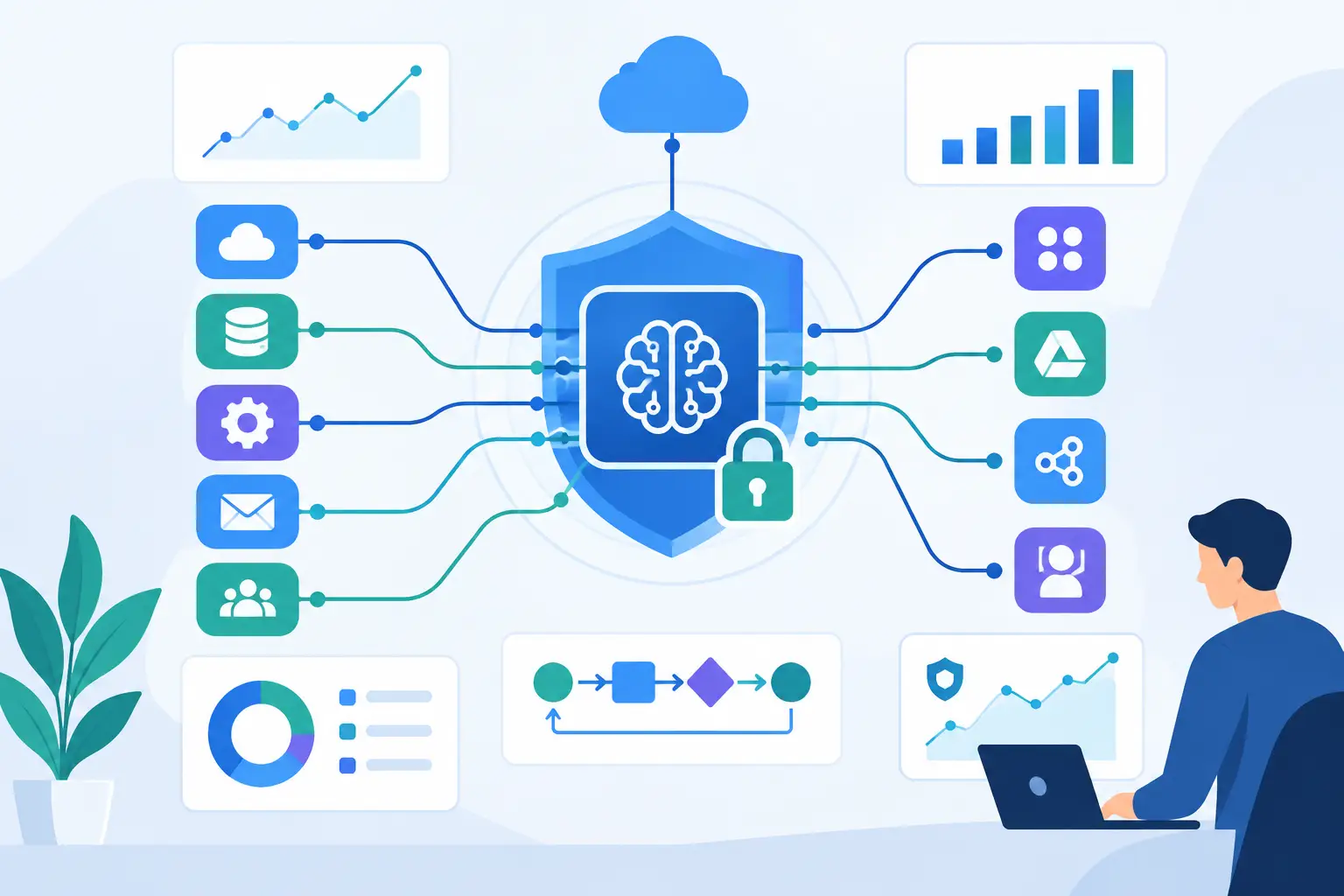
Secure AI system connectors are controlled integration layers between an AI application or agent and business systems. They retrieve approved information, execute narrowly defined actions, apply identity and permission rules, and create an audit record of what occurred.
A connector might allow an AI support agent to read a customer's open cases and order status, but not view payment details. It might let an underwriting assistant extract data from a submitted application and prepare a recommendation, while requiring a human approver before changing a policy status. It might search an internal knowledge base only within the documents available to the requesting employee.
The connector is not simply an API wrapper. It is where organizations encode the rules that determine whether an AI workflow is safe enough to operate. That includes data boundaries, action limits, validation requirements, logging standards, and error handling.
This design matters because models are probabilistic. A model can select the wrong tool, request an unnecessary field, or interpret an ambiguous instruction incorrectly. The integration layer must assume those outcomes are possible and limit their impact.
The controls that make an AI connector production-ready
Security is not one feature. It is a set of controls that work together across the application, connector, source system, and operational process.
Identity and least-privilege access
Every connector needs a clear identity model. In some cases, the AI acts on behalf of a signed-in user and inherits that user's permissions. In others, it operates as a service with a narrowly defined role. The correct pattern depends on the workflow, but broad, permanent access should be the exception.
Least privilege means providing only the permissions required for a specific task. If an agent needs to check invoice status, it should not have authority to edit vendor records or export the full accounts-payable ledger. Scoped tokens, role-based permissions, short-lived credentials, and environment separation reduce exposure if a credential is misused or a workflow behaves unexpectedly.
Data minimization and retrieval boundaries
AI systems do not need unrestricted access to create business value. In many workflows, they need only a small subset of records and fields.
A well-designed connector filters data before it reaches the model. It can limit results by account, case, region, document classification, date range, or user role. It can redact sensitive fields and return a business-safe view of a record instead of the raw source object. This reduces risk, improves relevance, and can lower processing costs.
Data minimization is especially important in healthcare, financial services, insurance, legal operations, and any business with contractual confidentiality obligations. The question is not whether an AI model can process the information. The question is whether that information is necessary for the decision or action at hand.
Controlled actions and human approval
Read access and write access are different risk categories. An AI agent that searches a knowledge base has a different risk profile than one that approves refunds, changes inventory levels, sends external communications, or updates a customer contract.
High-impact actions should be constrained by rules outside the model. A connector can require structured inputs, validate the requested action against policy, enforce spending limits, and route specific actions to a human approval queue. It can also distinguish between preparing a draft and executing a final change.
Not every workflow needs a person in the loop. Requiring approval for a low-risk status update can erase the efficiency benefit. But when an action affects money, compliance status, customer commitments, or regulated data, an approval step is often the sensible trade-off.
Auditability and traceable decisions
When an AI system touches core business processes, teams need to answer basic questions quickly: What data did it access? Which tools did it call? What action did it take? Who approved it? Which version of the workflow was running?
An audit trail should capture the event sequence without unnecessarily storing sensitive model context. The goal is operational traceability, not indiscriminate logging. Teams need enough evidence to investigate an incident, explain an outcome, improve a workflow, and meet internal or external review requirements.
This is also where mature delivery discipline matters. Logging standards, error monitoring, test cases, release controls, and incident procedures are not secondary work. They are what make an AI integration maintainable after it enters production.
Architecture choices depend on the workflow
There is no single connector architecture that fits every company. A customer-service assistant may need real-time access to a CRM and ticketing platform. A finance workflow may use scheduled synchronization into a controlled data layer to avoid placing direct pressure on an accounting system. A document-processing agent may retrieve data through a dedicated service that applies classification and retention policies before a model sees the file.
Direct API connections can provide current data and fast results, but they require careful rate-limit management, availability planning, and permission design. Middleware or an integration service can centralize business rules and make multiple downstream systems easier to manage, but it adds another component to own and monitor. Replicated data can improve performance and isolate production systems, but it introduces synchronization and freshness concerns.
The right decision depends on the required response time, system criticality, data sensitivity, source-system capabilities, and cost of an incorrect result. Architecture should follow the operational use case, not a vendor feature list.
Build connectors around business tasks, not generic access
The strongest AI integrations expose specific business capabilities rather than giving an agent a broad menu of raw endpoints. Instead of allowing unrestricted CRM queries, create functions such as `get_customer_case_context`, `find_eligible_accounts`, or `create_support_follow_up`. Instead of giving an agent access to every ERP operation, expose `check_purchase_order_status` or `prepare_inventory_exception_review`.
This approach improves reliability because the model has clearer tools to choose from. It improves security because each tool has a narrow permission boundary. It also makes QA more practical. Teams can test expected inputs, invalid requests, authorization failures, and edge cases for a defined function.
At Invatechs, this is the production mindset behind AI integration work: connect AI to the work that creates value, then engineer the controls needed for that work to run reliably. Concrete automation, not generic AI hype.
A practical delivery path for secure connectors
A sound implementation usually starts with process discovery, not model selection. Identify the manual bottleneck, the systems involved, the decision points, the data classifications, and the measurable outcome. A support workflow might target reduced handling time. An operations workflow might target fewer handoffs and faster exception resolution. An underwriting workflow might target more consistent document review.
Next, define the minimum viable access model. Decide which records and fields are required, which actions are permitted, which users can initiate the workflow, and where human approval is necessary. This is also the point to involve security, compliance, and system owners. Waiting until the pilot is complete creates rework and slows deployment.
Then build a focused pilot with production-grade habits. Use real authorization patterns, structured tool inputs, test data where appropriate, monitoring, and clear failure behavior. A pilot should prove more than model quality. It should show that the workflow can operate safely inside the company's environment.
After deployment, review usage patterns and exceptions. The first version often reveals missing business rules, confusing source data, or approval thresholds that are too strict or too loose. Ongoing optimization is expected. The connector layer should be designed to evolve as systems, policies, and workflows change.
The real measure of success
A secure connector is successful when people stop treating the AI workflow as a separate experiment. It becomes part of the operating model: handling routine work, surfacing the right context, enforcing process rules, and escalating exceptions to the right person.
That outcome requires more than an AI model and an API key. It requires architecture that respects the systems of record, controls that fit the risk, and engineering that holds up after the first impressive demonstration. Start with one high-value workflow, define its boundaries precisely, and build the connection your business can trust to run every day.