An AI assistant that can answer questions from a policy document is useful. An assistant that can retrieve an account record, validate approval rules, create a case, and leave an auditable trail can change how a business operates. That is where the MCP vs function calling decision becomes an architecture question, not a model feature comparison.
Both approaches let large language models interact with software beyond the chat window. Both can power capable agents. The practical difference is how your organization defines, exposes, governs, and reuses those integrations as AI moves from a pilot into production.
MCP vs Function Calling: The Core Difference
Function calling is a capability offered by many AI model providers. An application gives the model a defined set of tools, usually described with a name, a purpose, and an input schema. When the model determines that a tool is needed, it returns a structured request. Your application validates that request, calls the relevant API or internal service, and sends the result back to the model.
For example, a support copilot may receive functions named `get_customer`, `search_open_cases`, and `create_follow_up_task`. The model selects a function and fills in its arguments. The application remains responsible for authentication, validation, execution, error handling, and the final user-facing outcome.
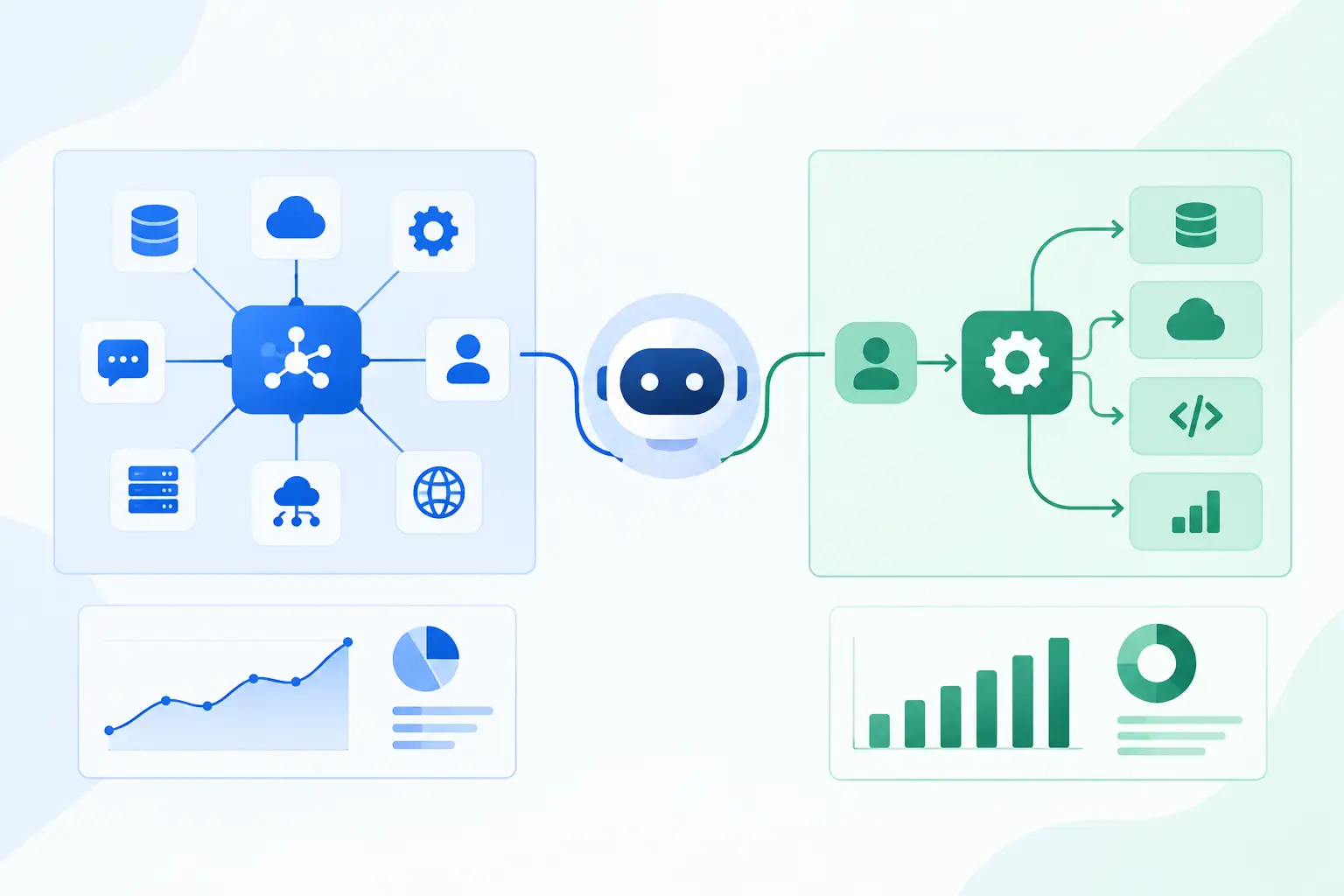
Model Context Protocol, or MCP, is a protocol for connecting AI clients to external tools, resources, and prompt capabilities through standardized servers. Rather than defining every tool directly inside each AI application, teams can expose approved capabilities through an MCP server. An MCP-compatible client can discover and use those capabilities through the protocol.
The distinction is straightforward: function calling is generally an application-level pattern for a model to request an action. MCP is an integration standard that can package and expose capabilities for multiple AI clients. They are not mutually exclusive. In many production designs, an AI client uses MCP to discover tools, while the model uses function-calling behavior to choose and invoke them.
Where Function Calling Is the Better Fit
Function calling is often the right choice when the workflow is narrow, controlled, and owned by one application team. It minimizes moving parts. If a product needs an AI feature that checks order status, creates a draft response, or retrieves data from one internal API, directly registering a small set of functions can be fast and effective.
It also gives product teams precise control over the experience. The application can expose only the functions relevant to a specific screen, user role, or workflow stage. A claims analyst should not see the same operational actions as a billing administrator, even if both use the same underlying model.
This approach works particularly well when tool definitions are stable and the product already has a mature backend service layer. The AI orchestration layer can call existing services instead of introducing another integration surface.
The trade-off appears as use cases expand. Tool definitions may become duplicated across products, agents, and teams. Authentication logic can drift. One assistant may interpret customer records differently from another because each has its own wrapper around the same CRM endpoint. Governance becomes harder when integrations are embedded in several codebases and prompts.
Function calling is not less secure by default. It becomes difficult to manage when organizations treat it as a shortcut around software architecture. Every requested action still needs server-side authorization, schema validation, idempotency controls, logging, and business-rule enforcement.
Where MCP Creates Operational Leverage
MCP is most valuable when AI capabilities need to be shared across multiple clients, agents, or workflows. Consider a company with an internal operations assistant, a customer support copilot, and a product-embedded AI experience. All three may need access to selected CRM records, document repositories, ERP data, and workflow actions.
Without a shared integration layer, each experience can create its own connectors. That produces repeated engineering work and inconsistent behavior. With a well-designed MCP server, teams can expose approved business capabilities once and make them available to authorized AI clients under a common contract.
That does not mean exposing raw access to every system. A production MCP server should represent business-safe operations, not simply mirror every database table or vendor API endpoint. For instance, `get_account_health_summary` is usually safer and more useful than unrestricted access to all CRM objects. `submit_invoice_for_review` is preferable to a generic write operation against a finance platform.
This design keeps domain rules close to the integration layer. The server can enforce permission checks, filter sensitive fields, apply tenant boundaries, require approval for consequential actions, and produce consistent audit events. It can also isolate changes in external APIs so AI applications do not all need to be updated at once.
For operationally complex companies, that reuse is the central MCP benefit. It turns isolated AI experiments into governed access to the systems where work actually happens.
The Security Question Is More Important Than the Protocol
Neither MCP nor function calling makes an AI system safe on its own. The main risk is giving a probabilistic system broad authority over deterministic business processes without enough control around it.
A model should not be trusted to decide whether it is authorized to approve a payment, change a customer’s contract terms, or access protected records. Those decisions belong in application logic and policy enforcement layers. The model can propose an action, collect information, and select from approved tools. Your systems must determine whether the action is permitted and whether it requires human review.
For both architectures, production controls should include least-privilege credentials, user and tenant identity propagation, strict input schemas, output filtering, rate limits, audit logging, and clear handling for failed or repeated requests. Write operations need additional safeguards. Use confirmation steps for high-impact actions, idempotency keys to prevent duplicates, and workflow states that make approvals visible.
MCP adds a specific governance responsibility: server selection and tool discovery. Teams need a trusted registry or controlled deployment path for MCP servers. An AI client should not connect to an unknown server simply because it advertises useful tools. Treat MCP servers as production integration services, subject to code review, security testing, version management, monitoring, and ownership standards.
Choose Based on the Operating Model
The right decision depends less on the number of tools and more on how your organization plans to operate AI.
Use direct function calling when a single product team owns a bounded workflow, the available actions are few, and the integration logic is unlikely to be reused elsewhere. It is a practical path for targeted automation and early product features.
Use MCP when several AI clients need access to the same controlled capabilities, when you want integrations to be discoverable under a shared standard, or when business systems require a formal governance boundary. It is especially relevant for organizations building an internal AI platform rather than a single assistant.
A hybrid architecture is often the most sensible answer. An application can maintain direct function calls for experience-specific actions while using MCP servers for shared enterprise capabilities such as knowledge retrieval, CRM access, document processing, or workflow initiation. This prevents a central platform from becoming a bottleneck while reducing duplicated connectors.
Design Tools Around Business Outcomes
The quality of an AI integration is determined by the tool contract, not by whether it uses MCP or function calling. Poorly designed tools force the model to make too many decisions, expose unnecessary data, and create ambiguous failure modes.
Start with a defined operational outcome. If the goal is to reduce support handling time, identify the smallest useful actions: retrieve customer context, search relevant policy guidance, draft a response, and create an escalation when confidence is low. Each tool should have a narrow purpose, explicit inputs, predictable outputs, and meaningful error messages.
Avoid tools that ask the model to assemble complicated internal identifiers, construct unrestricted queries, or infer critical policy rules from prose. Put those rules into services that can be tested. The model is effective at interpreting language and coordinating steps. It is not a replacement for authorization logic, accounting controls, or deterministic workflow engines.
Testing must reflect real operating conditions. Evaluate incorrect user requests, partial records, stale data, permission failures, API timeouts, duplicate submissions, and prompt injection attempts. Measure more than response quality. Track completion rate, escalation rate, time saved, error rate, tool failure rate, and the business impact of the completed workflow.
Build for Change, Not Just the Demo
AI integration architecture will change as models, vendors, and internal systems evolve. The objective is not to predict every standard winner. It is to prevent your automation program from becoming dependent on fragile prompts and one-off connectors.
Keep business logic behind stable services. Define ownership for each tool and connector. Version interfaces deliberately. Separate read access from write authority. Maintain observability from user request through model decision, tool invocation, downstream system response, and final outcome.
For companies moving beyond isolated AI features, MCP can provide a useful standardization layer. Function calling remains an efficient execution mechanism inside applications. The better choice is the one that lets your team ship concrete automation while retaining control over data, decisions, and operational risk.
Start with one workflow where delay, rework, or fragmented information has a measurable cost. Build the smallest governed integration that can improve it, then use the results to decide which capabilities deserve to become shared infrastructure.