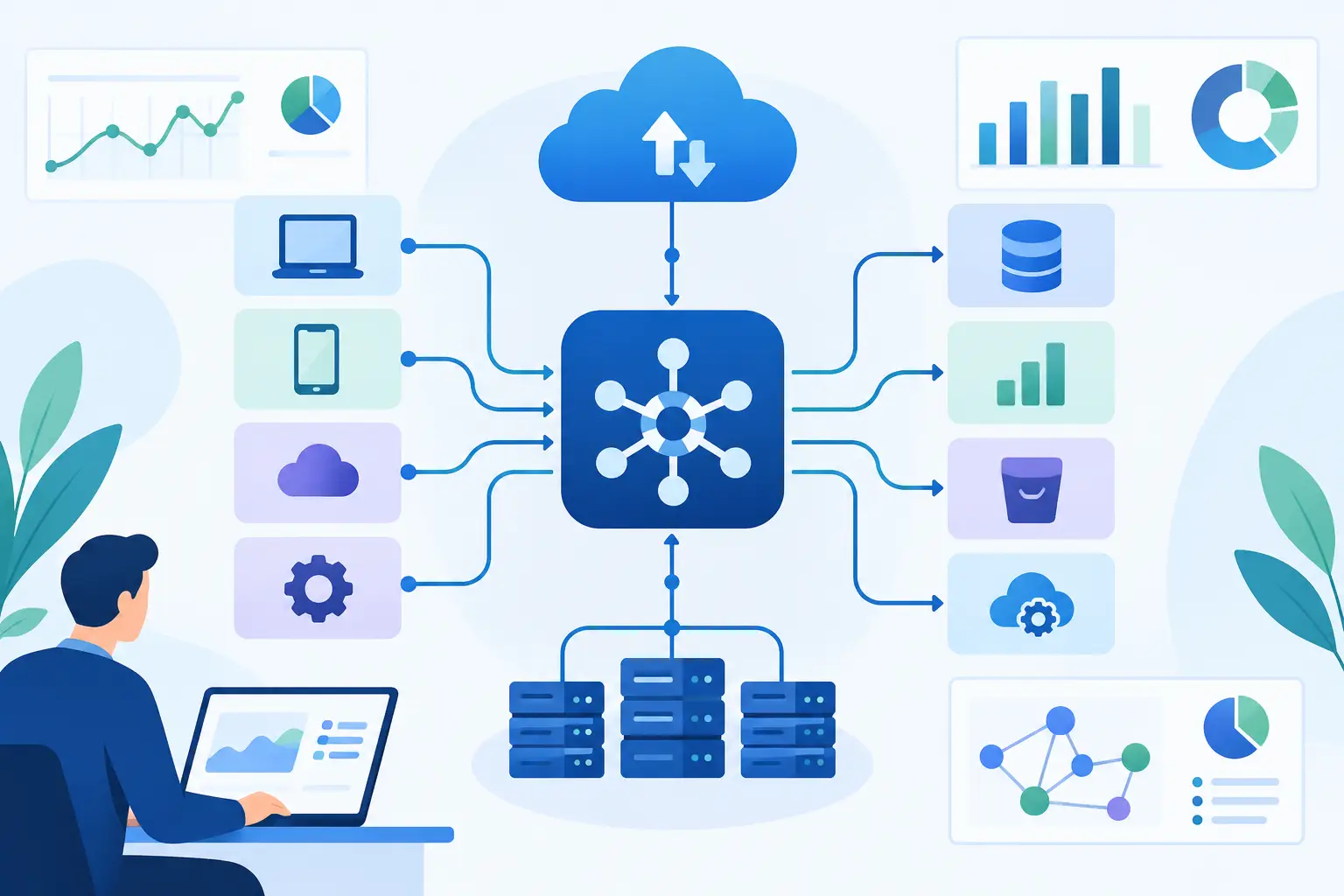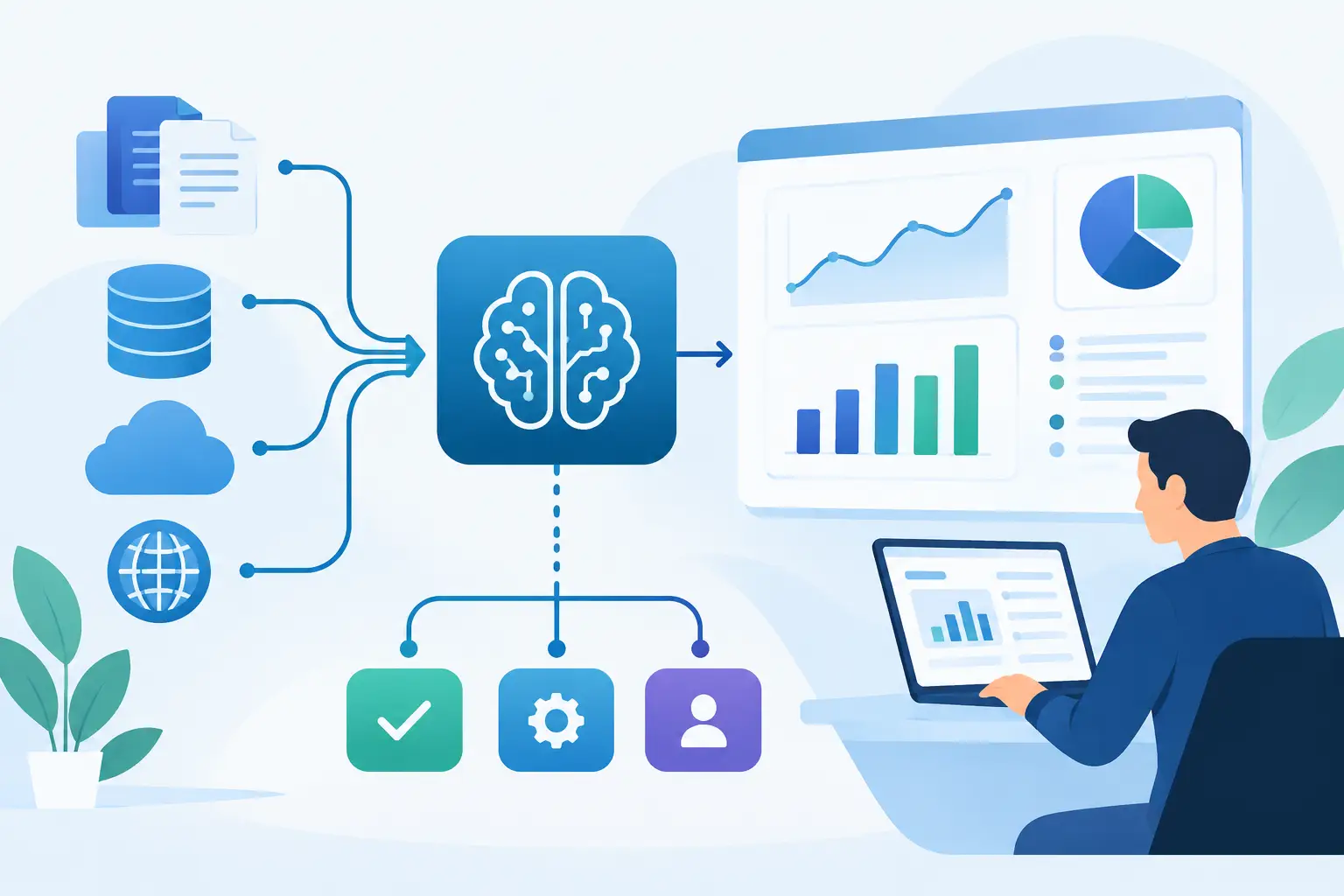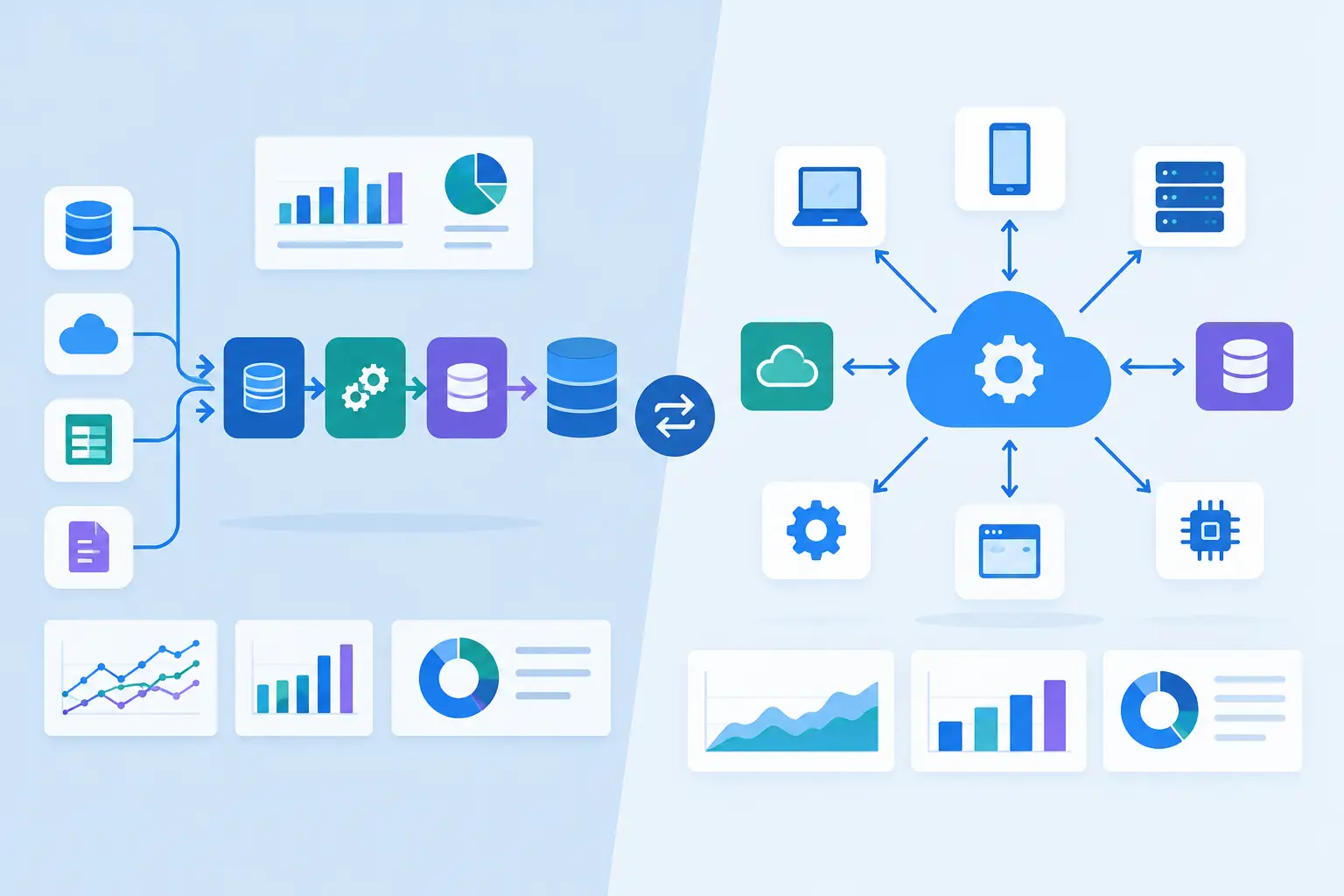
A sales team updates a CRM, an order enters an ERP, and a support ticket signals a possible churn risk. The question is not whether these systems should share data. It is how quickly, how consistently, and for what operational purpose. ETL vs API integration is the architectural decision behind that answer.
Teams often frame the choice as a technical preference: data pipelines versus APIs. That is too narrow. The right approach depends on whether the business needs trusted historical analysis, immediate operational action, or both. Choosing poorly creates delayed workflows, inconsistent records, fragile automations, and expensive rework when volume grows.
ETL vs API Integration: the Core Difference
ETL stands for extract, transform, and load. It collects data from one or more source systems, standardizes or enriches it, then loads it into a destination such as a data warehouse, lakehouse, reporting database, or analytics platform. ETL is designed to produce a consistent data layer for reporting, modeling, auditing, and large-scale analysis.
API integration connects applications through defined interfaces. One system requests, sends, updates, or receives information from another system through an API. The connection may be synchronous, where the calling application waits for a response, or event-driven, where an action such as a new order triggers a downstream workflow.
The simplest distinction is this: ETL prepares data for analysis, while API integration enables systems to act on data. There is overlap, but the primary job is different.
A finance team that needs a consolidated month-end revenue view usually needs ETL. A claims platform that must create a case in a CRM as soon as underwriting approves it usually needs API integration. A mature operation often needs both, with shared data definitions and clear ownership rules.
When ETL Is the Better Architecture
ETL is effective when data must be collected from multiple systems, cleaned, reconciled, and made reliable enough for decision-making. This is common when operational tools were introduced at different times and use different identifiers, formats, or business rules.
Consider a company with customer records in a CRM, billing details in an accounting platform, product events in an application database, and support history in a help desk. Executives want one view of retention, revenue, support demand, and product usage. Passing API calls between each system will not create a trustworthy analytical model on its own. The business needs transformation logic that can resolve duplicates, normalize timestamps, calculate metrics, and preserve historical changes.
ETL is also appropriate when real-time updates are unnecessary. Daily, hourly, or scheduled loads are often sufficient for executive dashboards, financial reporting, cohort analysis, forecasting, and compliance reporting. Batch processing can be simpler to control and less expensive at scale than continuous point-to-point synchronization.
That does not mean ETL is automatically safer. A pipeline can quietly produce misleading reports if source schemas change, records arrive late, or transformation logic is undocumented. Production ETL requires data quality checks, lineage, monitoring, alerting, retry behavior, and reconciliation against source systems. If a revenue report drives decisions, it needs engineering discipline equal to any customer-facing application.
When API Integration Is the Better Architecture
API integration is the right fit when a business process needs an immediate response. A customer submits a form, a payment clears, a document is approved, or an inventory threshold is reached. The next system must know now, not after the overnight data load.
For example, a B2B services company may receive signed agreements through its contract platform. An API-driven workflow can validate the account, create the project in an internal operations system, provision access, notify the delivery team, and record the event in the CRM. That is concrete automation, not generic AI hype.
API integrations are also better for targeted interactions. An application may need the current credit status of one account, the availability of one product, or the latest support case for one customer. Pulling an entire dataset through an ETL pipeline to answer a single transaction-time question adds delay and complexity.
The trade-off is that APIs are constrained by the systems they connect. Rate limits, authentication requirements, pagination, version changes, incomplete webhooks, and intermittent provider failures all affect reliability. A workflow that looks straightforward in a diagram can fail in production when a third-party API returns a partial response or times out during peak volume.
For that reason, operational integrations need idempotency, meaning repeated requests do not create duplicate outcomes. They also need durable event handling, retries with sensible backoff, dead-letter queues for failed messages, observability, and an audit trail. In compliance-sensitive workflows, the integration must also control who can access data, what is transmitted, and how exceptions are reviewed.
The Real Decision: Latency, Data Shape, and Business Risk
The most useful question is not, “Should we use ETL or APIs?” Ask what failure would cost the business.
If a dashboard is delayed by two hours, that may be acceptable. If a newly approved customer cannot be provisioned for two hours, revenue and customer experience may suffer. If a finance report contains duplicate invoices, the issue may affect forecasting. If an API update creates duplicate invoices, it may affect cash collection and customer trust.
Use these four factors to frame the decision:
- Latency requirement: ETL is often scheduled or micro-batched. APIs and event streams support near-real-time action when the source system can publish or expose changes.
- Data volume and history: ETL handles broad datasets, historical records, and analytical transformations well. APIs work best for focused requests and operational transactions.
- Transformation complexity: ETL is stronger when data must be joined, standardized, deduplicated, and modeled across sources. APIs can transform payloads, but they should not become an ungoverned replacement for a data platform.
- Failure tolerance: API workflows need immediate error handling and recovery because they affect live operations. ETL needs validation and reconciliation because errors can contaminate downstream analysis.
There are exceptions. A modern change data capture pipeline can move source updates with very low latency. An API can support bulk exports for reporting. The boundary is not defined by the technology name. It is defined by the operating requirement and the controls needed to meet it.
Why Point-to-Point Integrations Break Down
Early-stage teams often connect systems directly because it is fast. The CRM sends records to the billing tool. Billing sends updates to customer success. Customer success sends data to the warehouse. This can work for a small number of workflows.
It becomes difficult to manage when each application contains its own version of customer status, lifecycle stage, or account owner. One field changes in the CRM, but a downstream mapping still expects the old format. A retry sends a second record. A support workflow uses data that finance considers invalid. The result is not simply technical debt. It is operational ambiguity.
A scalable architecture defines systems of record. It documents canonical entities such as customer, order, policy, case, and invoice. It separates transactional workflows from analytical pipelines, even when both use the same underlying data. It also establishes ownership: who approves a schema change, who monitors failures, and who resolves data conflicts.
This is where implementation experience matters. The goal is not to connect every tool to every other tool. The goal is to create dependable information flows that match how the business actually operates.
Where AI Fits Into the Integration Design
AI adds another reason to make the distinction carefully. An LLM agent that summarizes support conversations may use API integrations to read tickets, retrieve approved knowledge, create drafts, and route exceptions. But the model should not become the source of truth for customer data or financial decisions.
ETL can prepare governed datasets for analytics, evaluation, and reporting on AI performance. API integrations can place AI capabilities inside live workflows. Together, they support useful automation: classify incoming documents, extract structured fields, validate them against ERP records, route low-confidence cases to a reviewer, and write approved outcomes back to the right system.
The production requirement is control. AI outputs need validation rules, confidence thresholds, human review where risk demands it, and complete records of the action taken. An integration that merely produces a plausible answer is not enough. It must produce a traceable business outcome.
Build the Architecture Around the Workflow
Start with the business event, not the preferred technology. Define what happens, which system owns each record, how quickly the next action must occur, and what happens when a dependency fails. Then decide whether the workflow needs an API call, an event-driven process, an ETL pipeline, or a combination.
For operationally complex companies, the strongest pattern is often layered: APIs and events handle live transactions; ETL or ELT consolidates data for analysis; governance ties the two together. Invatechs approaches integrations this way because a fast connector without monitoring, security, and recovery logic is not production-ready automation.
The most valuable integration is rarely the one with the most systems attached. It is the one that removes a meaningful manual decision, preserves data trust, and continues working when the business is busy.