
A customer support agent that can read account history, a document workflow that extracts financial data, or an AI assistant connected to an ERP can create immediate operational value. Each can also expose sensitive information, make an untraceable decision, or trigger an incorrect downstream action if it is deployed without controls. This enterprise AI governance guide is for leaders who need AI to work inside real business processes, not as an isolated demonstration.
Governance is often framed as a compliance exercise that slows delivery. That is the wrong operating model. Done well, governance defines what an AI system is allowed to do, what it must never do, who is accountable for it, and how the organization can prove those controls are working. It gives product, operations, security, and engineering teams a shared path from pilot to production.
Why Enterprise AI Governance Is an Operating Requirement
Enterprise AI introduces a different class of risk from traditional software. A conventional application follows coded rules. An AI-enabled workflow may generate variable outputs, interpret ambiguous documents, retrieve incomplete knowledge, or call an external tool based on natural-language instructions. The system can be useful and still be wrong in ways that are difficult to predict from a requirements document alone.
That does not mean every AI use case needs the same approval process. A marketing copy assistant has a different risk profile from an underwriting assistant, a claims workflow, or an internal agent with access to customer records. Governance should be proportional to the potential impact of a failure.
The practical goal is controlled autonomy. Let AI handle repetitive classification, retrieval, drafting, routing, and analysis where it can save time. Keep people, deterministic business rules, and approval gates where errors could create financial loss, regulatory exposure, customer harm, or irreversible system changes.
This approach also protects ROI. When a pilot is built without clear ownership, data boundaries, success measures, or a production support plan, teams may prove that a model can produce an answer but fail to prove that the workflow improves operations. Governance turns experimentation into an accountable delivery process.
Enterprise AI Governance Guide: Start With Use Cases
Do not begin with a policy document that treats every model and tool as identical. Begin with an inventory of proposed and active AI use cases. For each one, document the business owner, users, systems involved, data types accessed, actions the system can take, and expected business result.
A useful use-case record answers direct questions: Is the AI making a recommendation or an automated decision? Can it write back to a CRM, ERP, payment platform, or ticketing system? Does it process personal data, financial information, health information, or confidential internal documents? What happens if it produces an inaccurate, biased, or incomplete result?
This inventory supports a simple risk-tiering model. Low-risk use cases may include internal drafting or summarizing non-sensitive content. Moderate-risk workflows may classify tickets, extract data from documents, or generate customer-facing replies with human review. High-risk workflows may influence pricing, eligibility, credit, employment, compliance, or financial transactions. They require stronger testing, explicit approval, tighter access controls, and more frequent monitoring.
Risk tiers should guide delivery decisions, not create a bureaucratic queue. A high-risk use case may still be worth pursuing. It simply needs an architecture that matches its consequences.
Define Decision Rights Before Building
AI governance fails when accountability is shared vaguely across departments. Security cannot own business decisions. Operations should not be expected to validate model infrastructure. Engineering cannot determine what level of customer risk is acceptable without business input.
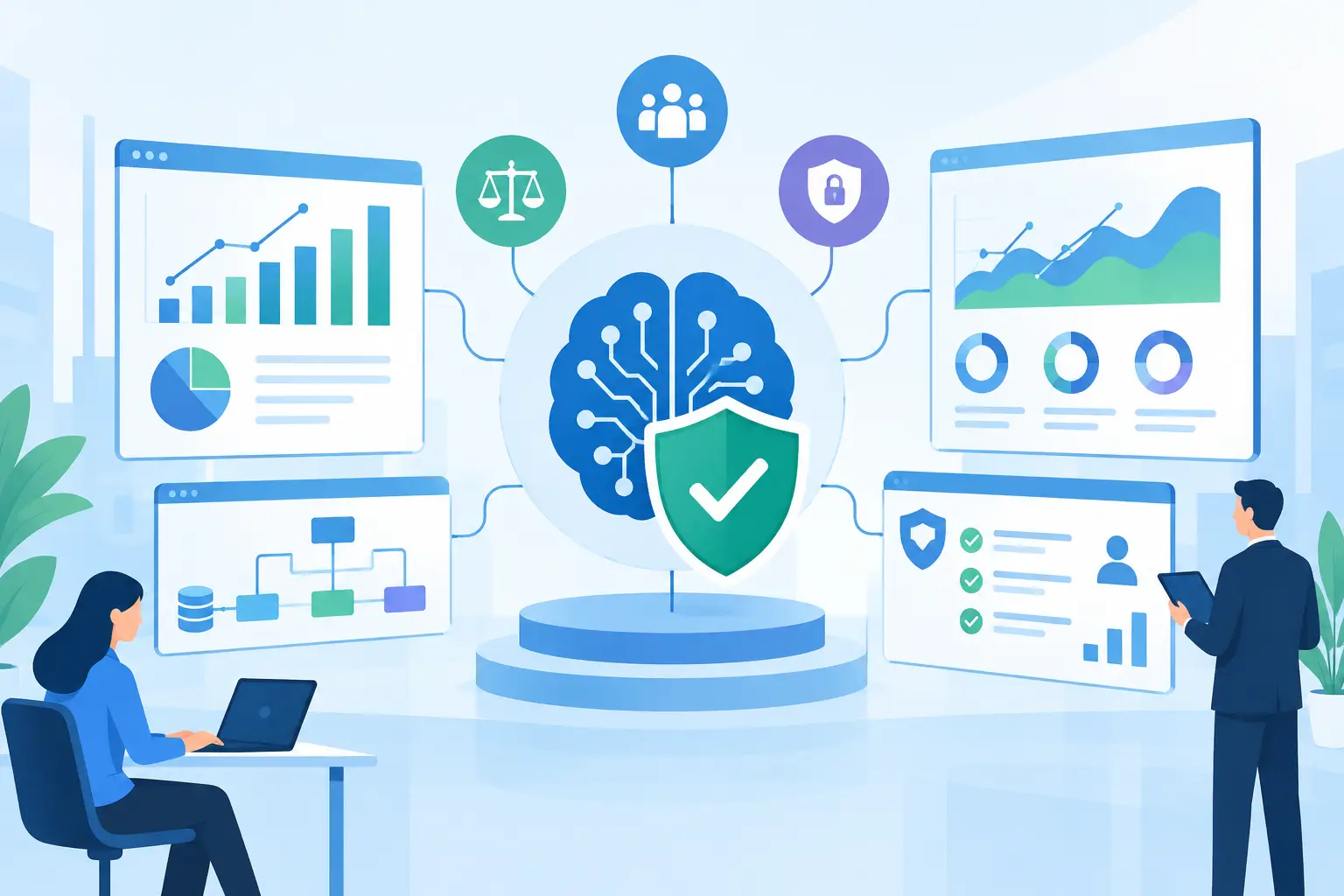
Assign clear decision rights. A business owner is accountable for the use case, measurable outcome, and acceptable operating boundaries. A product or operations lead defines the workflow and human escalation path. Engineering owns implementation, integration quality, testing, and observability. Security and privacy teams define required controls for identity, data handling, vendor review, and incident response. Legal or compliance stakeholders should be involved when the workflow falls within regulated or contractual obligations.
For material deployments, establish an approval checkpoint before production. The checkpoint should confirm that the system has a defined purpose, authorized data sources, tested failure paths, a named owner, and a plan to suspend or roll back the workflow. This is not paperwork for its own sake. It is the point where an AI feature becomes an operational service with accountable owners.
Control Data, Identity, and Tool Access
Most enterprise AI risk does not come from the model alone. It comes from what the model can see and what it can do.
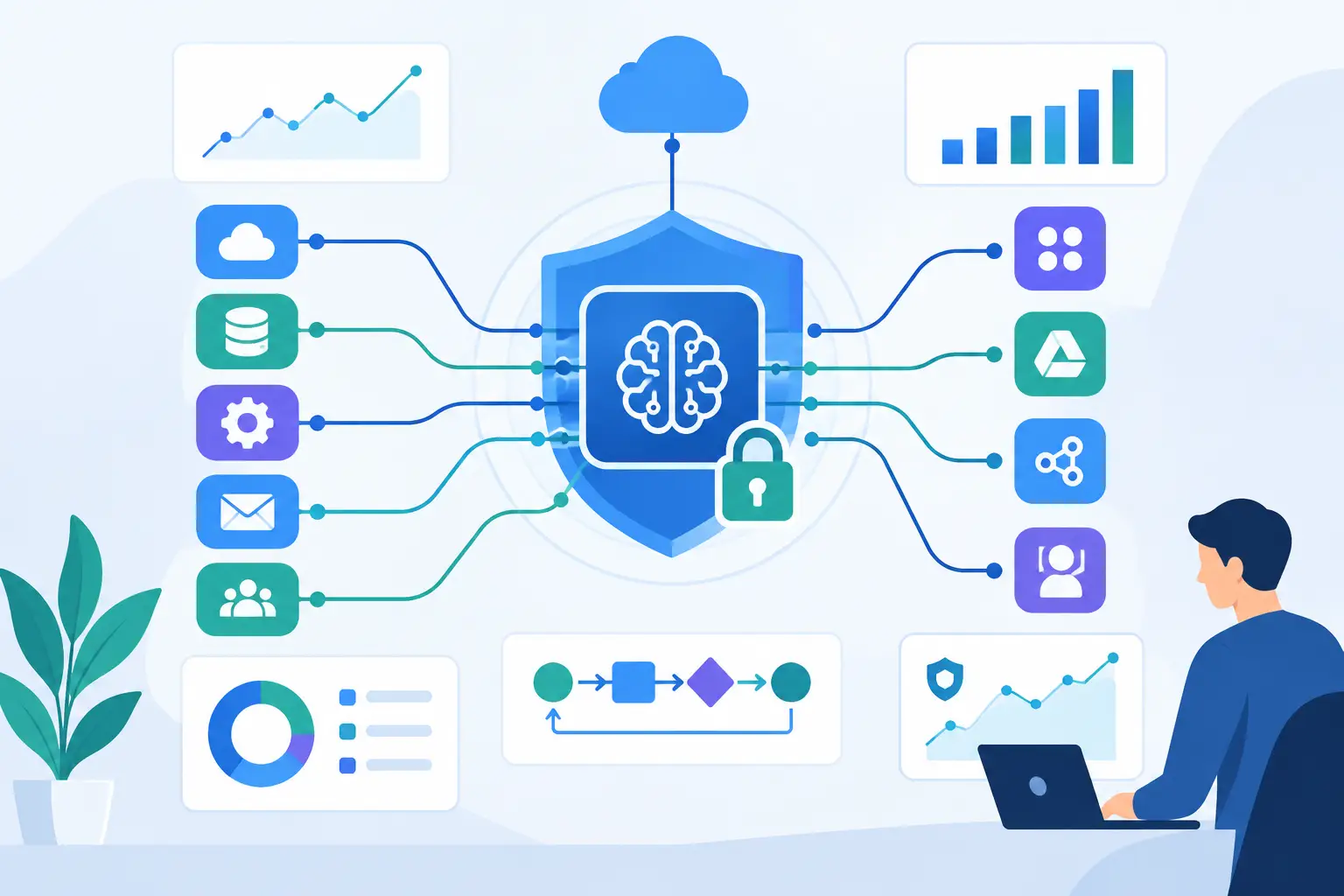
An AI assistant connected to internal knowledge should retrieve only the documents a user is already authorized to access. An agent that can update a CRM should use scoped credentials and narrowly defined actions, not broad administrative permissions. A workflow that processes documents should retain only the data needed for the task and follow existing retention requirements.
These controls require architecture, not just policy. Use role-based access, service identities, encrypted secrets management, audit logs, and environment separation between development and production. Map every connector to the systems and data it can access. Review whether prompts, uploaded files, model outputs, and telemetry are retained by external providers, and whether those terms fit your security and contractual requirements.
For AI agents, tool permissions deserve particular attention. An agent with read access can return incorrect information. An agent with write access can create operational damage. Where possible, separate analysis from execution. Have the agent prepare a recommended action, validate it against deterministic rules, and require human approval for high-impact changes. Automatic execution can make sense for repeatable, low-risk tasks, but it should be earned through testing and monitoring.
Test the Workflow, Not Only the Model
A model benchmark does not prove that an enterprise workflow is ready. Production testing should reflect the real inputs, integrations, exceptions, and business outcomes the system will encounter.
Build evaluation sets from representative documents, tickets, records, and requests. Include ordinary cases, ambiguous cases, incomplete data, adversarial prompts, and known failure patterns. Test whether the system retrieves the right source material, follows authorization boundaries, applies business rules, produces a usable output, and routes uncertain cases to the right person.
Define acceptance criteria in business terms. For a document processing workflow, that may include extraction accuracy, review rate, processing time, and correction rate. For a support agent, it may include resolution quality, containment rate, escalation accuracy, and customer satisfaction. For an internal operations assistant, it may include cycle-time reduction and the percentage of actions completed without rework.
There is a trade-off between speed and assurance. A small, contained pilot can use lighter controls if no sensitive data or irreversible actions are involved. Expanding that same pilot into a workflow connected to production systems requires stronger evaluations, logging, and approval gates. Treat the transition as a new delivery phase, not a simple configuration change.
Monitor AI as a Production Service
AI behavior can change after launch. Source data changes. Users find new ways to phrase requests. A connected API evolves. A model provider updates behavior or availability. Governance therefore needs ongoing evidence, not a one-time launch review.
Monitor technical health alongside operational outcomes. Track latency, errors, failed tool calls, model cost, retrieval quality, escalation volume, correction rates, and policy violations. Log the inputs, relevant context, outputs, tool actions, and approval decisions needed to investigate a failure, while minimizing unnecessary retention of sensitive data.
Set thresholds that trigger action. A sudden rise in human corrections may mean the source knowledge is stale. A decline in extraction accuracy may indicate a new document format. Repeated attempts to bypass instructions may require stronger input controls or narrower agent permissions. The response should be owned and documented: pause the workflow, revert to a prior version, restrict an action, or route more cases to human review.
Version control matters here. Maintain records of model versions, prompts, retrieval configurations, connectors, business rules, and evaluation results. Without this baseline, teams cannot explain why behavior changed or reproduce an issue during an audit.
Build Governance Into Delivery, Not Around It
The most effective governance model is integrated into discovery, architecture, development, QA, release, and support. During discovery, identify the process owner, risk tier, source systems, and success metrics. During architecture, define data boundaries, authentication, tool permissions, and escalation paths. During implementation, build auditability and approval controls into the workflow. During QA, test realistic edge cases. After release, monitor outcomes and improve the system against evidence.
This delivery discipline is especially valuable for organizations with fragmented systems. AI only creates lasting value when it is connected to the CRM, ERP, support platform, document repository, or internal application where work actually happens. Secure connectors and clear workflow boundaries matter as much as prompt quality.
Invatechs approaches AI implementation as production software delivery: align the use case to a measurable process, design the integration and controls, validate behavior under real conditions, and support the system after release. That is how organizations move beyond generic AI hype toward concrete automation.
The right question is not whether your organization has an AI policy. It is whether every material AI workflow has a defined purpose, accountable owner, controlled access, tested behavior, and a safe way to fail. Start there, and governance becomes the mechanism that lets useful AI reach production with confidence.