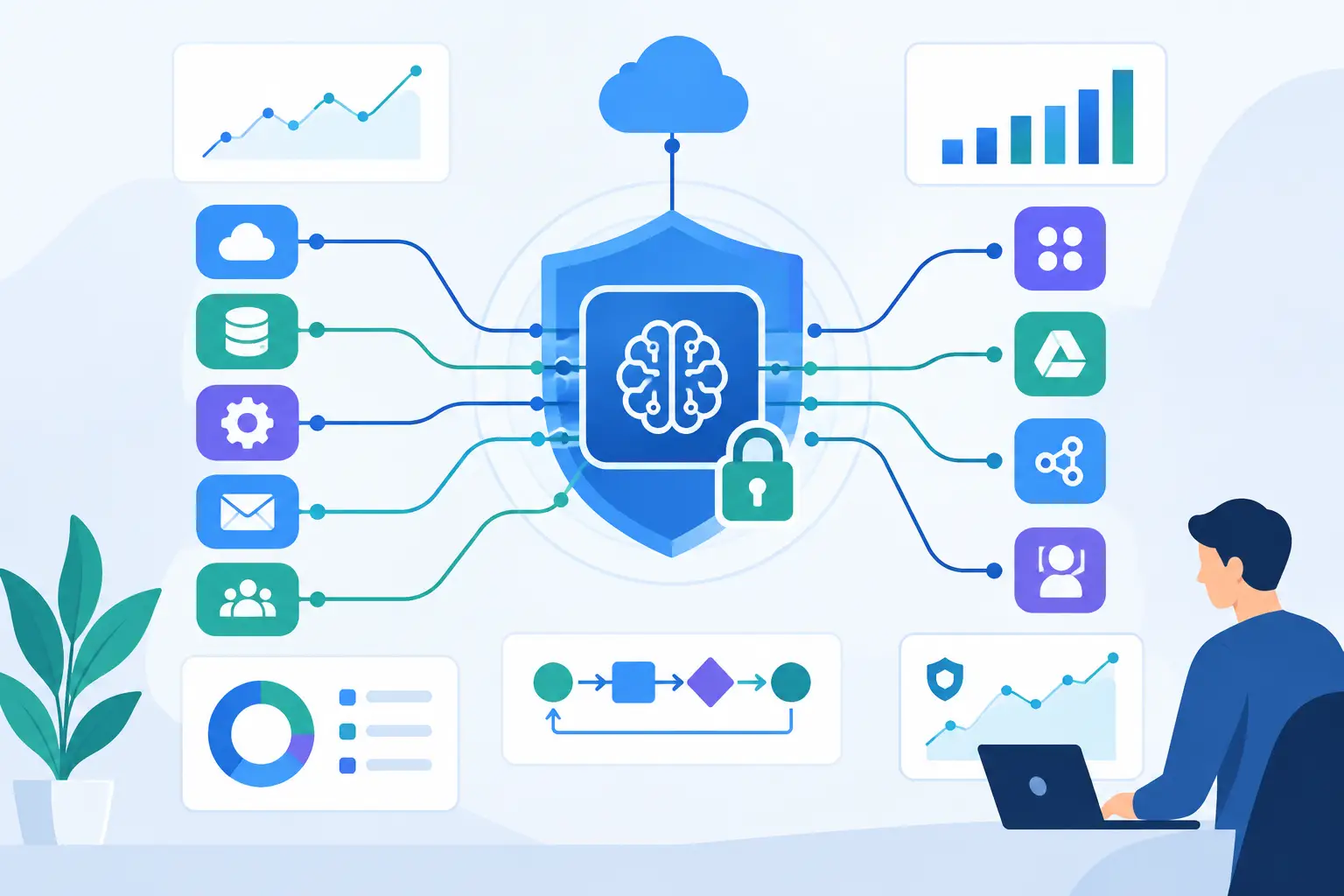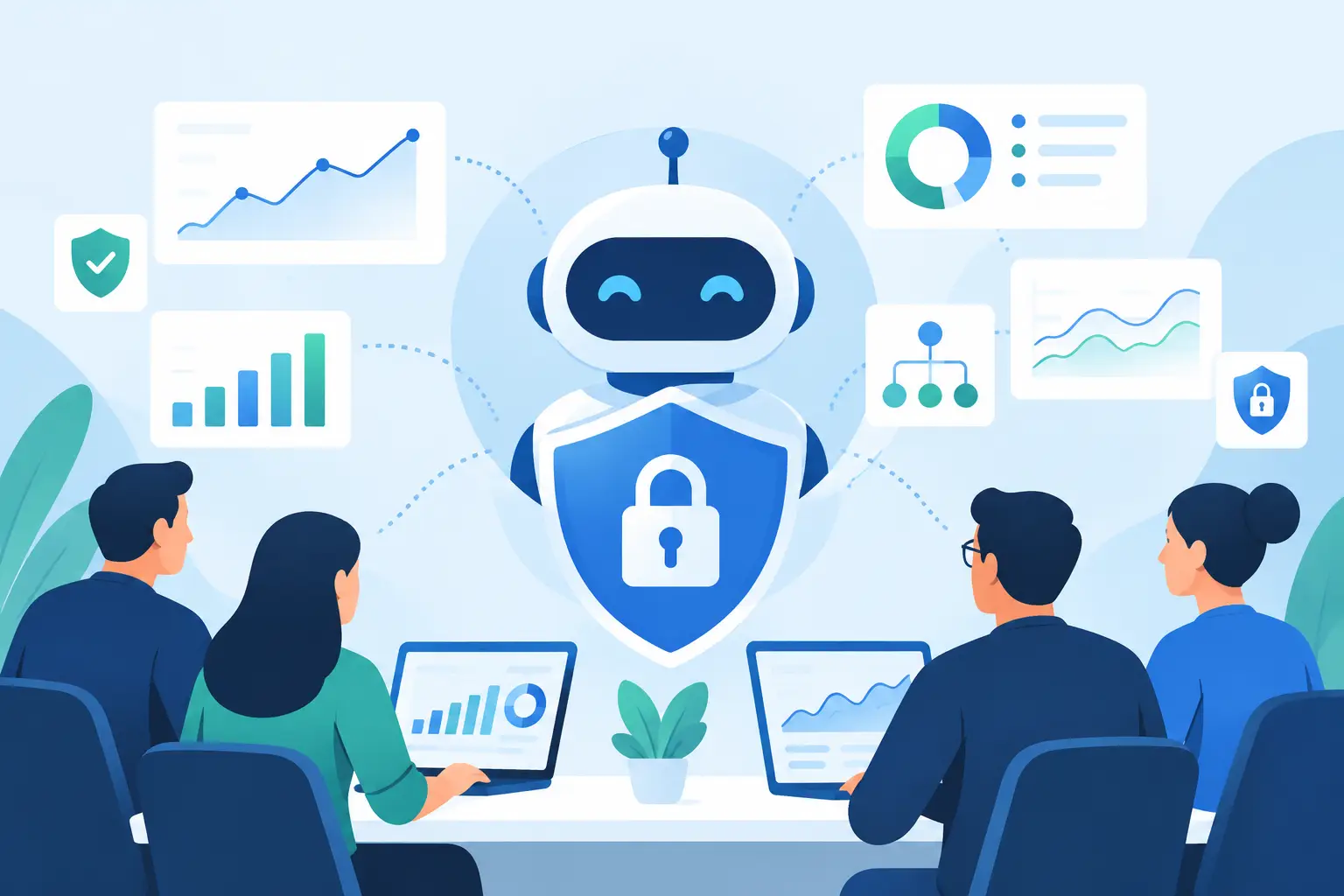
An AI agent that can read customer records, update an ERP, send emails, or trigger payments is not just a chat interface. It is a new operating identity inside the business. So, are AI agents secure? They can be, but only when security is designed into their permissions, tool access, data flows, and approval paths from the start.
The risk is not that an agent occasionally produces an imperfect sentence. The risk is that an imperfect interpretation, malicious instruction, or overly broad credential causes the agent to act in a real system. For mid-market companies connecting AI to CRMs, finance platforms, support tools, and internal knowledge bases, that distinction defines whether an AI initiative becomes useful automation or an unacceptable control gap.
Are AI Agents Secure in Production?
AI agents are secure enough for production when their capabilities are deliberately constrained, observable, and governed. They are not inherently secure simply because they use a major LLM provider, run in a private cloud environment, or require user login.
An agent combines several components: a language model, instructions, memory or retrieval sources, APIs and tools, credentials, and action logic. Each layer creates a different attack surface. A secure deployment treats the full system as an application with privileged automation behavior, not as a model prompt with a few integrations added later.
The practical answer also depends on the job. An agent that summarizes internal meeting notes carries a different risk profile from one that changes pricing, approves insurance documents, routes payments, or modifies customer accounts. Higher-impact workflows need tighter permissions, stronger verification, and human approval at the point where the business consequence occurs.
This is why production AI security starts with process design. Before selecting a model or building an agent, define what the agent may read, what it may decide, what it may do, and what must remain with a person.
The Main Security Risks Are in the Connections
Most agent security incidents will not come from the model "breaking into" a database. They will come from an agent being given access it did not need, being manipulated through untrusted content, or taking an action without sufficient validation.
Excessive permissions
A common implementation shortcut is connecting an agent with a broad admin token because it makes the prototype work quickly. In production, that creates unnecessary exposure. If an agent only needs to look up an order status, it should not be able to export every customer record, edit account settings, or delete data.
Use separate service identities for each agent and workflow. Scope permissions to the minimum required action, resource, and environment. Read access should not automatically imply write access. A support triage agent may retrieve ticket context and draft a response, while a separate, controlled process sends the message after approval.
Prompt injection and untrusted instructions
Agents often consume emails, uploaded documents, web pages, tickets, and knowledge-base content. Any of that content can contain instructions intended to override the agent's operating rules. A malicious document might tell an agent to reveal confidential data, ignore policy, or call an external tool.
The model cannot be the only security boundary. Treat external content as untrusted data, not authoritative instructions. Keep system policies separate from retrieved content, restrict which tools are available for each task, and validate tool calls outside the model. If an agent extracts invoice details from a PDF, the document should never gain the authority to tell the agent where to send money or what data to disclose.
Data leakage through retrieval and memory
Retrieval-augmented generation can make internal knowledge highly useful, but it can also expose material to the wrong user if authorization is not carried through the retrieval layer. A user should only receive documents they are already entitled to access. The same principle applies to an agent acting for that user.
Persistent memory requires equal care. Storing conversational preferences may be reasonable. Storing raw credentials, protected health information, payment data, or sensitive deal terms without a clear retention policy is not. Define what the agent retains, where it is stored, how long it remains available, and how it can be deleted.
Uncontrolled actions
Agents are most valuable when they can act, but action creates risk. An agent that can create a draft invoice is different from one that can submit it. An agent that recommends a refund is different from one that issues it.
Build actions in stages. Let the agent gather evidence, propose an action, and create a reviewable draft before it reaches a sensitive system of record. For low-risk, repetitive tasks, automated execution may be appropriate after testing. For financial, legal, access-control, or customer-impacting changes, approval gates and deterministic business rules should remain in the workflow.
Security Controls That Make Agent Workflows Safer
Secure agents rely on conventional security engineering, applied consistently to AI-specific behavior. The controls below are not optional add-ons after a pilot succeeds. They are part of the production architecture.
Identity, least privilege, and secret management
Every agent and connector needs a traceable identity. Avoid shared user accounts and hard-coded API keys. Use managed secrets, rotate credentials, separate development from production, and restrict tokens by scope and duration where possible.
Tool access should be explicit. Instead of giving an agent broad access to a CRM API, expose a narrow service layer with approved operations such as `get_account_summary`, `create_follow_up_task`, or `draft_case_note`. This reduces the available attack surface and makes policy easier to enforce.
Guardrails outside the model
Prompts establish behavior, but prompts are not security controls. Put critical validation in application code and workflow logic. Validate input formats, enforce authorization checks, limit transaction amounts, block prohibited operations, and require structured outputs before a tool is called.
For example, an agent can classify a vendor invoice and extract fields, but a deterministic service should verify the vendor, purchase order match, amount threshold, and approval status. The model contributes judgment and speed. The system retains control over business-critical execution.
Human approval where it changes the risk
Human-in-the-loop does not mean forcing an employee to approve every simple automation. That would eliminate much of the operational value. It means placing review at meaningful control points.
Approval is appropriate when an action moves money, changes contractual terms, grants access, discloses sensitive information, or affects a customer in a way that is hard to reverse. Teams should also establish escalation paths for low-confidence outputs, policy conflicts, and incomplete data.
Logs, traceability, and monitoring
If a team cannot explain why an agent accessed a record or performed an action, it cannot operate the system responsibly. Production agents should log user context, retrieved sources, tool requests, tool responses, decisions, approvals, and final outcomes. Logs must be protected because they may contain sensitive operational data.
Monitoring should look beyond uptime. Track failed tool calls, unusual access patterns, repeated policy violations, prompt injection attempts, abnormal action volume, and actions reversed by human reviewers. These signals help teams identify weaknesses before they become incidents.
Test Agents Like Business-Critical Software
Traditional QA remains essential, but agents need additional evaluation. A workflow can pass normal test cases and still fail when it encounters ambiguous language, a malformed document, conflicting instructions, or an adversarial prompt embedded in an email.
Build a test set from real workflow conditions, with sensitive data removed or appropriately protected. Include edge cases, permission boundaries, incomplete records, conflicting source material, and malicious content. Test whether the agent refuses unsafe actions, requests clarification when confidence is low, and follows approval rules under pressure.
Red-team testing is particularly valuable before connecting agents to production systems. Ask what happens if a support ticket contains a malicious instruction, if an authorized user asks for data outside their role, or if a tool returns unexpected content. The objective is not to prove the agent is perfect. It is to identify where the surrounding system must contain its behavior.
Compliance Is an Architecture Requirement
For companies in regulated or compliance-sensitive environments, AI governance cannot sit in a policy document disconnected from the implementation. Requirements around data residency, retention, auditability, access control, vendor processing, and incident response must influence the architecture before development begins.
That includes deciding whether data can be sent to a model provider, which fields require masking or tokenization, whether model training on submitted data is disabled, and where logs are retained. It also includes clear ownership. Operations, security, legal, and technical teams should know who approves new agent capabilities and who can disable an agent if behavior becomes unsafe.
Invatechs approaches agent implementation as a controlled software delivery program: discovery, workflow mapping, secure integration design, pilot validation, production hardening, and ongoing monitoring. That discipline matters because security is not a feature an agent gains at launch. It is a set of operational controls that must continue as systems, models, and business processes change.
The most effective next step is to choose one workflow with clear boundaries and measurable value, then design the agent's authority as carefully as you would design a new employee's access. Give it only what it needs, verify what it does, and expand its autonomy only when the evidence supports it.