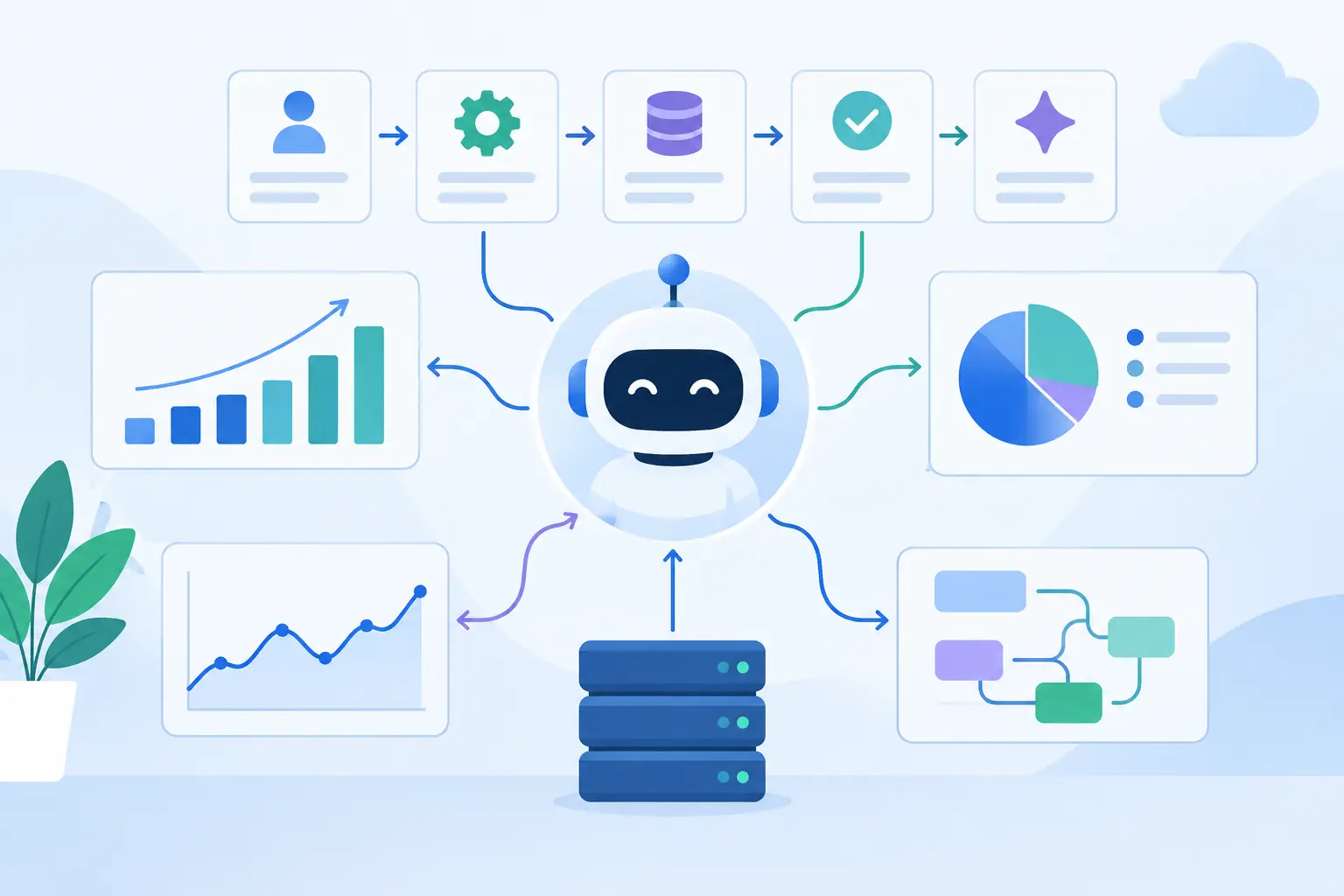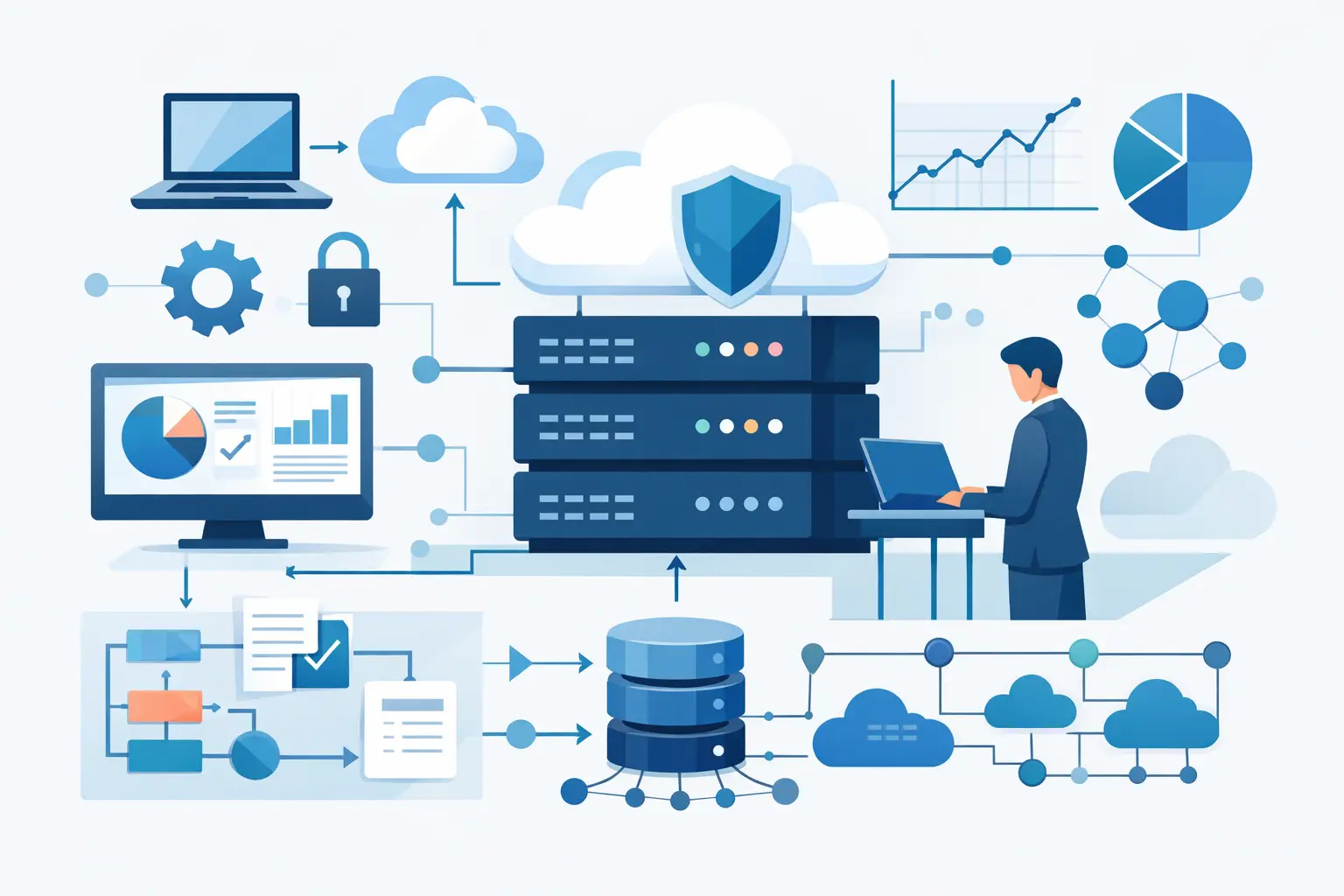


An LLM agent is not a chatbot with access to a few documents. In an operational setting, it is software that can interpret a request, retrieve the right context, take approved actions across business systems, and produce an auditable outcome. That distinction defines how to build LLM agents that create value rather than generate impressive demos.
For a COO, product leader, or technical executive, the goal is rarely “add AI.” The goal is usually to reduce handling time, eliminate repetitive work, improve decision consistency, or remove a bottleneck between fragmented systems. The agent is only useful when it fits that operational requirement.
Start with a workflow, not a model
The strongest agent projects begin with a narrow, repeatable process that has a clear owner and a measurable cost. Examples include classifying incoming support requests, extracting data from financial documents, preparing underwriting summaries, checking orders against policy rules, or drafting CRM updates after sales calls.
Choose a workflow where the agent can make a meaningful contribution but where the consequences of an error are understood. A support triage agent can route requests and prepare responses with a human approval step. A finance agent may extract invoice fields and flag exceptions, while a person remains responsible for payment approval. These are different risk profiles and should not be engineered the same way.
Before selecting a model or framework, document the current process. Identify the triggering event, required inputs, systems involved, approval points, exceptions, and final output. Then establish a baseline: average handling time, error rate, backlog volume, cost per case, or revenue impact. Without a baseline, it is difficult to prove whether an agent improved the operation.
Define the agent’s job and boundaries
An LLM is effective at interpreting unstructured language, summarizing information, reasoning across provided context, and selecting from constrained options. It is less dependable when asked to invent facts, perform high-precision calculations without verification, or make unrestricted changes to critical records.
A production agent needs a written operating contract. This should state what it is allowed to do, which sources it can use, when it must ask for more information, what it must escalate, and which actions require approval. The contract becomes the basis for prompts, tool permissions, tests, and monitoring.
For example, a claims intake agent might be permitted to read submission documents, extract fields into a structured schema, identify missing information, and create a draft record in a case management system. It should not approve a claim, alter a payment amount, or access unrelated customer records. Clear boundaries prevent the common failure mode of giving an agent broad access before its behavior is proven.
Build the system around tools and trusted data
The model is one component of the solution. The business value usually comes from the integration layer around it.
An agent needs tools to interact with approved systems: a CRM, ERP, support platform, document repository, internal database, email service, or proprietary application. Each tool should expose a limited, well-defined action. Instead of giving the agent unrestricted database access, provide functions such as `get_customer_account`, `create_support_ticket`, `search_policy_documents`, or `update_order_status`.
This design has practical benefits. It limits the blast radius of a bad decision, makes permissions easier to enforce, and produces cleaner audit records. It also makes the agent easier to test because each action has defined inputs and expected outputs.
Data access requires equal discipline. Retrieval from an internal knowledge base should respect document permissions, source freshness, and departmental boundaries. A model that can retrieve a policy document from last year may provide a plausible but incorrect answer. Versioning, metadata, access controls, and source citations in the agent’s internal workflow help prevent this.
For many organizations, the right architecture combines retrieval with direct system queries. A customer service agent may use knowledge base articles for policy guidance, then call the CRM and order system for current account details. One source explains the rule; the other confirms the facts.
Use deterministic controls where they matter
Not every decision should be delegated to language-model reasoning. Business rules that are stable and explicit should remain deterministic.
If an order over a certain value requires manager approval, enforce that rule in application logic. If an invoice total must reconcile to line items, validate it with code. If a user lacks permission to view a record, the authorization layer should block access before the model sees the content.
This is a critical architectural principle: use the LLM for ambiguity and language, and use conventional software for rules, calculations, permissions, and transactions. Agents become more reliable when they are not asked to behave like an all-purpose operating system.
Human review should also be designed deliberately. Review is not a sign that the project failed to automate. It is a risk control that can be applied selectively. Require approval for low-confidence outputs, high-value transactions, policy exceptions, sensitive communications, or actions that cannot be easily reversed. Over time, evaluation data may show that certain categories can move from review-required to automated execution.
Design for state, exceptions, and recovery
Real workflows do not end after one prompt and one response. An agent may need to request a missing document, wait for a customer reply, retry an unavailable API, hand a case to a specialist, or resume work after approval.
That requires explicit state management. Store the workflow status, inputs used, tool calls made, model outputs, approvals, errors, and next action. A durable workflow engine or application backend should manage this process rather than relying on the model’s chat history as the source of truth.
Exception handling is often where production projects succeed or fail. Define what happens when a source system is unavailable, retrieved information conflicts, the model returns an invalid format, or the agent reaches a confidence threshold it cannot meet. The safest default is not to guess. Create an exception record, preserve the context, and route the case to the correct person or queue.
Evaluate before production, then keep evaluating
An agent that looks accurate in a few hand-picked examples is not ready for live business use. Build an evaluation set from real, anonymized cases that represent normal work, edge cases, incomplete inputs, ambiguous requests, and known failure patterns.
Measure more than response quality. Depending on the workflow, useful measures include field extraction accuracy, correct routing rate, policy compliance, tool-call success, escalation quality, time to resolution, and cost per completed task. For customer-facing agents, also measure whether the answer was grounded in approved sources and whether the agent avoided unsupported claims.
Testing should include adversarial inputs. Users may paste irrelevant instructions into documents, ask the agent to ignore policy, or provide malicious content through email and support channels. The agent must treat external content as data, not as authority. Prompt injection defenses, tool-level permissions, output validation, and isolation of sensitive instructions are part of the production design.
After launch, monitor performance continuously. Model providers change, internal data changes, APIs evolve, and user behavior is unpredictable. Track failures, review sampled decisions, analyze escalations, and maintain a controlled release process for prompts, models, tools, and policies. An agent is an operating capability, not a one-time feature.
Select the right delivery path
A pilot is appropriate when the workflow is understood but the quality threshold, integration complexity, or user adoption risk is still uncertain. A pilot should connect to real systems where possible, use representative data, and have a defined success metric. A prototype that only demonstrates a conversation rarely answers the questions that matter to the business.
For high-volume or compliance-sensitive workflows, invest earlier in architecture, identity management, logging, QA, and integration hardening. This takes more effort than a quick proof of concept, but it avoids rebuilding the solution after stakeholders decide it must handle production data.
At Invatechs, the practical focus is concrete automation, not generic AI hype: connecting an agent to the systems where work already happens, enforcing business controls, and measuring whether the process actually improves. The model matters, but the delivered workflow matters more.
The best first agent is rarely the most ambitious one. It is the one that removes a visible operational burden, operates within clear controls, and gives the organization evidence for where automation should go next.