Manual work rarely looks expensive when viewed one task at a time. A coordinator copies customer data between systems. An analyst reviews documents, then retypes key fields. A support lead searches for answers across inboxes and knowledge bases. At volume, those small actions become slower response times, inconsistent decisions, preventable errors, and a team that cannot scale without adding headcount.
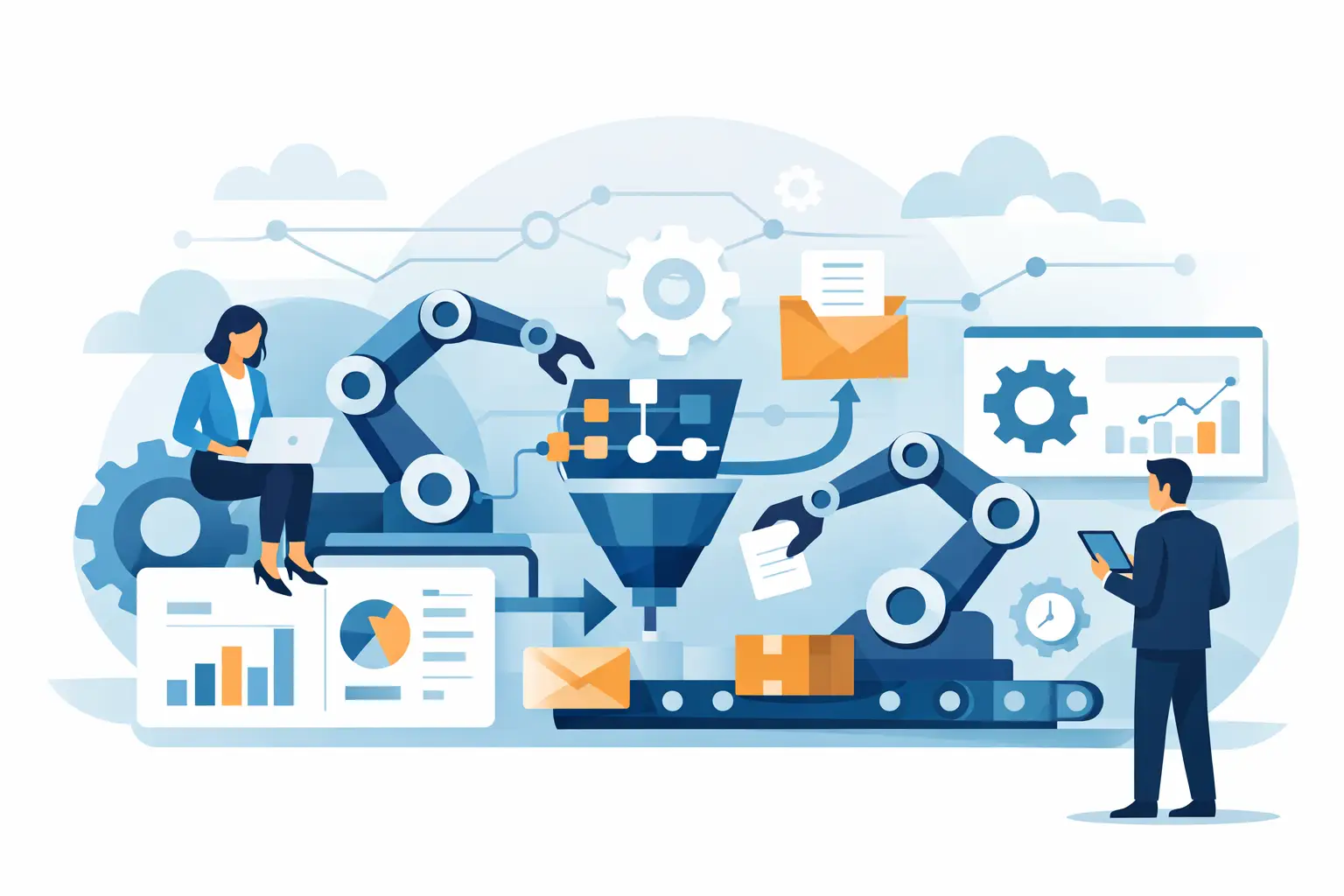
Business process automation services address that operational drag by redesigning how work moves across people, software, documents, and decisions. The goal is not to automate activity for its own sake. It is to create reliable workflows that reduce cycle time, improve data quality, and give teams control over exceptions that genuinely require judgment.
For mid-market and growth-stage companies, the difficult part is usually not finding an automation tool. It is connecting the right systems, defining sound business rules, handling sensitive data correctly, and operating the workflow reliably after launch.
What business process automation services should solve
A useful automation initiative starts with a business constraint, not a technology preference. Operations leaders may need to process more applications without expanding the back office. Finance teams may need faster invoice matching and cleaner approval trails. Support teams may need to resolve repetitive requests without forcing customers through a maze of forms.
The strongest use cases tend to have three characteristics: the process is frequent, the inputs follow recognizable patterns, and the result can be measured. A workflow that runs ten times a year may not justify custom engineering. A process that runs hundreds of times a week, touches several systems, and creates delays at every handoff is a different case.
Automation can cover deterministic work, such as routing requests based on status or value, and AI-assisted work, such as extracting facts from unstructured documents or classifying incoming emails. These should not be treated as the same problem. Rules-based automation is predictable and easier to audit. AI is valuable when the work involves language, documents, or variable inputs, but it needs guardrails, confidence thresholds, and a clear escalation path.
Where automation creates measurable gains
Most organizations do not need a broad transformation program to see results. They need one well-defined workflow that proves value and establishes the architecture for the next one.
Common high-value examples include document intake, where uploaded forms or PDFs are classified, key data is extracted, and records are created in a CRM or ERP. In underwriting or onboarding, automation can collect missing information, validate it against internal rules, assign risk flags, and route exceptions to the correct reviewer. In accounts payable, it can capture invoice data, match it to purchase orders, request approvals, and preserve an audit trail.
Customer support is another practical area. An AI agent can retrieve approved information from an internal knowledge base, draft responses, categorize tickets, and route complex cases with context attached. It should not be given unrestricted authority to make refunds, alter accounts, or provide compliance-sensitive advice without defined controls.
The same principle applies to sales and operations. A lead may arrive through a web form, be enriched using approved data sources, scored against agreed criteria, and sent to the right account owner. The real value is not the individual handoff. It is the removal of latency and ambiguity from the entire path between demand and action.
Start with process architecture, not a chatbot
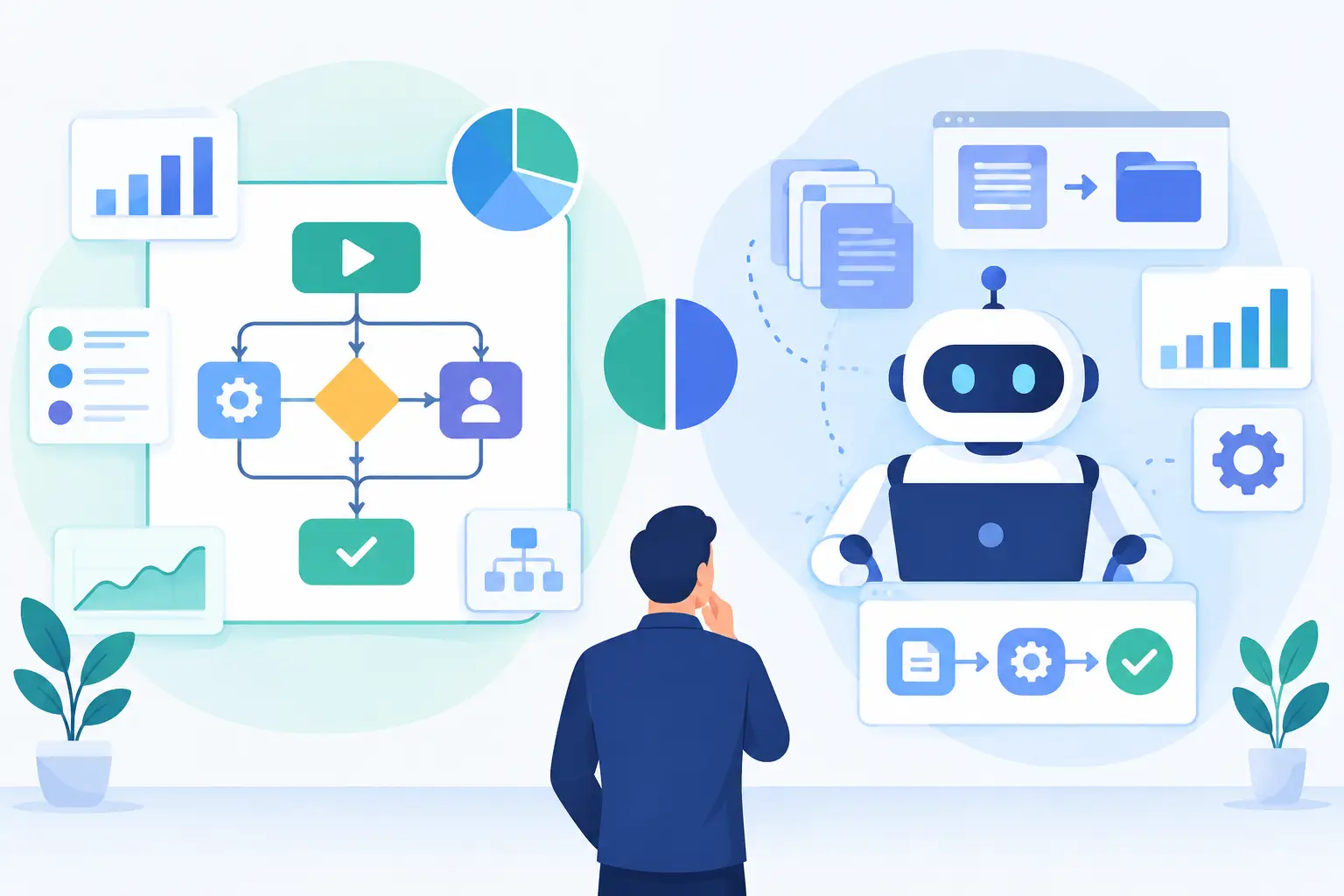
A generic AI interface can demonstrate potential, but it does not fix a broken operating process. Production automation requires an architecture that defines triggers, data sources, transformations, decision rules, approvals, error handling, and ownership.
Before building, map the current state in enough detail to expose friction. Identify where data enters the process, which systems are the source of truth, who makes decisions, where work waits, and what happens when an input is incomplete. This often reveals that the bottleneck is not a single manual task. It may be duplicate data, unclear approval authority, or an integration gap between systems.
Then define the future state with precision. A workflow should specify what starts it, what data it can access, what it is allowed to change, and when it must stop for human review. If an AI model is involved, define acceptable confidence levels and the evidence a reviewer needs to validate its output.
This work can feel slower than jumping into a prototype. In practice, it prevents costly rework. A pilot that bypasses identity controls, ignores exception queues, or relies on inconsistent source data may look impressive in a demo and fail under real operating conditions.
Integration determines whether automation is usable
Automation that lives outside core systems creates another place for employees to check. The better approach is to integrate workflows with the CRM, ERP, finance platform, support desk, document repository, and internal tools that already run the business.
That requires more than passing data from one API to another. Data fields need consistent definitions. Permissions must follow least-privilege principles. Failed requests require retries, alerts, and a process for recovery. System changes need versioning and testing so a minor update does not silently break a critical workflow.
For AI-enabled processes, secure connectors matter as much as model quality. The system should retrieve only the information needed for a task, respect user permissions, and record meaningful activity for review. In regulated or compliance-sensitive environments, auditability is a delivery requirement, not an optional feature.
A practical delivery model for automation
Business process automation services should move from discovery to production in deliberate stages. Discovery establishes the problem, baseline metrics, stakeholders, source systems, constraints, and success criteria. The result should be a prioritized use case with a clear business case, not a vague backlog of AI ideas.
Next comes solution design and a limited pilot. This is where teams validate integrations, test real inputs, and confirm that the proposed workflow handles normal and exception cases. A pilot should be narrow enough to control risk but realistic enough to expose the issues that a mockup cannot show.
Once the workflow proves its value, production deployment adds the engineering discipline that operations depend on: role-based access, monitoring, logs, QA, security review, documentation, and support ownership. Optimization continues after launch because process conditions change. New document formats appear, systems evolve, volumes rise, and users identify edge cases that were not visible during discovery.
Invatechs approaches this work as software delivery, not a collection of disconnected automations. Custom applications, API integrations, AI features, LLM agents, and ongoing maintenance can be designed as parts of one operating system for the business.
How to measure automation beyond time saved
Time saved is a useful starting point, but it is not sufficient. A process that completes faster while producing more exceptions or compliance risk has not improved.
Measure outcomes at the workflow level. Depending on the use case, that may include cycle time, cost per transaction, first-response time, error rate, percentage of straight-through processing, backlog size, exception rate, conversion rate, or customer satisfaction. Establish a baseline before launch, then review the metrics at planned intervals.
Also measure adoption. If employees repeatedly work around the automation, the design may not reflect how the process actually operates. Their feedback can reveal missing context, poor routing logic, or an approval rule that needs refinement.
There is a trade-off between full automation and controlled automation. For low-risk, repetitive actions, straight-through processing can create substantial gains. For high-value financial decisions, legal documents, or customer-impacting exceptions, a human-in-the-loop model is often the more responsible design. The right level of automation depends on the cost of an error, not on how much technology is available.
Questions to ask before selecting a delivery partner
The quality of implementation depends on questions that go beyond model selection. A capable partner should be able to explain how the workflow will connect to existing systems, how it will handle failures, where data will be stored, how access will be controlled, and who will support it after deployment.
Ask for a clear view of the delivery process. You should know how requirements will be validated, how real-world data will be tested, what acceptance criteria define success, and how changes will be managed. For AI components, ask how outputs are evaluated, how hallucinations are constrained, and how users can override or escalate a result.
Avoid treating a proof of concept as proof of production readiness. A valuable prototype demonstrates that an idea can work. A production solution demonstrates that it can operate securely, consistently, and at the volumes your business requires.
The best first automation is usually not the most ambitious one. It is the workflow with enough volume, pain, and measurable impact to justify engineering effort - and enough clarity to become a dependable foundation for the processes that follow.